
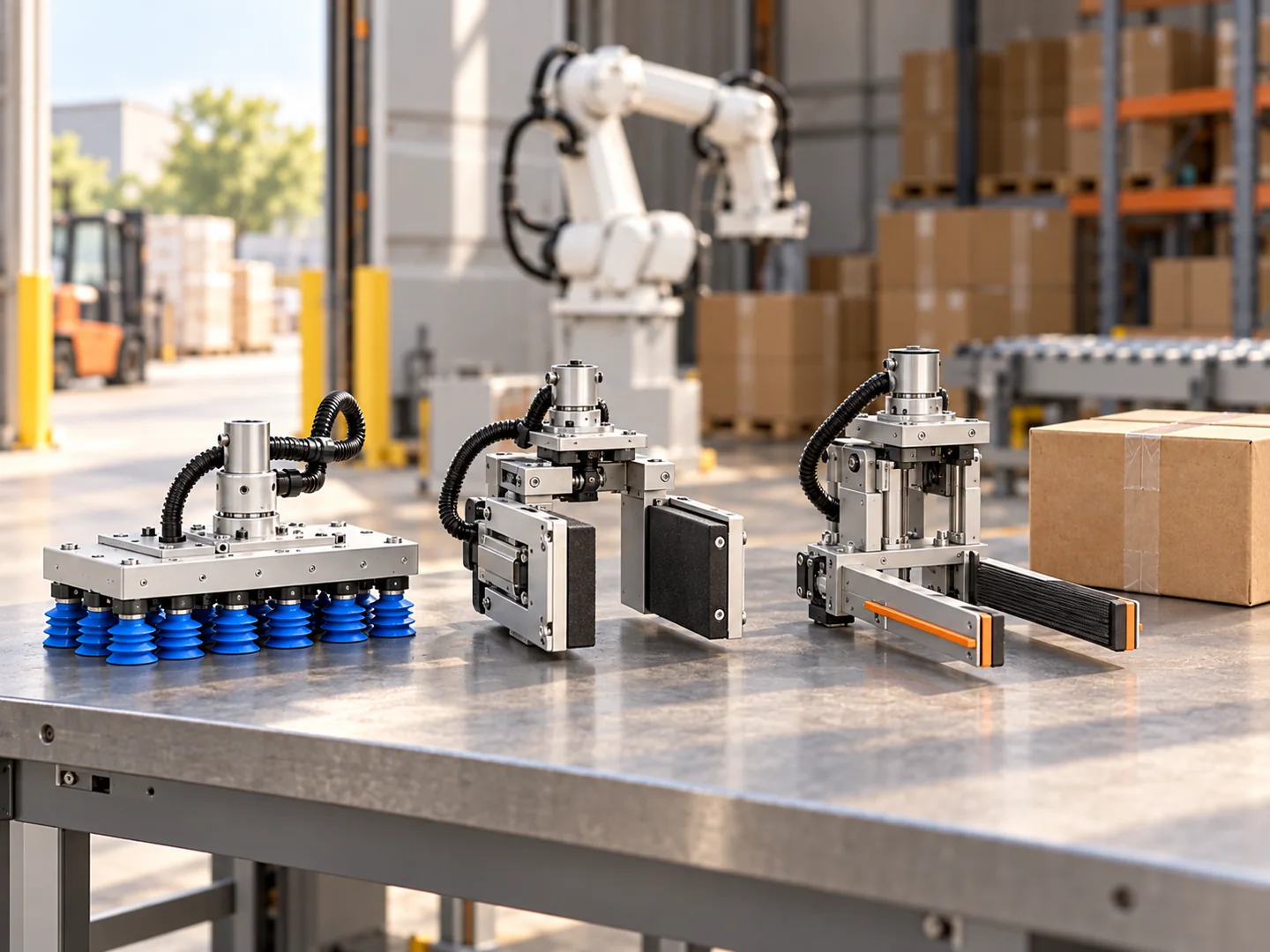
A palletizing gripper is the end-of-arm tool that holds a box while a robot moves it into a pallet pattern. Selecting one requires both a reliable pickup and a clean release at the destination. Carton strength, access, tool weight and placement clearance matter alongside nominal payload.
The same cardboard box can need a different gripping approach when it is picked from a prepared conveyor, taken off a pallet or extracted from a container wall.
Decide how many cartons one pick must carry
A single-box gripper gives the robot a separate placement decision for every carton. Multi-box tooling picks a group whose positions and load distribution must be compatible with the tool. A layer gripper handles a larger arrangement and depends on the combined mass, surfaces and support of that layer.
The Schmalz layer-gripping range illustrates a different tooling category from an individual carton pick. It is a supplier example, not evidence that a particular unloading robot can lift a layer.
For mixed cartons, establish whether “mixed” means different boxes handled one at a time or several unlike boxes lifted together. Those are different design requirements.
Compare the gripping methods
| Gripper approach | Contact and access needed | Check before selecting |
|---|---|---|
| Individual suction cups | Usable contact patches on the accessible face | Seal, leakage, cup position and carton-panel deformation |
| Foam area gripper | An area the foam can contact sufficiently | Coverage, leakage paths and the effect of tape or edges |
| Side clamp | Clearance around opposing sides | Wall compression, grip force and clearance at placement |
| Grip with bottom support | Space to insert and withdraw the support | Extraction path, load retention and the final pallet position |
Some tools combine methods. OnRobot’s 2FGP20 is a manufacturer example of a palletizing gripper with arms; it should be evaluated against its own documentation rather than treated as interchangeable with a vacuum tool.
For the carton-surface questions behind the first two options, read the vacuum-gripper and carton guide.
Use a batch-size selection table
Specify whether a pick carries one box, several boxes or an entire layer before comparing vacuum and mechanical tools. The same nominal carton weight can become a very different loaded-tool requirement when the batch changes.
| Pick requirement | Access and presentation | Load and carton checks | Placement constraint |
|---|---|---|---|
| One carton with vacuum | Usable contact face for every intended pick | Seal, panel strength and the complete loaded tool | Release without pulling tape or disturbing adjacent boxes |
| Several cartons with vacuum | All required contacts must match the presented group | Combined mass, contact coverage and unequal load distribution | Maintain the intended group until every carton is supported |
| One carton with a padded clamp | Opposing sides accessible to the jaws | Filled-box compression and retained grip during motion | Space to open the jaws at the final position |
| One carton with bottom support | An insertion path under the carton | Supported load and any retaining mechanism | Space to withdraw the shelf without disturbing the load |
| A complete layer | A known accessible layer compatible with the selected tool | Total layer mass, arrangement and tool-specific support | Entire receiving footprint and approved layer placement |
These are application checks, not interchangeable tooling specifications. A multi-box gripper can require prepared presentation that is unavailable inside a container wall. Do not infer that KRONA offers multi-box or full-layer extraction from a tooling-category comparison.
For quantitative inputs, use the carton-plus-tool payload example and suction-force worksheet. If the group contains different products, the mixed-case guide explains the additional downstream sequencing requirements.
Calculate the complete carried load
The robot carries the end effector, mounting hardware, routed equipment and the carton. A carton below the robot’s headline payload limit does not automatically leave enough capacity for the complete tool.
The integrator also needs the centre of gravity, wrist loading and intended motion. A long tool or a carton held away from the wrist changes the loading conditions. Check the robot and tooling manufacturers’ load envelopes for the actual arrangement.
A static test should be followed by the intended movement and placement. Record package condition after the cycle, not only whether the carton reached the pallet.
Design for the final placement
A clamp may need space beside a box to open. A support shelf may need a withdrawal path. A vacuum tool needs the release to complete without disturbing the carton or pulling on loose tape.
Review the tightest pallet positions, the highest stack and any adjacent equipment. Include pallet tolerances, slip sheets and changes in carton size where they belong to the application.
The same gripper should be assessed for pickup, travel, placement and recovery. Optimising only the pickup can move the difficulty to the end of the cycle.
A container wall changes the problem
On a conveyor, the top face may be exposed and the incoming position controlled. Inside a floor-loaded container, the robot usually encounters front faces, leaning cartons and neighbouring boxes that restrict the extraction path.
- ExtractChoose an accessible carton and a viable grip.
- TransferConfirm the receiving space and retain the load.
- PlaceRelease onto the conveyor or agreed pallet location.
A tool built for top picking is therefore not automatically suitable for front extraction. Use the container-to-pallet workflow guide to define what must happen before and after the gripping cycle.
Give the integrator a complete tooling brief
Provide:
- filled carton weights, sizes and frequency;
- accessible faces, board condition, tape and labels;
- single-box, multi-box or layer requirements;
- pickup and placement positions, with clearance measurements;
- tool and robot load data, including centre of gravity;
- utility, sensing and recovery requirements;
- a representative test sample and acceptance measures.
The carton-handling EOAT checklist develops the mounting, utility and control questions.
Make the release test part of gripper selection
Test the final placement geometry with the same attention as the lift. A side clamp needs room to open without pushing the adjacent carton; a support fork needs a withdrawal path; a vacuum tool needs clearance and a verified release. A tool that works on an isolated box can still disrupt a tightly packed layer.
| Trial | Observation to record | What it establishes |
|---|---|---|
| Carton next to an existing row | Adjacent-box contact and final position | Placement and release clearance |
| Highest required layer | Tool and arm clearance through the full path | Layout fit at the limiting placement |
| Ordinary transported carton | Grip confirmation, deformation and release | Behaviour beyond a pristine sample |
| Changed carton format | Setup change and validation record | Limits of a shared tooling configuration |
Universal Robots’ gripper article describes gripping categories and their application differences. Use those categories to form a shortlist, then verify the actual filled cartons and pallet pattern. A magnetic tool for metal items does not solve ordinary cardboard handling simply because it appears in the same taxonomy.
The payload guide checks the carried assembly; the cell-design guide checks where that assembly must move.
Check the reverse carton path for depalletizing
Removing cartons from a pallet changes the approach and escape paths. An upper carton can be accessible from above, while a carton beside a taller stack or a damaged case may leave less room for the tool. Record wrapping, straps and interlayers as preparation or separately supplied work rather than assuming the gripping tool removes them.
Use representative loaded pallets to check the first and last accessible cartons, loss of support as a layer is removed, and placement onto the receiving conveyor. Include ordinary shifted or deformed cases within the intended assessment, with a defined route for cartons that cannot be handled normally.
The carton depalletizing guide owns that pallet-to-conveyor workflow. For carton palletizing, keep the tooling brief tied to the required infeed and finished pattern; a gripper’s carton weight limit alone does not establish every pick and release position.
From gripper selection to an unloading solution
KRONA supplies the complete KRONA U1 unloading robot. Its application is eligible floor-loaded cartons with conveyor or pallet handoff. Direct transfer to pallets should be evaluated against the required receiving workflow; it does not establish arbitrary mixed-SKU patterns or full-layer handling.
If your tooling question comes from a container-unloading project, request a freight and handoff assessment. Include real cartons and the desired pallet or conveyor destination.
- vacuum gripper
- cardboard cartons
- palletizing
- robotic manipulation
KRONA U1 unloads boxes from containers onto pallets or conveyors and also loads containers with boxes from pallets or conveyors. Explore KRONA U1 →
Assess your carton and pallet handoff