
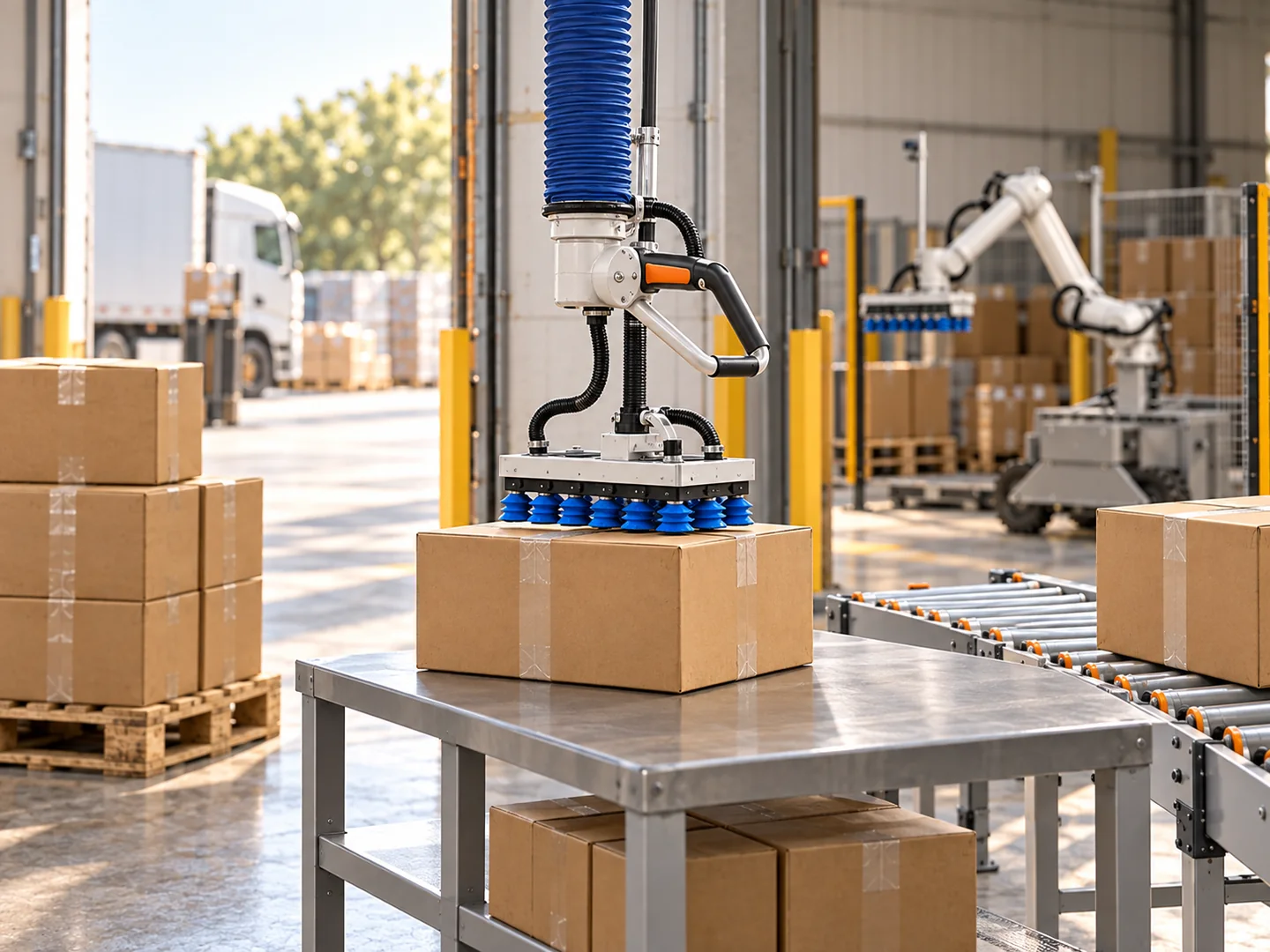
Vacuum carton lifting solutions use suction to grip cardboard boxes, but they solve different handling tasks. An operator-guided vacuum box lifter supports the load while a person directs it. A robot-mounted vacuum gripper holds the carton while the robot performs an assessed movement. Choose between them by the work you need to change, the accessible carton face and the complete receiving process.
This guide is for warehouses moving filled cartons between containers, conveyors, workstations and pallets. For detailed suction-cup selection, use the existing carton-gripper guide.
What is a vacuum box lifter?
A vacuum box lifter is a handling device that attaches a suction pad or cup arrangement to a carton. In a vacuum tube lifter, vacuum also acts inside a lifting tube: the tube contracts to raise the load and extends as the operator controls lowering. ANVER explains this operating principle and lists load material, available contact surface and pad configuration among its selection factors.
The equipment still needs a suitable support and working envelope. Depending on the application, this can involve a jib crane, overhead rail or mobile arrangement. A person normally selects the next carton, positions the tool, guides the transfer and commands release.
The terms vacuum carton lifter, vacuum box lifter and cardboard box lifting equipment often describe this assisted workflow. A vacuum gripper is the contact tool; it does not by itself provide the lifting structure, motion system or operating process.
Vacuum container unloader vs KRONA U1
A vacuum loader or unloader can mean an operator-guided lifting aid or an automated system. Here, vacuum container unloader means an operator-guided vacuum lifter used to remove cartons from a trailer or container. KRONA U1 also uses a vacuum gripper; the main difference is who selects the carton and controls its extraction and transfer.
| Decision | Operator-guided vacuum container unloader | KRONA U1 unloading robot |
|---|---|---|
| Who controls each pick? | A person selects the carton, positions the tool and guides movement and release | Perception and planning select an eligible pick and motion; the robot executes the movement |
| What work remains for people? | Continuous guidance of the lifting task, plus preparation and receiving | Positioning, preparation, agreed supervision, exceptions and receiving; confirm attendance requirements during assessment |
| What freight fits? | The package types, surfaces and movements approved for the chosen lifter and tooling | Assessed floor-loaded, closed cardboard cartons with suitable dry gripping surfaces |
| What weight can it handle? | Model-specific; TAWI lists up to 50 kg for its Container Unloader vacuum lifter | Up to 25 kg per eligible closed carton |
| How should speed be compared? | Measure accepted cartons over the complete task, including equipment movement and receiving stops | Up to 10 boxes/minute is the peak specification; measure sustained complete-task output on the same freight |
| Where do cartons go? | Conveyor or pallet, where supported by the offered configuration | Conveyor or pallet handoff within the assessed project scope |
| What belongs in the cost comparison? | Quoted equipment, installation, support and recurring operating costs, plus operator and receiving labour | Tailored hourly rental, one-time installation fee, agreed project costs and remaining human work |
| When is it worth assessing? | When people should keep directing handling and lifting assistance addresses the task | When recurring eligible carton extraction and transfer are the work to automate |
The named payload example comes from TAWI’s Container Unloader specifications, checked on 27 October 2026. Its stated 50 kg vacuum-lifter capacity is separate from its 80 kg belt capacity. Other vacuum lifters have their own limits. KRONA’s weight, handoff and peak-rate specifications come from the KRONA U1 product page; its pick-selection and motion workflow is described on the technology page.
These are manufacturer descriptions of different operating approaches, rather than a measured head-to-head trial. The weight limits do not establish that either system can grip every package within that mass.
When does an operator-guided vacuum unloader make sense?
Investigate lifting assistance when an operator needs to direct each movement and reducing the physical lifting burden is the main objective. The actual lifter and tooling still need to cover the package, contact face, working envelope and destination.
If the load includes cartons above 25 kg or other package types, those items are outside KRONA U1’s stated closed-carton envelope or need individual review. An appropriately specified assisted system may be the better route for that work; the supplier must confirm the application rather than rely on the higher headline payload alone.
When should you assess KRONA U1?
Assess KRONA when the warehouse has a regular flow of eligible closed cartons and wants the robot to perform extraction and transfer. The case is stronger when the receiving route can accept that flow and the operating team has an agreed process for preparation, exceptions and pallet changes.
Include the required operator attendance in the trial and cost model. Automated picking does not by itself establish unattended operation or removal of an entire receiving crew.
Which option is faster or cheaper for your warehouse?
That requires a comparison on representative freight using the same start and finish. Record complete unload time, total labour-hours, accepted cartons, damage, assistance and downstream waiting, then apply the actual installed or rental costs.
A higher payload is not a throughput result, and a peak pick rate is not a complete-load rate. Use the manual versus robotic comparison method and lifting-equipment cost guide to compare the same job. No measured speed or cost advantage over a named vacuum unloader is claimed here.
Fixed workstation tube lifters, mobile lifting aids and robot-mounted grippers also have different reach and mounting requirements. Some engineered systems combine robotic motion with tube lifting; assess the offered configuration and its operating responsibilities.
For a broader comparison that also includes conveyors and access equipment, see container unloading equipment for floor-loaded cartons.
Start with representative filled cartons
Record filled dimensions and weight, the available contact face, the carton construction and the condition after transport. Include the packaging that dominates the workload and the variations most likely to cause trouble.
A useful sample includes differences in tape position, labels, panel stiffness, dents and contents distribution. An empty carton with a clean, flat top does not represent every filled box arriving at the dock.
ANVER’s carton-handling examples include different pad arrangements and side-gripping tools. Those options illustrate why the actual package and contact direction belong in the supplier brief; they do not establish that every carton suits a standard attachment.
Use the carton-test results sheet to retain the package identity, configuration and complete transfer result. Record damage and retries separately from completed accepted cartons.
Match the contact face to the movement
Top lifting from an open pallet presents different access from extracting a box whose upper face is covered by the next row. Check which surface is reachable before comparing nominal payloads.
Also check where the carton must go. A pick may require turning, reaching across a conveyor, clearing an adjacent stack or placing a box at a different height. Specify those movements and the required orientation at release.
The suction-force calculation guide explains why theoretical static force alone is insufficient for a carton-handling decision. Leakage, panel deformation and load direction still require application testing.
Check reach, mounting and operator position
Map the lowest and highest pick, the furthest destination and the obstacles between them. Include the operator’s handle position throughout the task, rather than checking only the centre of an empty workstation.
For a fixed station, review the mounting arrangement and the area occupied by pallets, conveyors and people. For a mobile system, establish how it reaches each work area, how it is positioned and which utilities it requires.
TAWI’s box-lifting range illustrates several configurations for different handling locations. Treat the supplier’s application examples as a starting point for a site-specific review, rather than evidence that one configuration fits every dock.
If the job is inside a trailer or shipping container, use the dedicated vacuum lifter container-unloading checklist before requesting a trial.
Decide whether the goal is lifting assistance or automation
An assisted lifter is worth investigating when people should keep directing individual movements and repetitive lifting is the task to improve. A robotic application is worth investigating when eligible carton extraction and transfer form a recurring workload with an agreed receiving route.
Measure the work left around either option: preparation, scanning, inspection, sorting, pallet exchange and exception handling. A carton arriving on a conveyor does not establish that receipt or palletising is complete.
KRONA U1 is a complete mobile unloading robot for eligible floor-loaded closed cartons up to 25 kg, with conveyor or pallet handoff. It is assessed against the freight and site; it is not a standalone operator-guided tube lifter.
The manual versus robotic unloading guide sets out how to compare labour-hours, elapsed time and remaining work using the same start and finish.
Ask for a complete-cycle trial
Agree the carton sample, pick locations, destinations and acceptance conditions before the demonstration. Observe grip formation, extraction, transfer, placement and release across the representative task.
Record accepted cartons, retries, damage, assistance time and stops. Where the project concerns unloading, also measure equipment positioning and downstream waiting. A short lift of one convenient carton cannot establish a complete container result.
Request a quote for the tested scope, including the support structure, contact tooling, utilities, installation, training and maintenance. Use the vacuum box lifter cost guide to compare those inclusions.
Questions about vacuum carton lifting
Can a vacuum lifter handle corrugated cardboard?
Suitable equipment can handle appropriate corrugated cartons. The supplier must assess the filled package, available surface, leakage, panel strength and complete movement. A carton material label alone is insufficient.
Is a vacuum box lifter an automatic robot?
An operator-guided box lifter supports handling while a person controls the task. A robotic system adds programmed or perceived motion and other application functions. Confirm the responsibilities of the actual offered system.
Does KRONA U1 use vacuum lifting too?
Yes. KRONA U1 uses a vacuum gripper to hold suitable cartons. Its perception, planning and robot motion automate eligible picking and transfer, while an operator-guided vacuum lifter leaves those movements under the person’s control.
Can the same tool handle every carton size?
Do not assume it can. Check the smallest usable contact face, the largest package, weight distribution and any required tooling changes with representative filled cartons.
What should we send for a KRONA assessment?
Send carton dimensions and filled weights, representative transported samples, load-wall photographs, recurring volume and the intended conveyor or pallet handoff. Request a freight assessment to evaluate the complete robotic unloading application.
- vacuum lifting
- vacuum gripper
- cardboard cartons
- equipment selection
KRONA U1 unloads boxes from containers onto pallets or conveyors and also loads containers with boxes from pallets or conveyors. Explore KRONA U1 →
Assess your cartons for robotic unloading