
Load stands and carriers
Present the material on a compatible support with a defined underside, entry opening and lifting surface. Include the carrier and its load in the handling assessment.
Match the carrier to the lift.
KRONA lifting AGVs travel beneath a compatible load stand or carrier, raise it for transport and deliver it to the next station. Match the carrier, lifting interface and route to the recurring material movement.
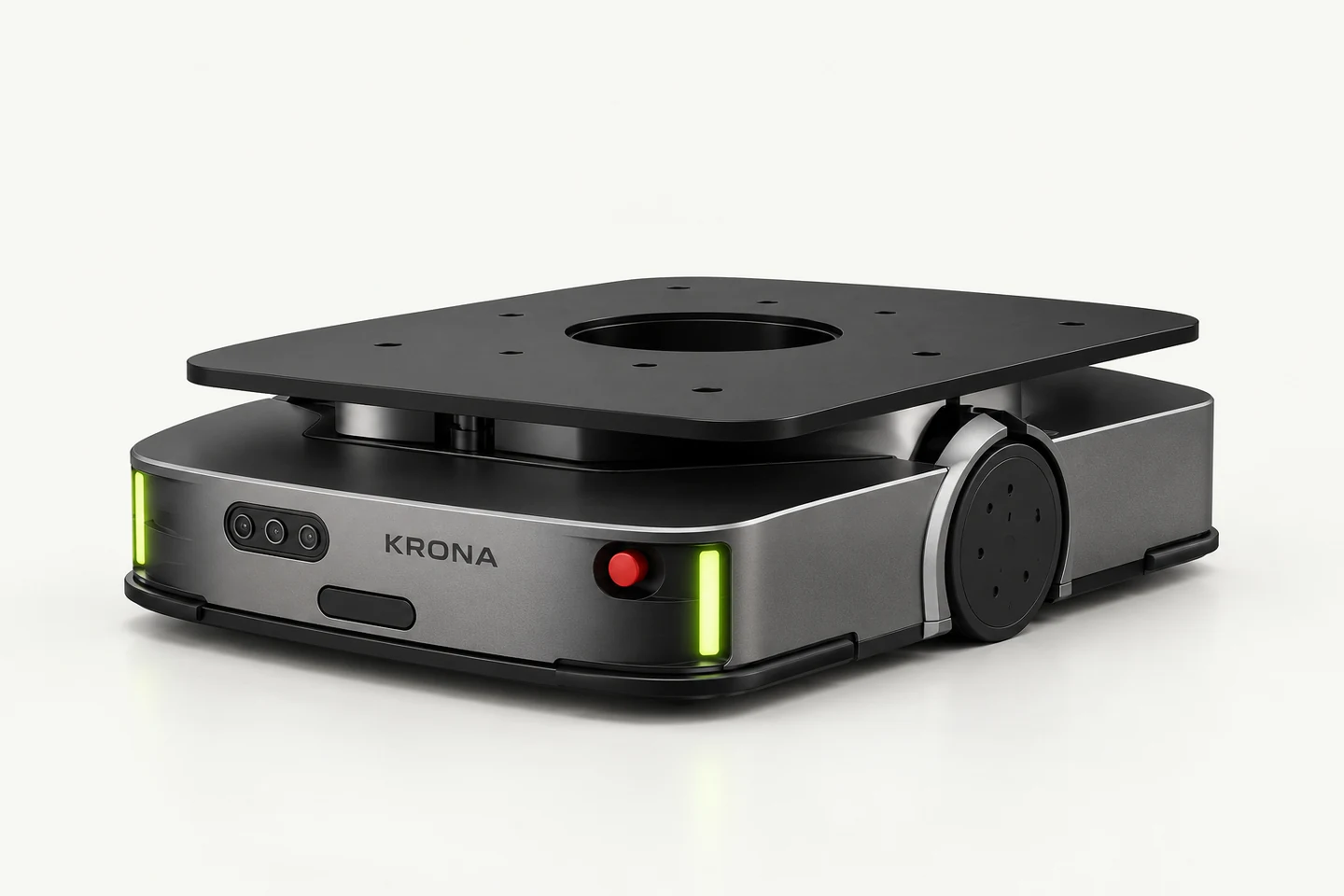
An under-load lifting robot is a different handling arrangement from a mast forklift. The load is supported through an agreed carrier interface, with space for the robot to enter, lift and leave.
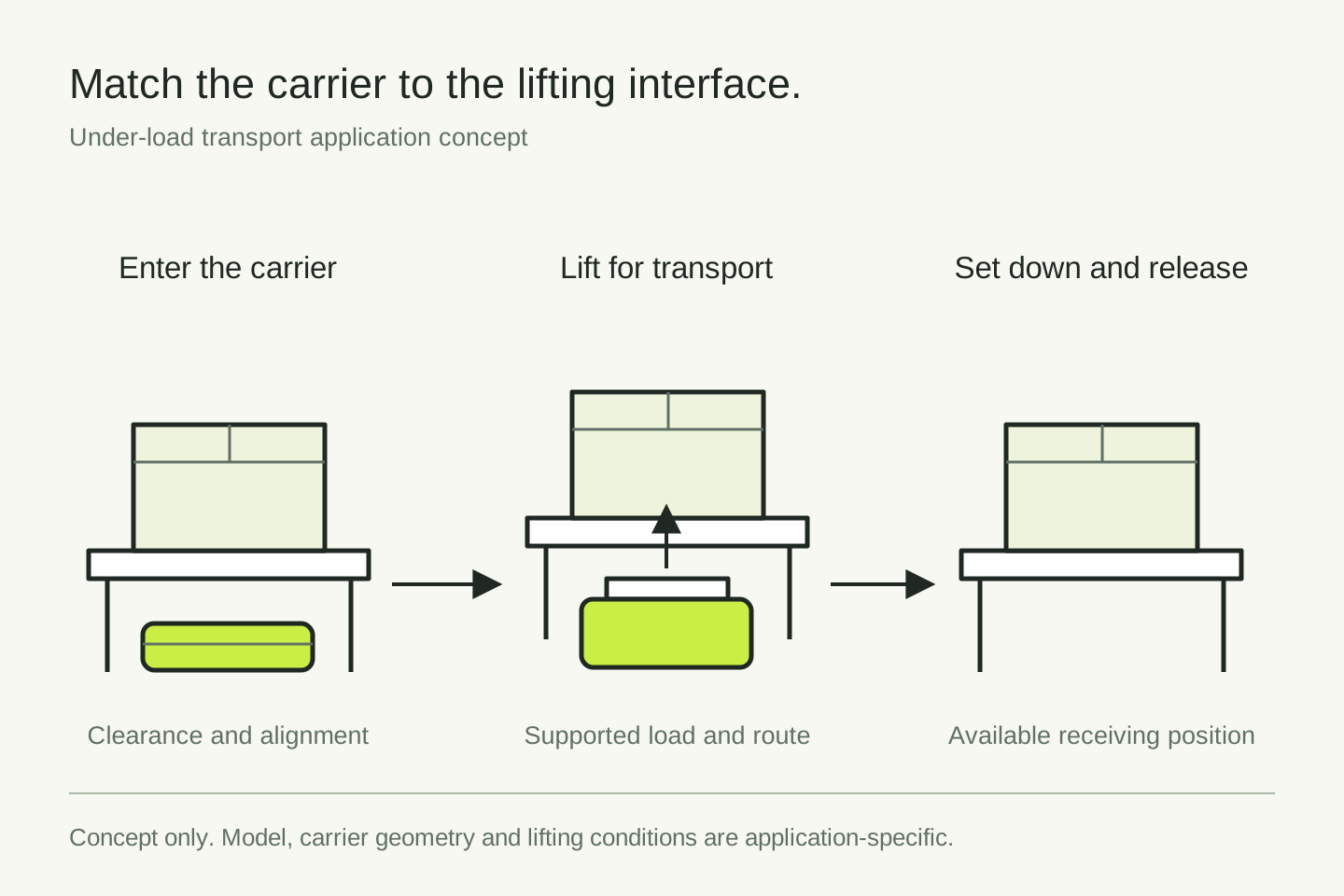
Record the carrier footprint, underside, leg positions, ground clearance and lifting contact surfaces. The robot needs a defined way to enter beneath the carrier, align with the lift interface and support the load without contacting another part of the structure.
Describe the complete transported unit: carrier mass, material mass, loaded height, centre of gravity and any overhang. Include the way the material is retained on the carrier and the conditions in which it can shift. Load suitability follows the selected model and interface, not only a headline payload.
A pallet resting on a designed carrier is different from a bare pallet on the floor. Confirm the supporting structure and pickup method rather than assuming that any pallet can be collected by an under-load vehicle.
A useful station definition includes the carrier's allowed location and orientation, the available approach and withdrawal space, and the lift and set-down conditions. Record what changes between a full and an empty carrier.
Agree how the system identifies the load and confirms that the support is ready to move. At delivery, define how the destination becomes available and how a successful set-down is confirmed before the robot withdraws or receives another task.
Include a missing or misplaced carrier, an occupied destination and an interrupted lift in the application review. The operator and controller need a clear way to return the physical load and its task record to a known state.
Measure the full loaded footprint when checking aisles, turns, doorways and intersections. A low robot body can still transport a wide or tall load, and the carrier may extend beyond the vehicle.
Review the floor, transitions, slopes and shared traffic along the route. Include temporary storage, people working at stations and the access required for charging and service. Navigation and operating conditions are confirmed for the selected KRONA configuration.
Use the recurring task cycle to estimate capacity: approach, enter, align, lift, travel, set down, leave and return. Waiting at a station, charging and the available quantity of carriers can limit the completed flow even when travel time is short.
A low-lift under-load robot transports its compatible supported load between defined positions. Mast forklifts engage a pallet or other approved load through forks and may provide a different range of lifting and placement geometry.
If the application requires rack access, a particular stacking height or collection of a floor pallet, describe that task directly. Low-lift carrier transport does not establish those capabilities. If the load is already on a repeatable stand and moves between workstations, assess the under-load arrangement alongside the alternative handling methods.
Compare the completed job, including carriers, station hardware, charging, controls, commissioning and support. KRONA's proposal identifies the vehicle model, supported interface, load conditions and application acceptance test.
The proposal names the KRONA lifting AGV configuration and compatible load interface, carrier or station work, task controls, charging, deployment and support. Model-specific load and navigation data belong to that agreed configuration.
Discuss a lifting AGV applicationDescribe floor pickup, stacking and rack placements when the required job calls for a forklift arrangement rather than an under-load carrier.
Explore KRONA autonomous forkliftsConnect the carton or pallet handoff, carrier availability and task records before selecting the wider warehouse system.
Plan the connected AGV flowDefine the accepted pallet output and the supporting carrier or pickup arrangement before releasing transport from the palletizing station.
Assess carton palletizingSeparate navigation labels from load-handling and station requirements.
Distinguish carton handling, pallet transport, carrier movement and storage.
Include carrier interfaces, software, charging and commissioning alongside the vehicle.
Identify the actual handled unit and the next accepted destination.
A lifting AGV is a mobile robot that enters beneath a compatible carrier or load stand and raises the supported load for transport. The carrier, lifting contacts and operating conditions are matched to the selected vehicle configuration.
Those tasks depend on the pickup interface and lifting geometry. An under-load lifting robot does not establish fork entry, rack access or arbitrary floor-pallet pickup. Describe those requirements so KRONA can compare the appropriate vehicle arrangement.
It is a distinct load-handling category in the KRONA range. A lifting AGV works through a compatible under-load interface; a forklift uses a fork and mast arrangement. The application determines which configuration is appropriate.
Share roughly how much you need to move. We’ll get in touch to discuss the possibilities.
info@kronarobot.com