
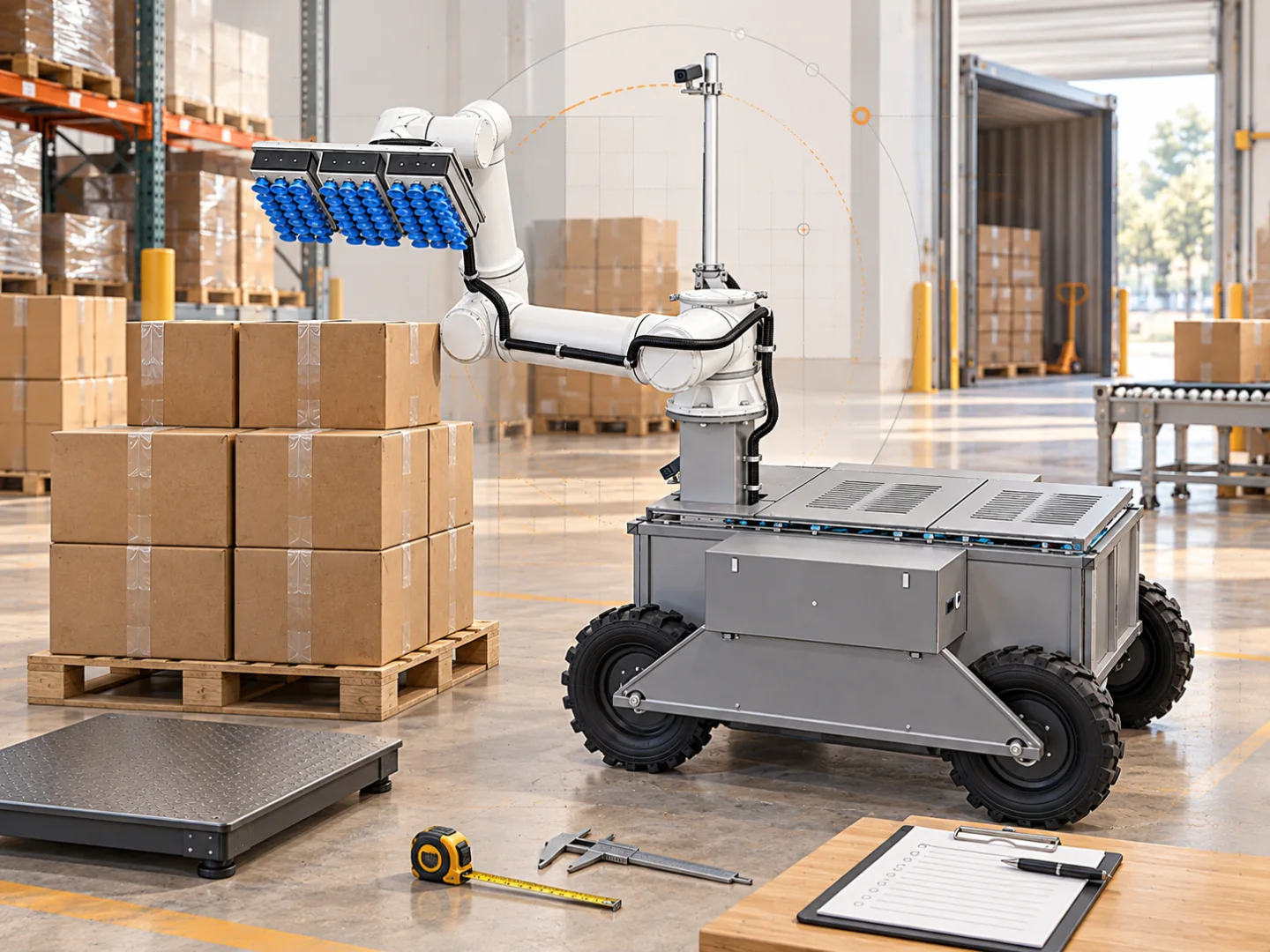
End-of-arm tooling, or EOAT, is the equipment attached to a robot’s wrist to perform the handling task. In carton handling it includes the gripping tool and the mounting, utilities and sensing needed to complete a pick and place.
A useful EOAT brief describes the complete movement: contact, grip confirmation, extraction, transfer, release and recovery. It gives the integrator an application to validate rather than a list of components to buy.
Start with the carton and the accessible face
Record filled weight and dimensions, board condition, tape and labels, surface damage and the position of the contents. Identify the contact face that is actually available to the robot.
Top picking from a prepared conveyor or pallet is different from front picking inside a container. The latter may have neighbouring cartons, restricted clearance and a load direction that places different demands on the grip. Use the carton-gripper guide to establish package suitability first.
Include ordinary transported cartons in the sample. Empty boxes do not reproduce the stiffness or load distribution of the incoming freight.
Separate theoretical force from a validated grip
For a sealed suction area, the elementary static relation is F = Δp × A: pressure difference in pascals multiplied by effective suction area in square metres gives force in newtons. Schmalz’s holding-force explanation identifies this as a theoretical value without safety factors.
It is not a complete safe-payload calculation. Effective area, leakage, acceleration, the direction of loading, friction and carton-panel strength all need assessment. Front picking cannot be reduced to dividing the carton weight by a headline suction force.
The integrator should document the limiting load case and use the robot and tooling manufacturers’ design methods. Do not select a universal vacuum threshold or cup size from the equation alone.
Check the robot and mounting arrangement
The robot carries the tool as well as the carton. Include the flange adapter, sensors, utility routing and any support mechanism in the tool mass and centre-of-gravity data.
Confirm mounting pattern, tool orientation, load envelope, reach and collision clearance. Check the tightest extraction and placement positions, not just the neutral arm position.
For a replacement or custom tool, confirm who owns the mechanical drawings and approval of changes. A mechanically compatible flange does not establish electrical, pneumatic or software compatibility.
Define utilities and signals
| Interface | Information to agree | Evidence needed |
|---|---|---|
| Vacuum or compressed air | Supply, flow needs, routing and behaviour during a loss of supply | Tool documentation and application measurements |
| Electrical supply | Required power, wiring and protection | Approved connection information |
| Tool control | Command sequence and controller compatibility | Interface documentation and commissioning checks |
| Grip confirmation | How contact and load retention are checked | Logged picks with representative cartons |
| Release confirmation | How placement and tool withdrawal are completed | Recorded handoff and exception tests |
| Receiver availability | How the next system permits a placement | Agreed conveyor or pallet handoff sequence |
Treat protocol names and controller features as requirements to confirm. KRONA’s public product description does not by itself specify a PROFINET, EtherNet/IP, PLC or WMS interface.
Review the pick sequence and its exceptions
Describe the intended conditions at each stage: a valid contact face before gripping, confirmed load retention before transfer, an available destination before placement and completed release before withdrawal.
Identify how the application detects an unsuccessful pick or a dropped carton. Agree the permitted response, who can intervene and how the system returns to its approved sequence.
Mech-Mind’s carton-gripper documentation illustrates grip-related component choices. Its examples are reference designs, not confirmation of KRONA’s interfaces or settings.
Use a short integration worksheet
For every representative carton group, record:
- Package: filled weight, dimensions, condition and frequency.
- Contact: face, proposed contact area and clearance.
- Motion: extraction direction, transfer path and placement.
- Tool: mass, mounting, centre of gravity and manufacturer limits.
- Utilities: available supply and agreed connections.
- Signals: grip, release, receiving readiness and fault reporting.
- Exceptions: observed failures, assistance and recovery ownership.
- Acceptance: agreed measures, evidence and decision owner.
Keep actual observations separate from assumptions. See the vacuum-grip troubleshooting worksheet for logging a failed pick.
Include empty, loaded and interrupted states in the brief
The robot’s application data should cover the empty tool and the loaded assembly, with the mass, centre of gravity and required inertia information for each. The payload example shows why tool mass and carton mass must be combined and checked against the exact robot’s load envelope.
Also specify what confirms the transition between states. After contact, which signal confirms retention? After release, how is the receiving position confirmed and the tool’s state established? Describe an interrupted cycle in which the carton has left its source but has not completed handoff. A generic fault reset must not assume that the source, tool and destination are all empty.
Give each state an owner, allowed next action and evidence required for restart. The conveyor handshake checklist handles the receiving side of that agreement. These are integration requirements to resolve with the supplier, not undocumented KRONA interface settings.
Attach an annotated state and evidence register
- Before contactIdentify the carton face, empty-tool state, available utilities and intended receiving route.
- During retained movementRecord the loaded-tool condition, approved motion and evidence confirming retention.
- After placementRecord release, tool withdrawal and receiver confirmation before the next cycle.
Download the EOAT state-and-evidence worksheet. Retain source documents, test observations and unresolved questions separately for normal and interrupted states. For a receiving inventory connection, keep those physical confirmations distinct from the WMS receiving event.
Apply the brief to a complete unloading system
KRONA U1 combines a mobile platform, robot arm, vision and vacuum gripping for eligible container and trailer freight. Its complete-system assessment covers the cartons and the receiving workflow.
For a container project, send the worksheet inputs and the desired conveyor or pallet handoff to KRONA’s pilot assessment. Agree project-specific interface and acceptance requirements before planning the deployment.
- vacuum gripper
- cardboard cartons
- end of arm tooling
- deployment planning
KRONA U1 unloads boxes from containers onto pallets or conveyors and also loads containers with boxes from pallets or conveyors. Explore KRONA U1 →
Request a freight assessment