
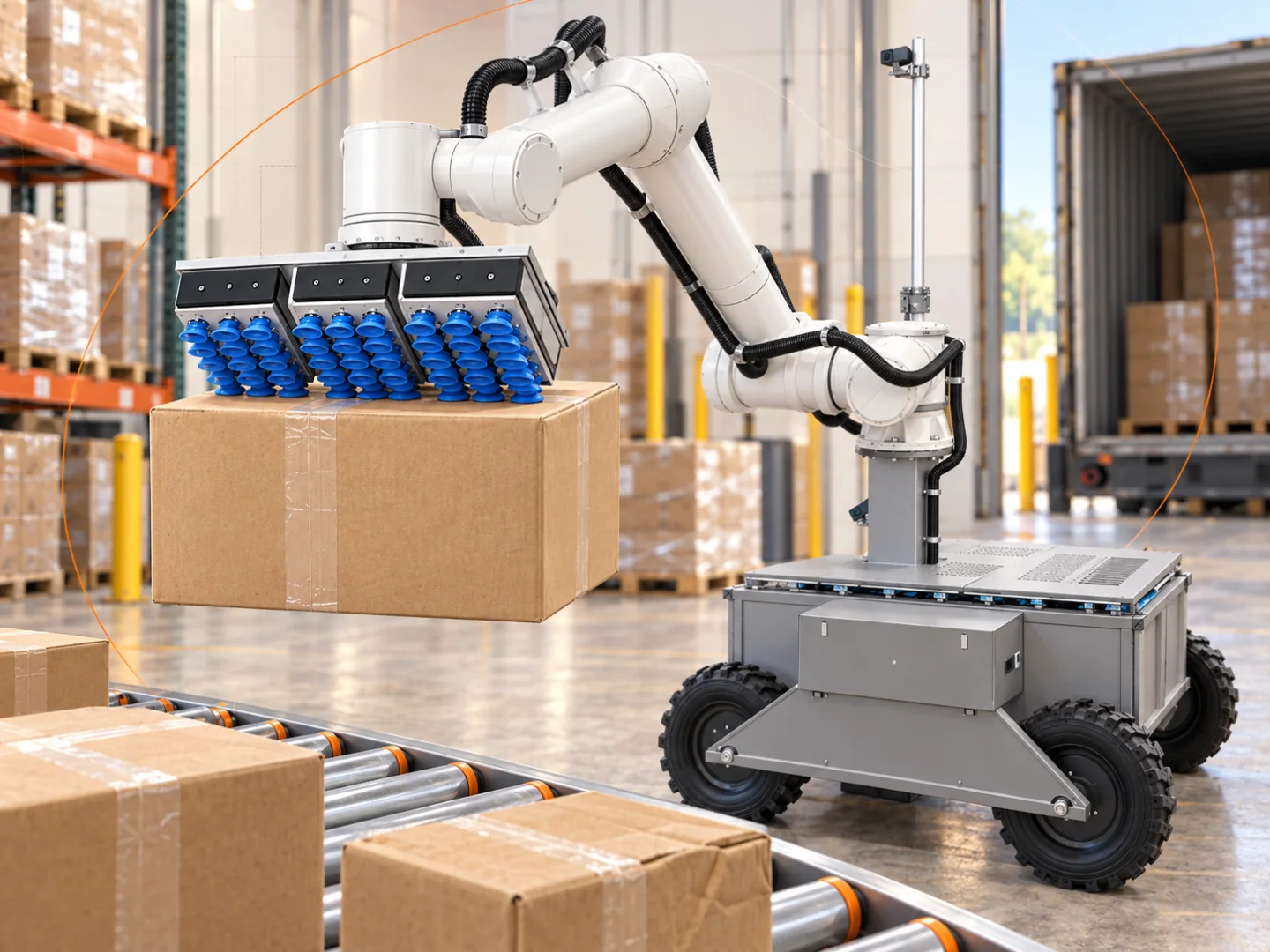
A carton gripper is the robot’s tool for retaining a cardboard box during pickup, movement and release. Choose it against the filled box’s mass and strength, the accessible contact face, available clearance and the complete receiving movement. KRONA supplies the complete U1 unloading robot, rather than a catalogue of standalone carton grippers.
A vacuum gripper gives a robot a practical way to lift a cardboard carton without placing mechanical fingers underneath it. “Cardboard,” however, covers a wide range of surfaces. One carton maintains a stable vacuum while another leaks, dents, or tears before reaching the handoff point.
Eligibility should be established with a test that represents the complete package and the real robot movement.
Compare carton-gripper types
| Tool | Required access | Application checks |
|---|---|---|
| Individual suction cups | Suitable patches on the exposed face | Seal, cup layout, leakage and local panel strength |
| Foam area gripper | Enough of an area to establish contact | Coverage, open zones, tape and edge leakage |
| Mechanical side clamp | Clearance at opposing sides | Compression damage, grip force and opening clearance |
| Grip with bottom support | Space beneath the carton | Support insertion, extraction and withdrawal at placement |
Schmalz’s vacuum-gripper glossary describes suction and area-gripping approaches. Tool categories are a starting point; suitability still depends on the actual filled package and movement.
Top picking versus front picking
A prepared conveyor or pallet may expose a box’s top face. A container wall usually exposes front faces while surrounding freight restricts access. Contact position, support and load direction differ. A top-picking demonstration does not verify a front extraction.
For pallet placement and tool-clearance questions, see the palletizing-gripper guide. For mounting and controls, use the EOAT integration checklist.
Vacuum requires a sealed contact
The gripper holds a carton by creating a pressure difference between the suction element and the surface. Reliability does not depend only on pump power. The element must conform to the surface, and the system must cope with leakage.
Contact can be weakened by:
- rough or highly porous board;
- creases and dents;
- a gap at a carton edge;
- poorly attached tape;
- labels that lift away from the surface;
- holes, perforations, or moisture.
Several smaller vacuum zones behave differently from one large zone, but no arrangement is universal. The tool should be selected against the actual package mix.
The front panel has to carry the load
A good seal is not enough if the carton deforms under the suction element or its contents tear the wall. Package construction, corrugation direction, fill level, and storage humidity interact.
Check whether:
- the carton is full or contains voids;
- contents can shift during the lift;
- the front wall is reinforced or weak;
- the package has been stored in humid conditions;
- surrounding freight has already compressed it.
A test with a new, empty carton does not predict the behaviour of inbound freight.
Weight is only part of the force
During a slow vertical lift, the gripper mainly counters package weight. Acceleration, braking, and direction changes add dynamic loads. The centre of mass may also sit far away from the contact point.
The test should reproduce the planned trajectory rather than only lifting the carton from a table. Controls should limit acceleration for the package profile and monitor whether vacuum remains inside a safe range throughout the movement.
Package position changes the pick
In a real load wall, the most convenient surface does not always face the robot. Adjacent packages, a strap, or a damaged edge can partially block it. A carton near the ceiling may lean, while one at the floor may be heavily compressed.
Vision and motion planning need to select more than a detected rectangle. They need an accessible contact area and a safe extraction path. Sometimes the correct action is to leave the carton and request operator assistance.
Build a package test matrix
Select cartons according to frequency and risk. For each type, record:
- dimensions and actual weight;
- board and sealing type;
- surface damage;
- distribution of contents;
- contact point and orientation;
- successful or failed result;
- maximum vacuum leakage;
- package condition after repeated cycles.
Include dry, humidity-affected, dented, and genuinely transported packaging. Give high-volume carton types more repetitions.
A reliable grip includes failure detection
An industrial process cannot assume that every pick will succeed. The system needs to detect a missing seal, package movement, or an unintended release. It then has to stop safely, execute another verified action, or call an operator with a clear message.
Do not measure only the successful-pick percentage. Track false confirmations, dropped packages, retry counts, and time required to resume operation.
Eligibility belongs to a package–system pair
It is not meaningful to declare every cardboard carton suitable for vacuum handling. The result depends on the specific end effector, robot movement, package construction, and environment. A representative package test before deployment is the fastest way to define a reliable operating envelope and clear exceptions.
Extend the test through release
Add these fields to the package matrix: board porosity or observed leakage, tape and label positions, usable contact area, the approved motion and acceleration profile, grip-confirmation result and release behaviour. Record vacuum as a trace where available rather than one isolated reading.
A successful result means the representative filled carton completes the intended extraction, transfer and release without unacceptable damage. Define acceptance criteria with the responsible engineer; a universal suction-cup diameter or vacuum threshold cannot establish carton suitability.
Keep untested profiles separate from verified eligibility
Use four statuses in the package worksheet: verified within the stated test conditions, further testing required, outside the operating envelope and not yet assessed. Attach the filled weight, contact face, tool configuration, movement and carton condition to a positive result.
A changed tape pattern, board grade or contents distribution may alter the application even when the SKU stays the same. Record the change and decide which tests to repeat. A product identifier is not a gripping specification.
For example, a carton may retain a static grip but fail when extracted from compressed freight. Assign the observation to the stage actually tested. Complete-sequence eligibility needs evidence through transfer and release, not merely a vacuum reading at contact. Use the failure diagnosis guide to retain the failing stage and its supporting measurements.
Watch the KRONA unloading sequence
KRONA U1 is the complete mobile unloading robot for eligible closed cartons up to 25 kg, with conveyor or pallet handoff. Its maximum specification of up to 10 boxes per minute is separate from the sustained rate established for a load.
The same KRONA U1 also loads containers with boxes from pallets or conveyors. For a loading project, share the carton profile, box-supply layout and required container loading sequence.
Read the demonstrated contact and handoff separately
The footage above contains several views, rather than one continuous instrumented test. The following observations identify visible geometry; they do not establish carton mass, vacuum readings, success rate or sustained throughput.
| Approximate video time | Visible observation | Evidence still needed for a carton assessment |
|---|---|---|
| 00:05 | The suction array is positioned above a carton in a warehouse view | Contact patch, filled mass and retention through the intended movement |
| 00:22 | A held carton is visible above a pallet inside a container | Placement and release confirmation across the complete recorded sequence |
| 00:43 | A held carton is visible near a roller conveyor inside a container | Receiving availability, completed transfer and repeated load results |
These views help distinguish contact from destination requirements. A still image of a held carton cannot establish a completed release, and the video provides no package-test dataset. Keep the observed demonstration separate from the measurements you collect for deployment.
Record complete carton-test results
Download the carton-test results sheet to log the client/carton identity, filled mass, face, profile version, configuration, movement, test count, completed sequences, retries, damage and exceptions. Record the acceptance decision and its evidence, including release and receiving where tested.
Use one row per defined package and test condition. Calculate completed-sequence rate from completed accepted sequences divided by attempted sequences, retaining retries separately so they do not inflate the carton count. A sample with an unrecorded weight or motion profile is incomplete, even when every visible pick worked.
No measured KRONA success percentage is supplied here. Add the actual results to the worksheet; do not substitute the maximum product payload or footage duration for a retained-grip measurement.
Keep an evidence pack with the completed row: a photograph showing the filled carton’s identity and contact face, its measured mass and dimensions, configuration and motion version, and footage or observations through the final release. Use the unloading-test recording protocol to define timing, repeated attempts and assistance consistently. A package result covers the recorded conditions; it does not approve every carton with the same product code.
Assess these cartons for unloading, using the freight-fit guide to include the load wall and receiving route as well as the box itself.
Compare the complete lifting solution
If you are choosing between an operator-guided vacuum box lifter and robotic carton handling, use the vacuum carton lifting selection guide. It separates the contact tool from the lifting structure, movement and receiving process so that a suitable grip does not become an unsupported claim about the complete task.
Carton-gripper questions
Which cardboard boxes work with a vacuum gripper?
Start with closed, dry cartons whose accessible face can retain a grip through the intended movement. Filled weight, panel strength, porosity and condition need a representative test.
Why can a box lose its grip?
Leaks, uncovered contact zones, a deforming wall, loose tape or movement loads can all contribute. Use the failure-diagnosis worksheet to record the failing stage and evidence.
What should an assessment include?
Send filled dimensions and weights, transported sample boxes, images of accessible faces and load walls, frequency, damage conditions and the desired receiving route. Request a carton assessment for the complete KRONA unloading application.
- vacuum gripper
- cardboard cartons
- robotic manipulation
KRONA U1 unloads boxes from containers onto pallets or conveyors and also loads containers with boxes from pallets or conveyors. Explore KRONA U1 →
Request a package assessment