
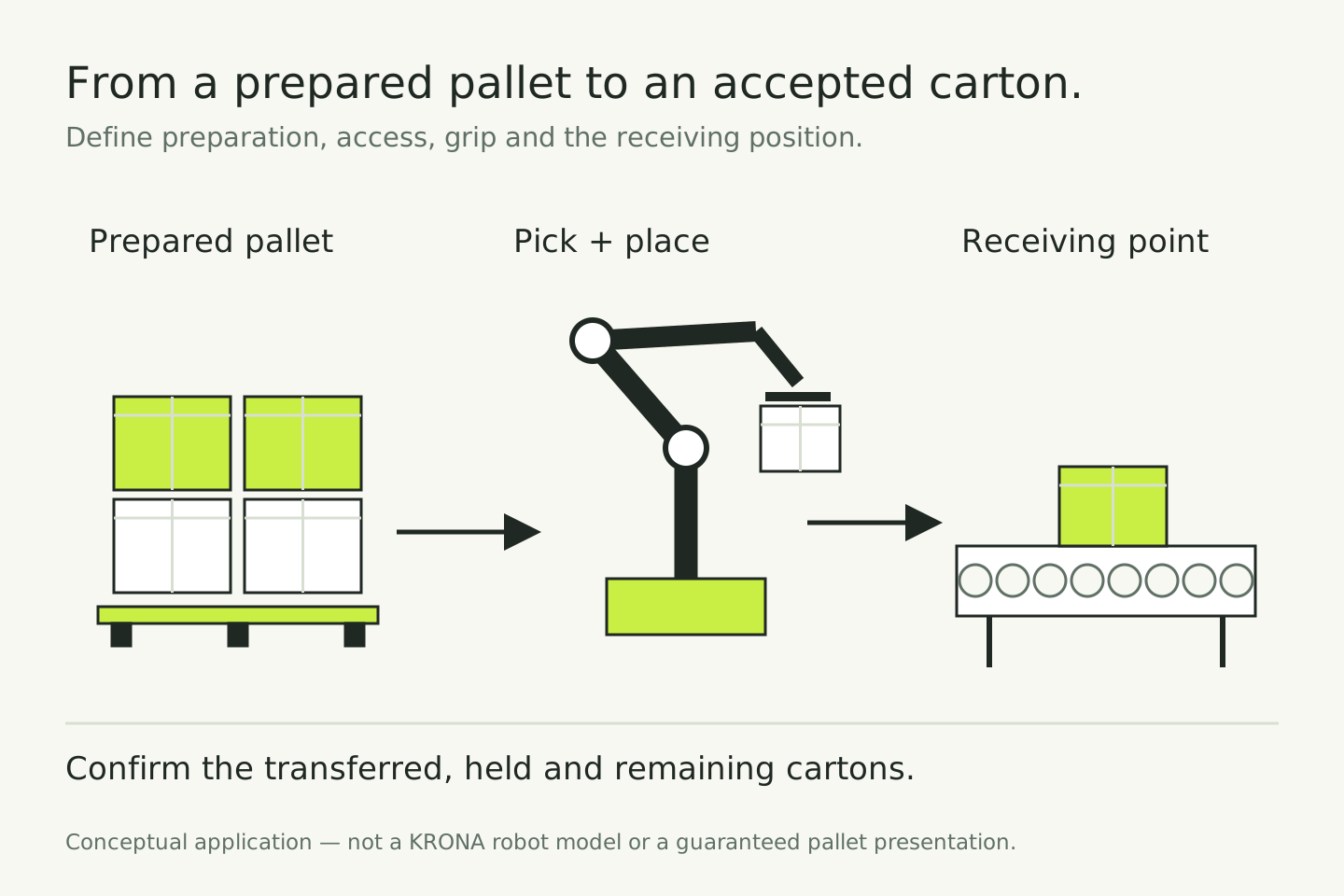
Carton depalletizing removes individual boxes from a pallet and supplies them to another process. The destination may be a conveyor, an inspection station, a picking operation or container loading. Define both ends of the job: the pallet as it really arrives and the carton presentation the next process needs.
A pallet-to-conveyor robot does more than reach the top layer. The application must account for carton access, grip, identity, orientation, the available receiving position and what happens when a box cannot be transferred.
Distinguish the pallet presentations
| Incoming presentation | Main planning question | Evidence to bring |
|---|---|---|
| Known product and repeatable pattern | Does the transported pallet match the expected layout? | Filled pallet photographs, dimensions and representative arrival condition |
| Known product with shifted cartons | Can each accessible box be located and approached? | Transported samples with actual offsets, lean and gaps |
| Mixed carton sizes or products | How are position, product identity and the next permitted pick established? | Carton range, identification method and required destination sequence |
| Partly depleted pallet | How is the remaining pallet state detected or recorded? | Representative partially handled loads and restart cases |
| Wrapped or separated layers | Who removes wrap, straps, sheets and other packaging? | The complete preparation sequence and responsible equipment or person |
Do not specify a difficult mixed pallet only as a larger carton range. Arrival condition, available faces and the order in which cartons can be removed can change the handling task.
Pickit’s depalletization examples illustrate the role of 3D vision in locating products on pallets. Product detection, inventory identification and reliable gripping still answer separate questions in the project brief.
Define the required carton output
The receiving process may require a certain face up, a label facing a scanner, a gap between cartons or a particular product sequence. Record these requirements before choosing the transfer arrangement. A successful lift does not establish a completed supply cycle if the conveyor cannot accept the carton.
- Present the palletPrepare packaging, confirm the load and make the required boxes accessible.
- Transfer a cartonEstablish the pick, grip and permitted placement at the receiving point.
- Confirm supplyReconcile the actual carton, its destination and the remaining pallet state.
Specify the maximum and minimum filled carton size, mass, surface condition and permitted contact areas. Include open flaps, damaged board, film, labels and transport marks in representative samples. Use the carton-gripper guide for tooling and the robot payload guide for loaded reach and tool mass.
Keep the pick position separate from product identity
A vision result can describe where a box is without confirming the stock-keeping unit (SKU), quantity or stock owner. A product label may also identify a type rather than a unique physical carton. Define which scan, record or operator decision associates the transferred box with its destination.
For a loading job, the next accessible box on the pallet may not be the next box required by the vehicle plan. Choose how the process handles that mismatch: a different supply order, a defined buffer, a second pallet source or an agreed change to the plan. The loading sequence guide owns the timing and buffer questions.
Reconcile transferred, held and remaining cartons
Use a hypothetical acceptance trace, not a product performance claim. A prepared pallet begins with 40 declared cartons. During the test, 32 reach and are accepted by the receiving process, two are held for damage review and six remain on the pallet.
The reconciliation is 40 = 32 accepted + 2 held + 6 remaining. A count of commanded picks would not establish this result. After a missed pick or interrupted placement, agree how the system determines where the carton actually is before deciding what to do next.
Keep packaging material, discarded cartons and empty pallets out of the normal product count. The receiving-system integration guide explains event ownership and retry handling when equipment status connects to stock records.
Include pallet exchange in the complete job
Record how the next full pallet reaches the station and how the empty pallet leaves. If pallet movement is automated, the handoff needs a declared position, load state and receiving permission. The carton process must also have a defined response when that position is unavailable.
KRONA autonomous forklifts and carton handling can be assessed within a warehouse AGV system. The interface brief should identify who supplies each movement and who confirms the transfer. A separate carton palletizing assessment addresses building the downstream pallet when that is part of the flow.
For material presented on a compatible load stand or carrier, compare a KRONA lifting AGV using the carrier’s underside, lift contacts and station geometry. That under-load arrangement does not by itself establish pickup of an unprepared bare pallet from the floor.
Assess depalletizing as part of the intended application
KRONA’s container-loading workflow includes eligible closed boxes supplied from pallets or conveyors. Specify how those boxes become available: pallet preparation, individual extraction, identification and required supply order are part of the application review. Standalone depalletizing, random mixed pallets and every packaging-removal task are not implied by a pallet source.
Bring filled pallet and carton examples, the receiving geometry, preparation steps, required output and exception cases to the assessment. A useful trial covers accessible and difficult positions, the last cartons, pallet exchange and recovery, with acceptance measured at the agreed receiving point.
- depalletizing
- cardboard cartons
- system integration
KRONA U1 unloads boxes from containers onto pallets or conveyors and also loads containers with boxes from pallets or conveyors. Explore KRONA U1 →
Assess carton depalletizing to a conveyor