
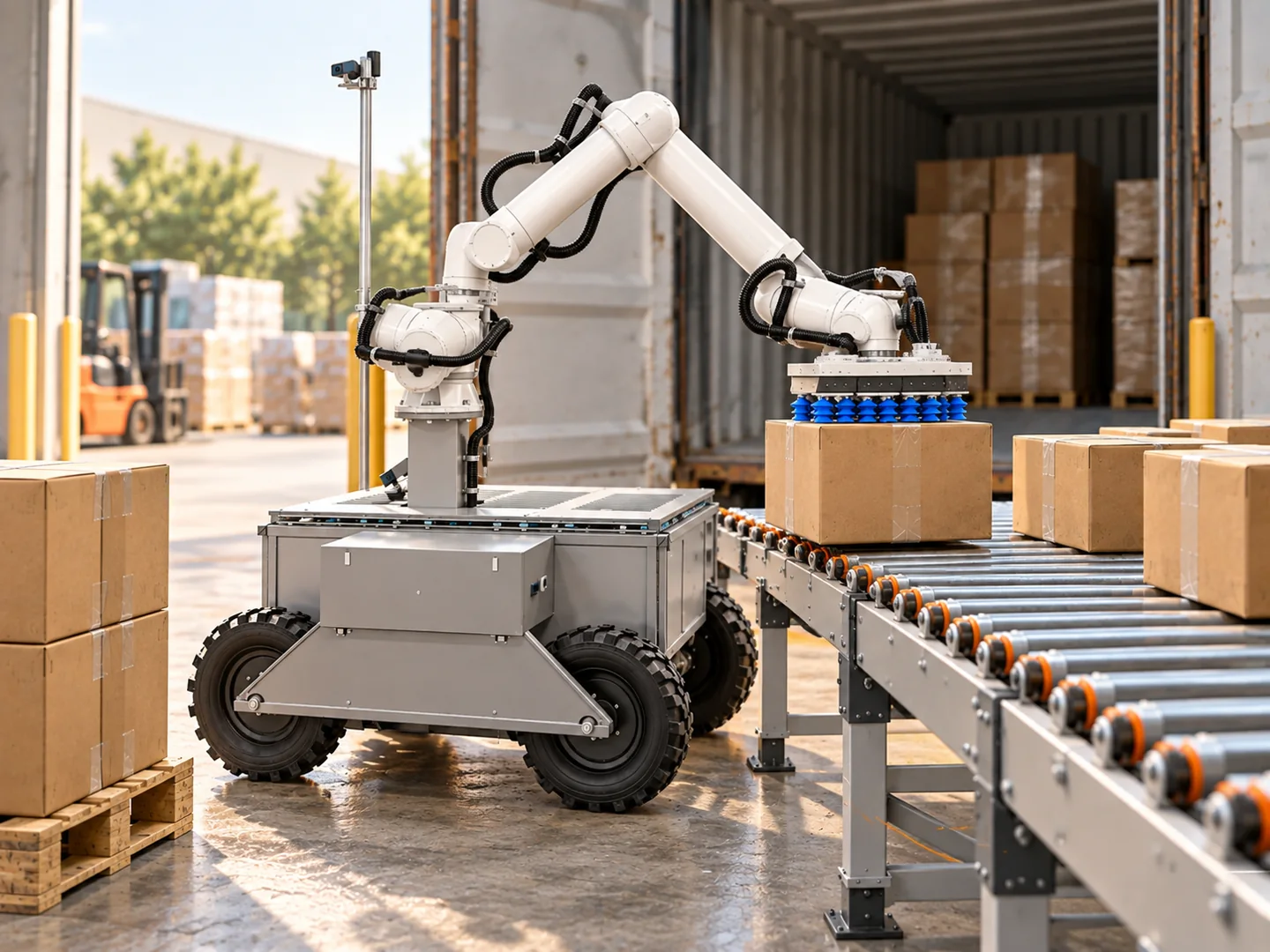
Container unloading and palletizing are connected tasks, but they do not have to be one machine or one uninterrupted movement. A robot can feed an existing conveyor, collect cartons on pallets or supply a separate palletizing cell. The right workflow depends on what receiving needs to do with the boxes next.
Start at the destination and work backwards: scanning, sorting, inspection, storage and pallet replacement can determine the pace of the whole unload.
Compare three receiving routes
| Route | Best question to answer | Work that remains downstream |
|---|---|---|
| Unloading robot to conveyor | Can the line accept the carton mix and sustained flow? | Scanning, routing, inspection and any palletizing |
| Unloading robot to pallets | Can the receiving location accept and remove the loaded pallets? | Any pattern validation, wrapping, sorting or put-away |
| Unloading robot to a separate palletizing cell | Can the two systems coordinate through a defined handoff? | Pallet supply, pattern control, finished-pallet removal |
The distinctions matter when specifying equipment. Direct pallet placement means cartons are deposited on a pallet. A mixed-case palletizing system may additionally need rules for SKU order, box dimensions, stack stability and the intended delivery sequence.
For the difference between the incoming freight formats, see floor-loaded freight vs pallets.
Map the flow before choosing the robot
- ContainerIdentify and extract eligible cartons.
- HandoffReceive on a conveyor or at an agreed pallet position.
- ReceivingScan, sort, inspect and move the goods onwards.
Draw the real route of a carton through receiving. Include where damaged boxes go, where labels are checked and how a pallet or conveyor section is cleared.
For each step, record the available capacity during the intended shift rather than only the equipment’s maximum rating. A line shared with another dock may have less capacity when both loads arrive together.
When conveyor handoff makes sense
A conveyor can maintain a continuous receiving stream where scanning, sorting or inspection already takes place on a line. It can also move the handoff away from the dock’s immediate working area.
Confirm carton size and weight limits, transfer height, gaps, orientation and whether packages can roll, jam or deform. Establish how the robot learns that the receiving point is available and what happens when the line fills.
Buffer space can absorb a short interruption, but it cannot repair a permanently slower downstream process. Specify who clears a jam and how the equipment returns to service. Treat signal and controller compatibility as project requirements to verify.
Fill in a carton-conveyor fit worksheet
Record the actual cartons and receiving arrangement before selecting a transfer point. A conveyor’s maximum load alone does not show whether the smallest box bridges the rollers, clears a gap or reaches the next handling stage in the required orientation.
| Input | Record for the project | Evidence to obtain |
|---|---|---|
| Carton geometry | Minimum and maximum filled length, width and height | Representative transported carton measurements |
| Filled mass and underside | Weight range, panel condition and contact surfaces | Conveyor limits and actual transfer observations |
| Transfer point | Receiver height, gaps, side clearance and placement orientation | Measured site drawing and supplier review |
| Carton presentation | Spacing, stopping position and label orientation | The downstream scanning or handling requirement |
| Buffer | Usable carton positions and interruptions it must absorb | Observed rates and a temporary queue calculation |
| Exception route | Damaged or unidentified carton destination | Agreed operator access and recovery ownership |
A generic layout is extraction → receiving zone → scanning or inspection → downstream routing. Show the exception route alongside it, and mark who owns each transfer. That layout is an assessment aid, not an approved KRONA interface drawing.
Use the robot-conveyor handshake checklist to define normal-control permissions and completion. The capacity worksheet shows how a buffer fills when the receiver slows or stops.
For a separate downstream cell, include the palletizing layout brief. In a 3PL warehouse, confirm whether receiving capacity is available to this client during the planned unload rather than shared with another arriving load.
Compare extraction equipment with the same receiving brief
A telescopic conveyor primarily changes transport between the container and receiving. A lifting aid assists the operator’s handling. A robotic extractor handles eligible picks and transfers. Write down the human work remaining in each proposal instead of treating all three as equivalent automation.
| Option | Work the proposal should identify | Application evidence to request |
|---|---|---|
| Telescopic or extending conveyor | Extraction, feeding, line operation and receiving work | Container access, transfer geometry and accepted carton flow |
| Lifting assistance | Operator selection and movement, plus downstream work | Assessed grip surfaces, load envelope and equipment access |
| Robotic extraction | Assessed carton picks, positioning, exceptions and receiver operation | Complete-sequence freight tests and sustained receiving capacity |
Download the equipment-comparison worksheet. Use the same load count, freight profiles, start/finish boundary, receiving destination and shift for each option, with separate columns for measured values and assumptions. Include preparation, person-hours, stops, damage and quoted scope.
If the options finish at different points, add the work needed to bring each to the same receiving outcome. Use the manual-versus-robotic guide for the process comparison and the recurring-unload checklist to collect load records.
Evaluate pallet handoff
Pallet handoff may fit an operation that receives cartons by batch or needs to collect them close to the dock. It can reduce reliance on a long conveyor route where the layout supports that choice.
Measure the pallet positions, operator access and finished-pallet removal route. Agree who brings an empty pallet, who confirms its position, and how the next receiving location becomes available.
If goods must be sorted by SKU or placed in a particular stack pattern, define that separately. A visible carton-to-pallet demonstration is not evidence that every palletising pattern or mixed-case load is supported.
Connect the finished pallet to warehouse transport
A carton handoff and a pallet pickup are different transfers. After the load is built, agree whether inspection, wrapping or an inventory decision must finish before a vehicle may collect it. Mark separate positions or statuses for pallets that are complete, on hold and ready to move.
KRONA autonomous forklifts address the pallet-movement task. Specify the pallet and load format, collection position, destination, floor route and empty-pallet replacement process for the proposed model. Keep the position used for carton placement available through a defined exchange sequence.
If the load sits on a stand or dedicated carrier, assess a low-profile lifting AGV against that carrier’s underbody clearance and lift interface. This is a different pickup arrangement from inserting forks into a pallet; specify the support used at collection and delivery.
A KRONA warehouse AGV system assessment can connect carton extraction, accepted pallet output and movement onwards. The handoff should confirm that the correct pallet was collected and delivered, not merely that a transport request was sent. Retain a recovery owner if the destination is blocked or a pallet is moved outside the planned sequence.
Where a separate palletizing cell fits
A dedicated cell may own the pallet recipe while the unloading robot owns extraction from the load wall. The handoff needs an agreed package identity, position, flow rate and response to interruptions.
A palletizing gripper selected for a prepared box on a conveyor has different access conditions from an unloading gripper inside a container.
Supplier architectures illustrate this separation: XYZ Robotics describes an inbound unloading/pallet-building workflow, while Granta presents an unloading-and-palletising solution. Their integration scope must be checked for each project.
Agree the handoff and exception ownership
Before commissioning, answer these questions:
- What confirms that a carton can be placed?
- What happens if the receiver becomes unavailable during a pick?
- Who owns damaged cartons, unreadable labels and unsuitable freight?
- How are a full pallet, blocked conveyor and missing empty pallet handled?
- What data is recorded for stops, assistance and recovery?
- Who authorises restart after a fault or an intervention?
The EOAT integration guide covers the gripping side of that exchange. The pilot checklist helps turn the questions into agreed acceptance checks.
Size the receiving interruption before choosing a buffer
Hypothetical pallet exchange: extraction delivers six cartons per minute and receiving cannot accept cartons for a three-minute exchange. To maintain extraction through that interruption, an initially empty buffer would need 18 usable carton positions. If it already contains five cartons, at least 23 total positions are needed for that simplified scenario.
That is a carton-count calculation, not a conveyor length specification. Carton dimensions, gaps, allowed accumulation and the stopping sequence determine the physical design. If the downstream station resumes at the same six-carton rate, it cannot clear the accumulated backlog while extraction continues. It needs spare capacity, a scheduled pause upstream or another agreed route.
Include full-buffer behaviour in the robot–conveyor interface brief. A larger buffer covers a temporary interruption; it cannot make a permanently slower receiving station match the upstream supply. The capacity guide gives the rate calculations.
Evaluate KRONA’s two unloading modes
KRONA U1 offers conveyor or pallet handoff for eligible closed cardboard boxes up to 25 kg. Choose the mode against your receiving process and confirm the carton mix, positioning, safeguards and downstream capacity during assessment.
The same KRONA U1 also loads containers with boxes from pallets or conveyors. For a loading project, share the carton profile, box-supply layout and required container loading sequence.
Send a simple dock sketch, representative package details and the intended receiving route to start an inbound-flow assessment. For the business case, compare whole-process costs with the unloading calculator.
For the outbound direction, use the container and truck loading solution guide to define carton supply and placement. The loading RFQ assigns the responsibilities that change when cartons move into the vehicle.
- container unloading
- palletizing
- warehouse automation
- deployment planning
KRONA U1 unloads boxes from containers onto pallets or conveyors and also loads containers with boxes from pallets or conveyors. Explore KRONA U1 →
Assess your carton-to-storage flow