
Floor-to-floor transport
Move a known pallet between receiving, production, storage or dispatch positions. Match the load entry and set-down conditions at both ends.
Define pallet pickup and delivery.
KRONA-branded AGV forklifts connect pallet pickup, transport and delivery. Start with the load and the route, then select the vehicle, handoff and control arrangement around the complete job.
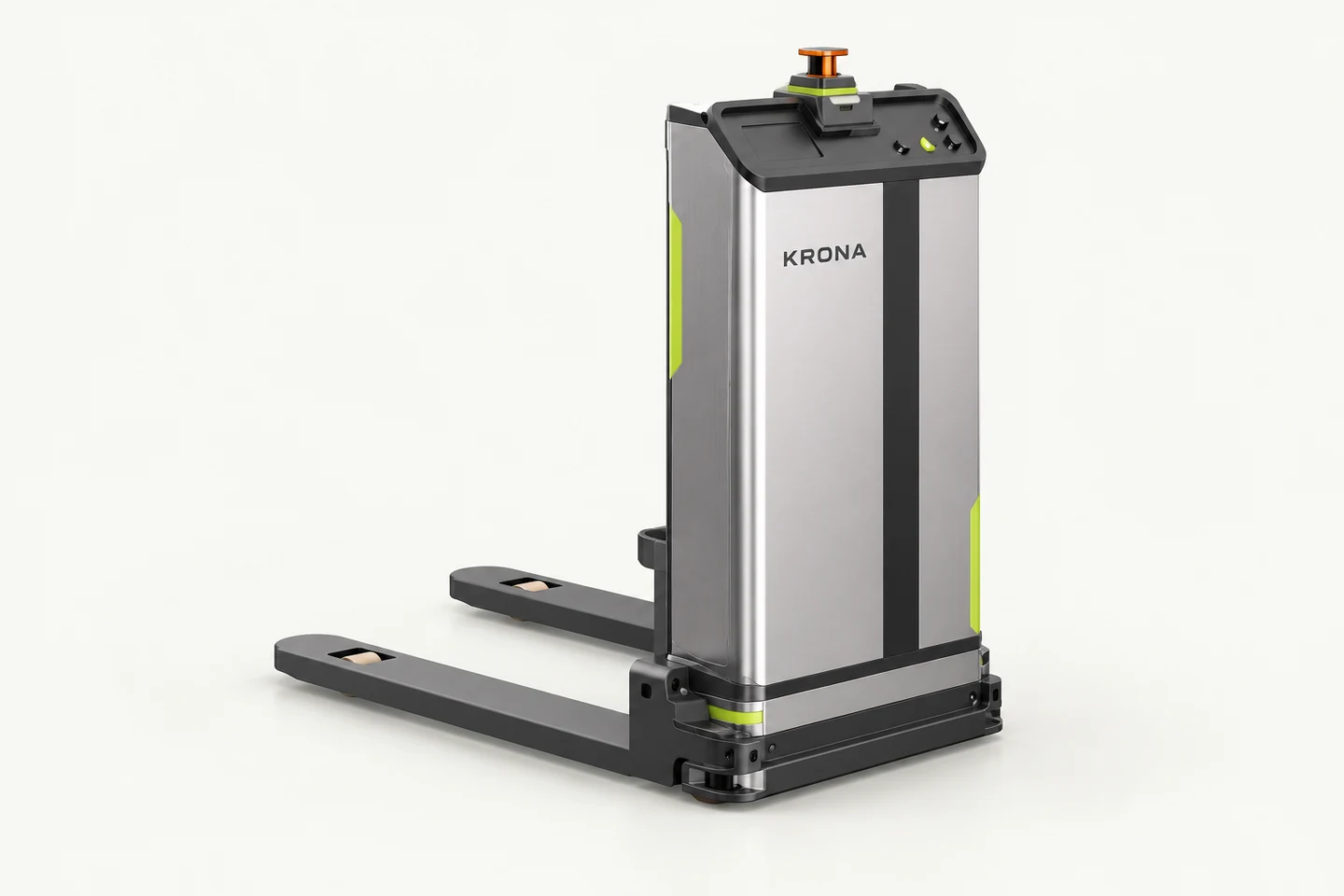
AGV forklift, autonomous forklift and forklift robot describe related equipment. The useful distinction is what the vehicle must pick up, where it travels and how it places the load.
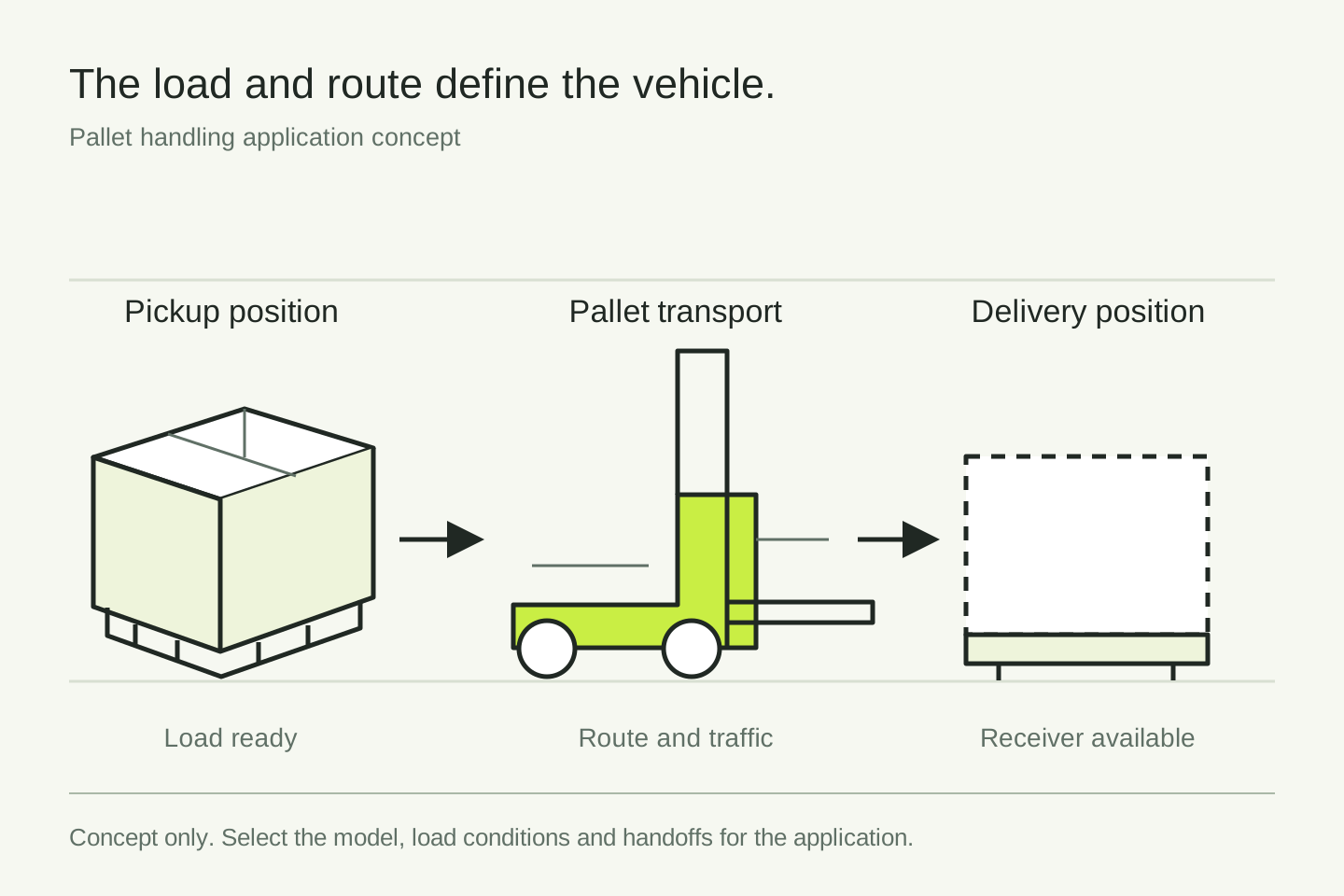
List the origin and destination of each recurring move. Record the loaded pallet dimensions, total mass, entry direction, underside and condition, including any overhang or load that can shift. A pallet format name alone does not describe what the forks or support surfaces will encounter.
Walk the route during the intended shift. Include aisle and turning space, doorways, intersections, floor transitions and temporary storage. Measure the operating space with the load in place rather than drawing only the vehicle footprint.
A repeatable movement between defined stations is a different job from finding an arbitrary pallet in a changing area. Explain how the pickup location is assigned, how the pallet is presented and how a destination becomes available.
Pallet trucks, stackers, reach configurations and counterbalance vehicles address different handling geometry. Your KRONA proposal should identify the selected model, rated load conditions, required lift positions and operating envelope for the application.
Navigation and route control also belong in the comparison. Ask how paths are established, what happens around people and other vehicles, and who can change a route. An autonomous vehicle still operates within an agreed site and traffic arrangement.
Use the same job to compare an AGV and an autonomous mobile robot. The labels do not establish rack access, trailer capability, route flexibility or compatibility with another supplier's fleet manager.
Define who requests the move, who confirms that the pallet is ready and how the receiving position signals availability. Include a completed delivery and a rejected or uncertain handoff so that a physical move and its stock record stay connected.
A standalone transport job may need a different control scope from one released by a warehouse management system. Specify task interfaces, vehicle or fleet control, charger access and operator responsibilities together. Multi-vehicle coordination and third-party interfaces are confirmed for the selected configuration.
Plan the ordinary interruptions: an occupied destination, a damaged pallet, a blocked aisle, charging or an interrupted task. Agree who resolves each exception and how the load returns to a known state.
Compare the vehicle with the software, charging, handoff equipment, site preparation, commissioning and support it needs. Ask for the supported model and operating conditions in the same proposal rather than comparing an equipment price with an installed system price.
Use recurring moves, travel distance, shift patterns, loading and unloading time, waiting and charging to establish the required capacity. Fleet size should follow the complete cycle and its interruptions, not a travel-speed headline.
Agree a representative site test and acceptance criteria for pallet pickup, delivery, task completion, remaining human work and sustained flow. KRONA confirms equipment and commercial terms for the defined application.
The proposal names the KRONA vehicle configuration, included hardware and software, charging, handoff responsibilities, commissioning, acceptance test and support. Model-specific data and delivery terms are provided for that scope.
Discuss a forklift applicationKRONA U1 can extract eligible closed cartons to a conveyor or pallets. Define the accepted pallet output and its availability before releasing a transport task.
Explore KRONA U1 unloadingPlan pallet building, pallet exchange and vehicle access as one flow. Pallet removal should keep pace with the intended cell output.
Assess carton palletizingA lifting AGV addresses a different geometry: it travels beneath a compatible stand or carrier and raises the load for transport, rather than using a mast and forks.
Compare lifting AGV transportSeparate moving pallets, handling cartons, picking orders and accessing storage.
Include the whole installed operation and its recurring costs.
Compare route, load and workflow requirements rather than labels.
Make temperature and operating conditions part of model selection.
Yes. The autonomous forklift and AGV range is offered under the KRONA brand. KRONA selects the vehicle and project scope around the pallet, route and required handling task.
Trailer work is a specific application, not a feature established by the name AGV forklift. Define the vehicle, pallet, dock and trailer geometry and confirm that capability for the proposed configuration.
Describe the system, task ownership and required confirmations in the application brief. The proposal identifies the supported interface and integration work; compatibility is confirmed for the selected setup.
Share roughly how much you need to move. We’ll get in touch to discuss the possibilities.
info@kronarobot.com