
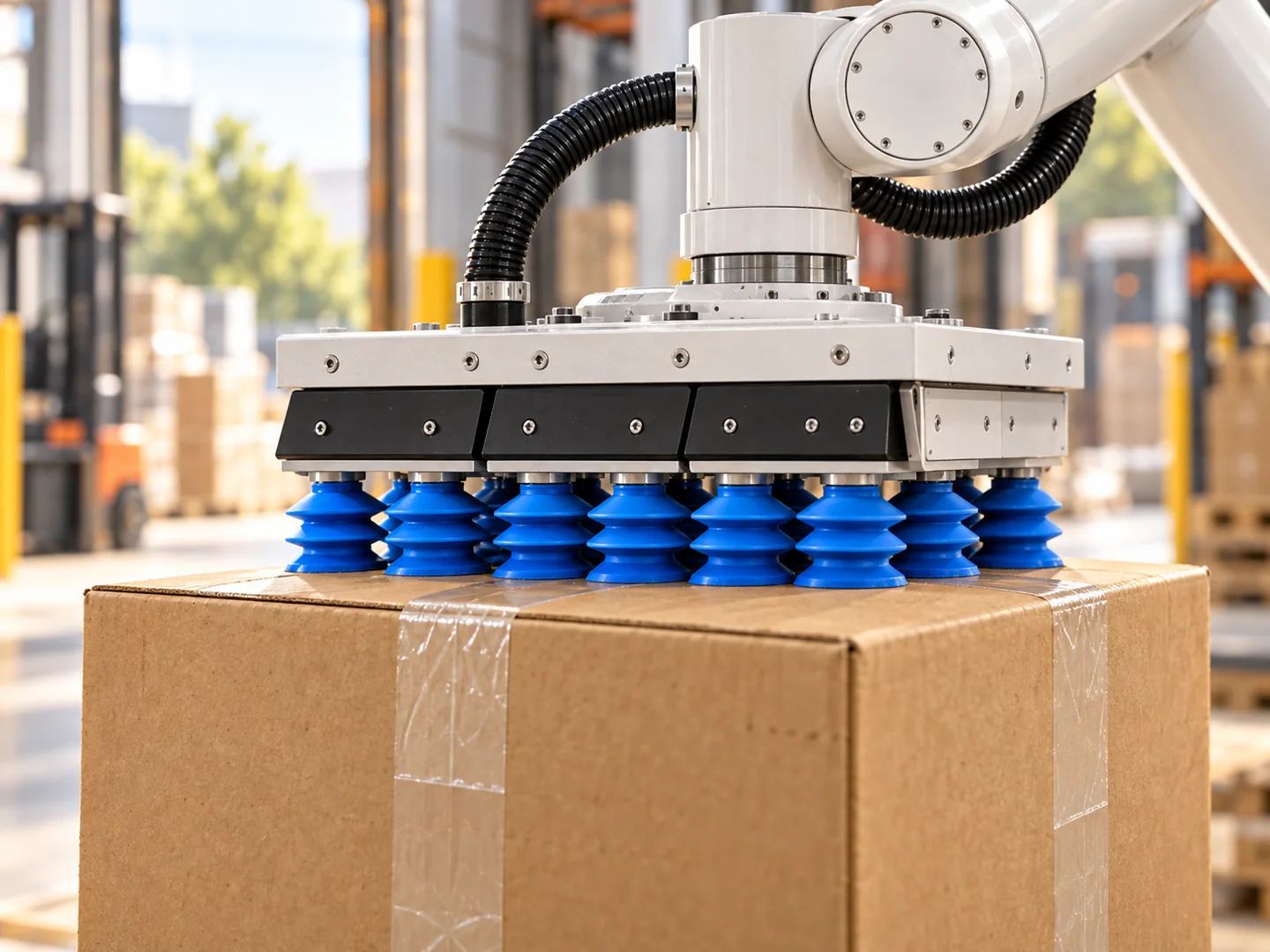
The elementary suction cup force calculation is F = Δp × A: pressure difference multiplied by effective suction area. It estimates a static force normal to a sealed contact surface. Cardboard handling also depends on leakage, the load direction, motion and the strength of the carton panel.
Use the equation to understand the variables and check units. Choose the actual tooling through the manufacturer’s application method and tests on representative filled cartons.
Define pressure and effective area
Pressure difference, Δp, is the difference between ambient pressure and pressure inside the suction contact, expressed in pascals. Effective area, A, is the sealed area used in the manufacturer’s calculation, expressed in square metres.
The outside diameter of a bellows cup is not automatically its effective suction diameter. Foam tools, uncovered zones and different cup geometries need their own manufacturer data.
Schmalz’s suction-cup design explanation describes this basic relation as a static holding force before design factors. Treat it as a starting point, not a safe working-load rating.
A unit-checked theoretical example
Assume a hypothetical effective circular diameter of 50 mm and a maintained pressure difference of 40 kPa. These are teaching inputs, not recommended settings for cardboard.
Convert first: 50 mm is 0.050 m, and 40 kPa is 40,000 Pa. The effective radius is 0.025 m.
A = π × 0.025² ≈ 0.001963 m²
F = 40,000 × 0.001963 ≈ 78.5 N
| Input or result | Value | Meaning |
|---|---|---|
| Effective diameter | 0.050 m | Assumed sealed contact diameter |
| Effective area | About 0.001963 m² | Circular area for this example |
| Pressure difference | 40,000 Pa | Assumed maintained pressure at contact |
| Theoretical static normal force | About 78.5 N | Pressure difference × area |
Although 78.5 N is approximately the weight force of 8 kg under gravity, it is not an 8 kg carton rating. The example leaves out application factors, leakage, movement and package failure. Adding cup forces also assumes an appropriate load distribution and effective contacts.
Top picking and front extraction create different loads
When lifting from above, gravity can act primarily along the cups’ normal holding direction. When a tool contacts a carton wall from the side, supporting the weight also involves lateral forces and the contact’s resistance to sliding.
Schmalz’s load-case guidance separates load directions and requires surface-dependent design factors and tested friction data. A universal friction coefficient cannot be assumed for taped, dented or porous cartons.
Review the complete extraction, transfer and stop conditions using the manufacturer’s method. A grip that holds a stationary box can fail during an accelerated movement or a constrained extraction.
Measure leakage and carton response
Corrugated board, seams, tape edges and incomplete cup coverage can change the seal. A measured pressure level also needs to be considered with the vacuum supply’s ability to handle leakage throughout the cycle.
The carton itself can deform before the nominal tool holding force is reached. Filled contents, panel stiffness and contact position therefore belong in the test. Test normally transported boxes, including the relevant surface variations.
The vacuum-grip failure guide helps separate initial sealing failures, pressure loss, panel deformation and failures during movement.
Turn calculations into a test record
Record the carton group, filled mass, accessible contact face, cup arrangement and effective-area source. Add measured contact pressure, seal behaviour, the intended motion and the observed result.
For each unsuccessful pick, distinguish a missed contact from a lost grip or damaged panel. Keep photographs, movement conditions and observations together so a tooling change can be assessed against the same package sample.
Do not choose a universal vacuum threshold, cup size or motion setting from the worked example. Have the application and operating settings confirmed by the responsible tooling and robot specialists.
Apply the answer to an unloading project
Use the carton-gripper guide for initial package suitability and the EOAT checklist for the broader tool and interface brief.
KRONA U1 is a complete unloading system for eligible floor-loaded closed cartons. Request an assessment with representative filled boxes, load-wall photographs and the intended conveyor or pallet handoff. Theoretical suction force is one input to that assessment, not proof that a carton will complete the unloading cycle.
- vacuum gripper
- cardboard cartons
- end of arm tooling
KRONA U1 unloads boxes from containers onto pallets or conveyors and also loads containers with boxes from pallets or conveyors. Explore KRONA U1 →
Request a representative-carton assessment