
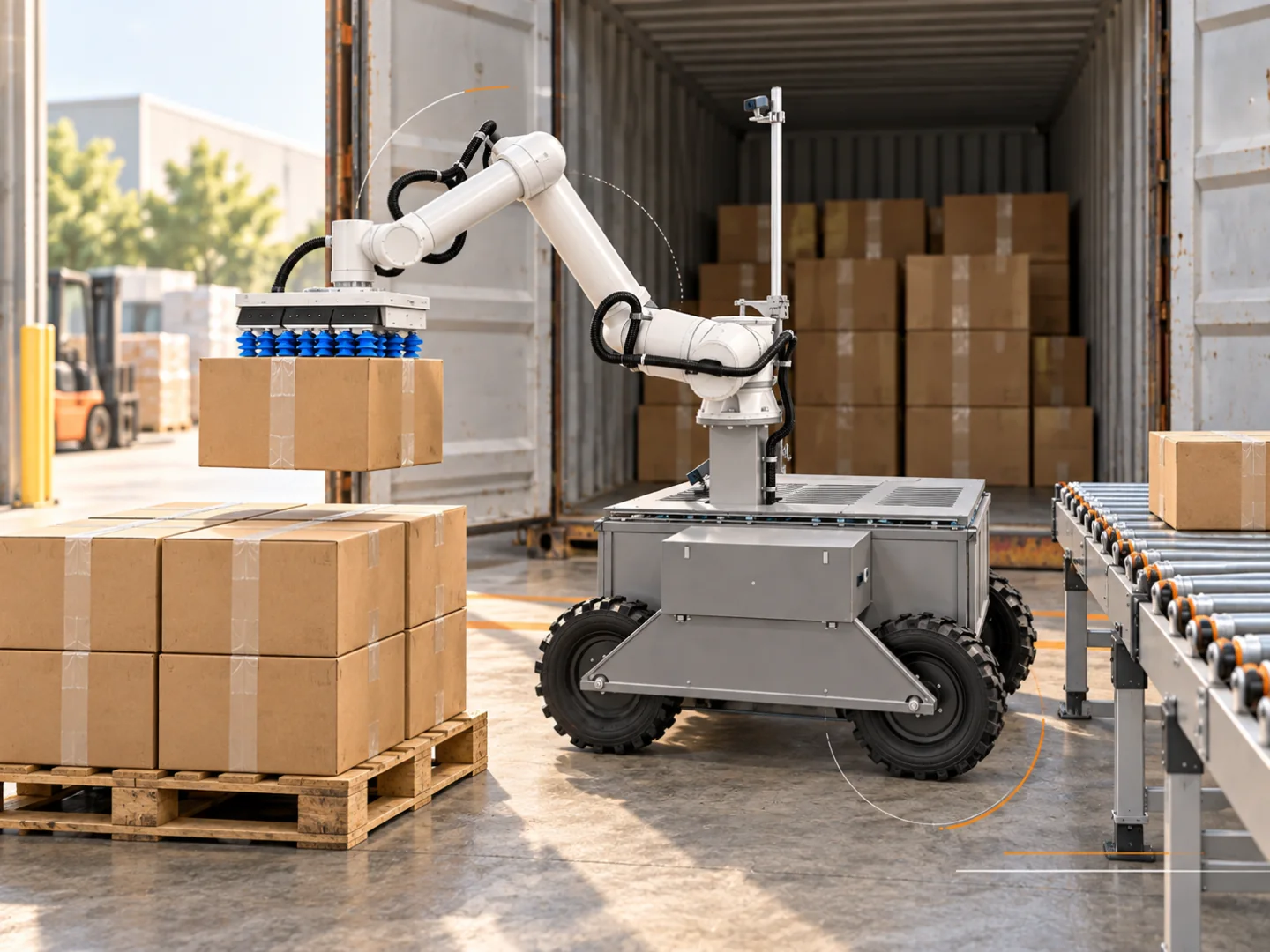
Palletised freight and cartons loaded directly on a container floor may arrive at the same dock, but they create two different operations. A stable pallet can often be removed with one forklift movement. Floor-loaded freight must be broken down and transferred one carton at a time.
The best automation approach depends on why each loading method is used and what happens both before and after unloading.
Why freight travels without pallets
A pallet makes handling easier, but it consumes space and adds weight. Floor loading can use container volume more efficiently, particularly when many cartons travel over a long international route.
The choice may be driven by:
- transport volume and cost optimisation;
- supplier loading practices;
- mixed package sizes and SKUs;
- incompatible pallet standards;
- phytosanitary or return requirements;
- a need to sort products immediately at receiving.
“Just use pallets” is therefore not always a supply-chain solution. It may reduce unloading work while increasing transport or supplier cost.
The palletised process
When a pallet is stable, correctly labelled, and compatible with receiving equipment, unloading is relatively structured. The main variables are pallet count, weight, height, condition, and forklift access.
A pallet is not necessarily the final handling unit, however. Receiving may still have to:
- remove stretch wrap;
- inspect and count cartons;
- rebuild onto a local pallet standard;
- break down mixed SKUs;
- feed packages into a conveyor or storage system.
Alternatives should be compared across the whole internal process, not only the minutes needed to empty the vehicle.
The floor-loaded process
Loose cartons form an unstructured three-dimensional wall. Packages may be rotated, compressed, damaged, or have different weights. The front package is not always safe to remove because it may support freight above it.
In a manual process, people combine perception, selection, lifting, and exception handling. A robotic system has to implement each function deliberately: vision identifies accessible surfaces, controls select an action, the gripper confirms the hold, and the safety system manages the working area.
Where automation can be introduced
There are at least three distinct automation points:
- Extraction from the vehicle. A robot transfers suitable cartons to a conveyor or handoff point.
- Inbound-flow handling. Packages are scanned, sorted, and routed after extraction.
- Palletising after unloading. Local pallets are built from the floor-loaded carton stream.
These stages can be deployed independently. In one site, the primary problem is manual work inside the container while an existing conveyor already handles cartons well. Elsewhere, unloading is fast but inbound sortation creates the queue.
Measure the constraint across the whole flow
Robot capacity has no value without somewhere to send the boxes. A full conveyor stops both a person and a robot. Measure:
- maximum downstream carton flow;
- available buffer capacity;
- scanning and label quality;
- time needed to route exceptions;
- availability of empty pallets and space at the palletising point.
An automation project should balance the line instead of moving the bottleneck several metres downstream.
Decide from the freight profile
Segment inbound loads into palletised freight, eligible floor-loaded cartons, and packaging outside the current system’s envelope. For each group, estimate volume, labour time, dock occupancy, and the downstream process.
This map identifies a realistic first automation stage. The goal is not to force every load to look the same. It is to apply the right handling method where it improves the outcome of the complete operation.
Unloading is different from depalletizing
| Task | Starting load | Typical access question |
|---|---|---|
| Floor-loaded carton unloading | Boxes stacked inside a vehicle | Can an exposed front face be gripped and extracted safely? |
| Pallet unloading | Goods already on a pallet | Can the pallet be removed and transported as a stable unit? |
| Robotic depalletizing | Boxes on a pallet at a handling station | Can individual boxes or layers be picked from the available faces? |
| Palletizing after unloading | Extracted boxes | Can boxes be placed into the required stable pallet arrangement? |
Depalletizing a prepared pallet may expose top faces and provide controlled station geometry. Front extraction from a container has neighbouring cartons, restricted clearance and an extraction order that must account for load stability. Neither demonstration verifies the other application.
Palletizing/palletising means building a load on a pallet. Depalletizing/depalletising means taking goods off it. The spelling variants describe the same tasks. Removing an intact pallet from a trailer is pallet unloading, rather than carton depalletizing.
Compare the same delivered quantity across the full route
Floor loading may save space otherwise occupied by pallets, while creating carton extraction and preparation work at the receiver. Palletised freight may leave the dock sooner, while retaining transport, pallet and later sorting costs. Compare the same delivered goods rather than one trailer of each format with different contents.
Build a worksheet covering sender preparation, transport space, receiving dock time, carton handling, pallet circulation and the final storage unit. If every carton must be scanned and sorted individually, rapid forklift removal has not completed receiving. If the goods remain on a single-product pallet through storage, extra carton handling may provide no useful step.
Agree that final receiving outcome before comparing unloading costs. The handoff guide helps identify which work happens immediately after extraction and which belongs elsewhere in the route.
Connect the freight format to the receiving route
The container-to-conveyor or pallet guide covers buffers, pallet replacement and handoff ownership. The palletizing-gripper guide covers tool access and placement.
KRONA U1 is a complete unloading robot for eligible floor-loaded cartons with conveyor or pallet handoff. Assess that operation against the actual freight and dock.
For equipment choices after the freight format is clear, compare conveyors, lifting aids and carton-unloading robots.
Include origin loading in the format decision
The sender’s loading operation changes the comparison. Palletized freight may need cartons built, secured and staged as complete handling units before loading. Floor loading needs a reliable carton supply and an approved placement sequence inside the vehicle. Include that preparation even when it happens away from the dock.
At origin, record how cartons are supplied: source pallets, production output or a conveyor. Measure the work needed to identify the right SKU and present it for loading. If a mixed pallet must be broken down to produce the sequence, that work belongs in the route comparison rather than disappearing from the loading estimate.
| Stage | Floor-loaded cartons | Palletized freight |
|---|---|---|
| Origin preparation | Identify cartons and provide the required supply order | Build and prepare accepted pallet loads |
| Loading | Move and place individual cartons, including exceptions | Move complete pallets with compatible equipment |
| Transport space | Measure the approved carton arrangement and reserved space | Include pallet dimensions, weight and permitted arrangement |
| Destination | Extract, identify and route cartons to the receiving outcome | Remove pallets, then include any required breakdown or rebuilding |
Compare the same delivered carton quantity and destination outcome. A geometric estimate that ignores door access, packaging requirements or reserved clearance can overstate usable capacity. A faster origin load may also create more handling at the receiver. Record both effects before selecting the format.
Match loading equipment to the handling unit
A loading conveyor brings cartons toward the working position; people may still place them. Robotic carton loading adds assessed picks and placements. Whole-unit systems move pallets or prepared loads and require their own vehicle and interface assessment. These proposals should identify the actual unit they handle.
The truck and container loading guide connects carton supply, conveyors and KRONA U1 loading. KRONA can supply conveyors within the agreed project scope. Final suitability depends on the cartons, vehicle, source layout and required loading operation rather than freight format alone.
Open the editable full-route comparison. Record origin preparation, loading, transport-space assumptions, destination work and pallet circulation for each format. Separate measured values from assumptions and unresolved quotation items.
Use the loading labour and equipment worksheet alongside the existing unloading cost guide. Avoid assigning a universal space or savings percentage: the result depends on the actual carton and pallet dimensions, approved arrangement, recurring volume and handling work at both ends.
- floor-loaded freight
- pallets
- warehouse automation
KRONA U1 unloads boxes from containers onto pallets or conveyors and also loads containers with boxes from pallets or conveyors. Explore KRONA U1 →
Check freight eligibility