
A useful loading-system request for quotation (RFQ) describes the freight and finished job before naming equipment. Give each supplier the same carton data, vehicle geometry, supply arrangement and acceptance boundary. Ask it to identify what is supplied, what needs testing and which responsibilities remain with the site or another integrator.
The editable loading RFQ and scope matrix records the requirement, supplier response, owner and evidence. Use it for carton-loading projects rather than replacing “unloading” with “loading” in an inbound specification. Forming a load introduces its own sequence, access and finished-load requirements.
Define the shipping unit and project boundary
State whether the job loads individual cartons, pallets or another prepared unit. Automated truck loading includes several mechanisms; a system that transfers a prepared load answers a different requirement from a robot placing boxes individually.
Describe the start point and accepted finish. For example, cartons may be available on source pallets or on a conveyor, and the finished operation may include an agreed load check and handover. Name preparation, replenishment and transport work outside that boundary so suppliers do not silently assume it is provided.
Give recurring volume, shifts, peak patterns and the current operational constraint. Record whether the project targets manual carrying, placement work, variable loading time or another specific issue. This context helps suppliers propose a complete process rather than equipment sized only from a peak carton count.
Provide representative carton data
Include measured filled dimensions, mass and quantities by SKU and packaging version. Record box condition, permitted orientation, gripping surfaces and any required identity or label presentation. Include the difficult profiles that recur in normal work, not only the easiest demonstration cartons.
Identify the owner and source of carton support and crush limits. Supply the approved separation, loading and restraint requirements where relevant. Mark unknown values for review; they should not become implicit permission for unrestricted stacking.
Ask each supplier to describe the supported application envelope and the evidence behind it. A maximum payload says little about whether the gripper can access a given carton or place it in the required orientation. The optimization requirements guide helps specify those dependencies.
Describe the vehicle and working envelope
Provide vehicle types and measured internal space, door openings, obstructions, floor levels and thresholds. Include dock photographs or a drawing showing the relation between warehouse floor, vehicle and intended loading equipment.
Show operating, retracted and parked positions. Include space for replenishment, workers, safeguarding and recovery. If equipment must move between bays, describe the travel route, floor conditions, power connection and repeatable setup at each position.
For truck applications, include the approved payload and load-distribution constraints for the actual vehicle and route, plus any multi-stop unloading order. Ask who verifies those inputs and which part of the quoted system checks them. Do not substitute an assumed generic truck model for the vehicle that will be used.
Assign carton supply and planning responsibilities
For pallet-fed supply, describe how required cartons become accessible and who replenishes the source. For conveyor-fed supply, provide orientation, spacing, transfer height, identification method and arrival order. State whether the source can deliver a requested sequence or only a live stream.
Assign ownership of the loading plan, data revisions, carton release and confirmed placements. Specify temporary holding and any ability to retrieve cartons out of arrival order. Ask what happens when a carton is late, missing, damaged or different from its approved profile.
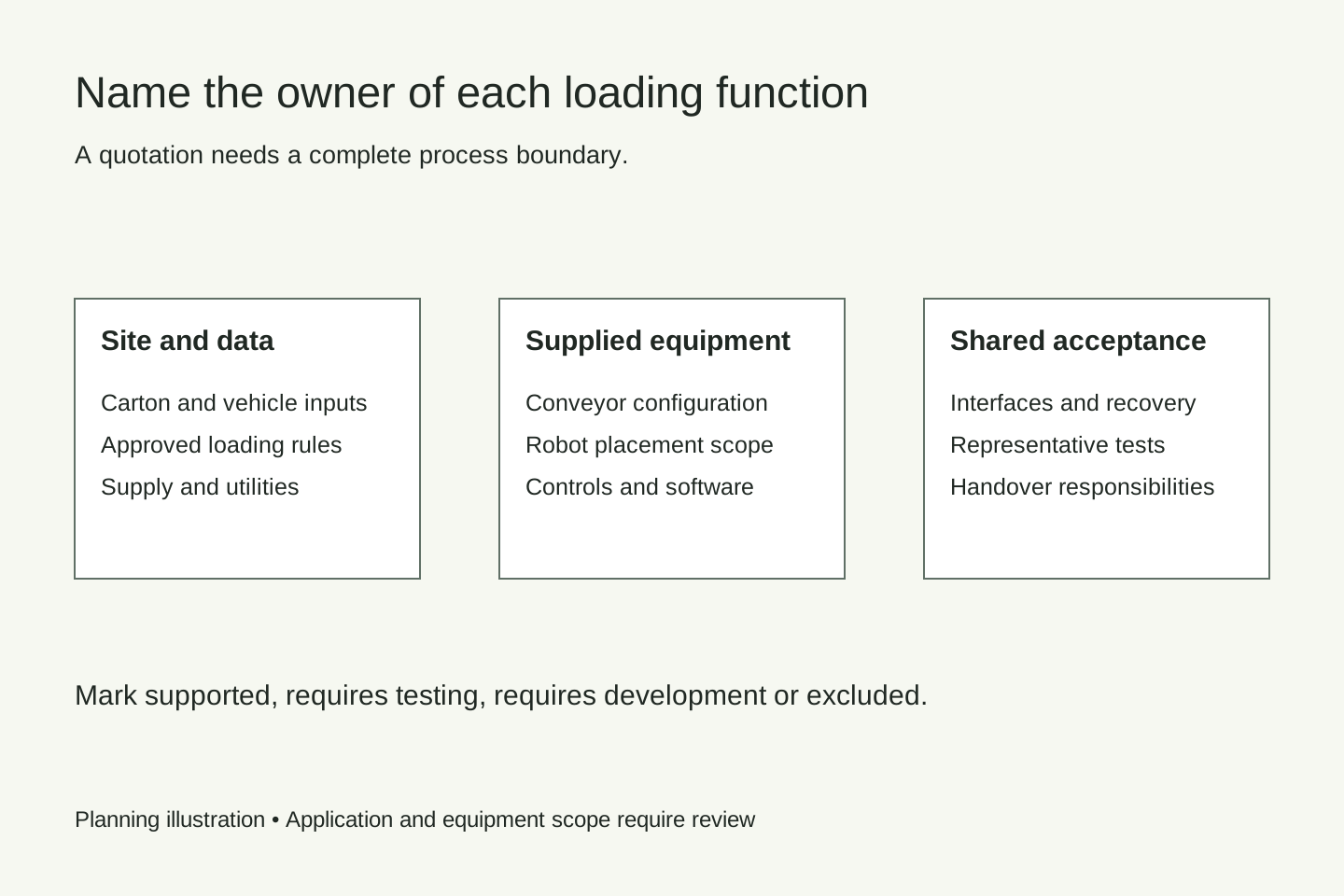
| Function | Owner to name | Evidence requested |
|---|---|---|
| Carton and vehicle data | Site, customer or integrator | Accepted profiles and measured geometry |
| Loading plan and rules | Named planner and rule owners | Supported constraints and plan version |
| Carton supply and sequencing | Site or supplied equipment | Arrival trace and replenishment scope |
| Conveyor transport | Named supplier | Configuration, controls and handover limits |
| Robotic placement | Named supplier | Assessed carton and placement envelope |
| Completed-load review | Agreed responsible party | Acceptance criteria and completion record |
Specify controls and interruption behavior
Describe the normal transfer states and the permissions that allow each movement. Name the receiving-ready signal, release request and completion confirmation. State what each acknowledgement proves, including the distinction between a received command and a physically placed carton.
Include a full buffer, blocked conveyor, unavailable robot, power or communications interruption and uncertain placement completion. Ask how the physical load is reconciled before restart. A protocol name alone does not define the state machine, recovery ownership or tested interface.
Specify required controller and software versions, networks and site responsibilities. Suppliers should classify connections as supported, needing testing, needing development or excluded. The robot-conveyor handshake checklist provides a starting structure for the local transfer.
Align the equipment and commercial scope
Request a supplied-equipment list, configuration drawing and clear quotation inclusions. Identify conveyor supports, drives, controls, guards, utilities, transport, installation, commissioning, training and service responsibilities. State which drawings and instructions are delivered at handover.
For the conveyor route, distinguish an incline with supported roller extension from a nested telescopic belt boom. Ask for configuration-specific dimensions and ratings rather than importing values from an illustration or another supplier.
Compare one-time work and recurring commitments separately. Clarify software, updates, support coverage and any usage or minimum-charge conditions. Use the same completed loading boundary in the cost comparison so a smaller hardware quote is not mistaken for a complete installed process.
Request the same acceptance evidence
Give bidders the same representative tests, freight profiles and start/finish definitions. Ask for complete loading time, person-hours, assistance, stops, exceptions and package condition. Define the finished-load review separately from robot placement completion.
Set thresholds with the buyer and responsible specialists before the trial. Use the loading pilot protocol to record pass, revise, additional test or excluded application, with evidence for each decision. A short successful demonstration should not close requirements that were never tested.
Bring the completed RFQ, carton list and dock sketch to KRONA’s integrator team. KRONA U1 loads containers with boxes from pallets or conveyors; the loading plan, equipment, software connections and acceptance scope are confirmed for the project.
- container loading
- system integration
- conveyors
- project specification
KRONA U1 unloads boxes from containers onto pallets or conveyors and also loads containers with boxes from pallets or conveyors. Explore KRONA U1 →
Discuss an integrator loading project