
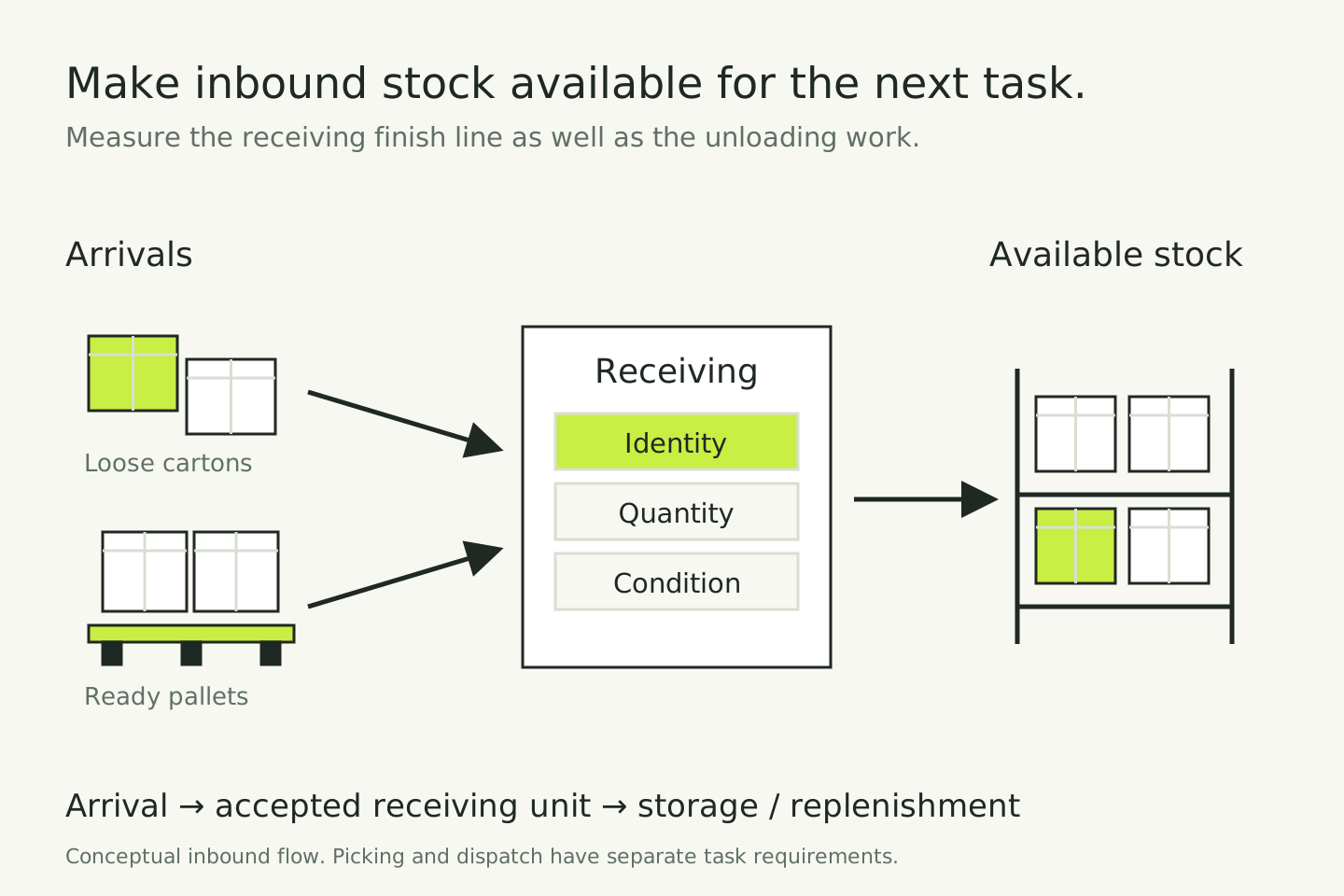
Ecommerce warehouse automation often brings order picking to mind, but stock must first arrive, be accepted and reach the right location. Delays in container unloading, receiving or pallet movement can leave a picking system waiting for inventory. Assess inbound work against the time stock needs to become available for replenishment.
This guide concerns the flow from arriving freight to accepted stock and its next destination. Item picking, packing and parcel dispatch are separate automation jobs; an inbound robot does not automatically perform them.
Separate loose-carton arrivals from palletized goods
Floor-loaded cartons require extraction before a pallet-transport system can move an assembled load. Palletized arrivals may enter a pallet movement or storage process sooner, while still requiring identification and inspection. Count the two streams separately in the workload.
| Arrival type | Work to identify | Useful first assessment |
|---|---|---|
| Floor-loaded closed cartons | Extraction, carton handling and receiving handoff | Carton unloading with a defined conveyor or pallet destination |
| Ready pallets | Pallet condition, identity and pickup/drop geometry | Autonomous pallet movement to an agreed location |
| Mixed cartons needing sorting | SKU/owner identification and destination rules | Unloading plus the separately defined receiving/sorting process |
| Goods requiring a new pallet build | Carton sequence and accepted finished load | Carton palletizing and pallet exchange |
| Pallet supply to a conveyor | Pallet preparation and individual box presentation | Assessed carton depalletizing |
Use the warehouse robot types guide to connect these tasks to equipment categories. This keeps a pallet travel problem from being scoped as a carton picking problem, or the reverse.
Measure when stock becomes usable
Choose the finish point that matters to replenishment. It could be the accepted pallet in a receiving location, stock available in the warehouse system or stock delivered to a forward-pick area. Those are different boundaries and can have different owners.
Record arrival, unloading completion, receiving acceptance and availability for the next task separately. A fast unload can still miss a replenishment deadline if inspection, labelling or pallet removal happens much later. The WMS receiving guide covers the relationship between physical handling and warehouse records.
For logistics units that use GS1 identifiers, the GS1 SSCC explanation describes linking an individual unit to its information. The site’s labelling and receiving rules determine the actual identification process; do not assume every inbound carton already carries the required readable identifier.
Size the receiving flow around its constrained step
- Release cartonsUnload eligible freight to the agreed receiving point.
- Accept the stockResolve identity, damage, quantity and required pallet output.
- Replenish the destinationMove the accepted load and confirm the next location is available.
In a hypothetical fixed-rate example, 120 cartons arrive at receiving over 12 minutes: ten cartons per minute. If receiving accepts six cartons per minute throughout that interval, it processes 72 and leaves 48 waiting. With no further arrivals and the same acceptance rate, clearing that queue takes another eight minutes.
This arithmetic is not a KRONA rate or a sizing recommendation. It shows why extraction and acceptance must be planned together. Buffer space can absorb a temporary difference, but a faster unloading step cannot remove a continuing downstream capacity limit. Use the line-capacity guide for the complete calculation and interruption assumptions.
Keep changing SKU mixes in the test
Daily averages can hide a receiving peak. Record the arrival window, carton mix, number of concurrent loads and the replenishment deadlines served by those loads. Include the labour and destinations available during that same window.
Test normal cartons alongside unreadable labels, a damaged box, a missing item reference and an unavailable pallet destination. When stock ownership varies by client, retain that distinction in receiving decisions. The existing 3PL automation guide covers client and contract qualification in more detail.
If the flow builds pallets from different products, define the required result rather than describing every collected pallet as mixed-case palletizing. Use the mixed-case overview for the differences between inbound collection and an accepted mixed-order shipping load.
Give each KRONA stage a defined handoff
KRONA U1 unloads eligible floor-loaded closed cardboard boxes up to 25 kg onto conveyors or pallets. KRONA-branded autonomous forklifts address the separately specified pallet movement. A carton palletizing assessment defines any required build between those stages.
Where material is staged on compatible reusable load stands or carriers, a KRONA lifting AGV offers a distinct under-load transport arrangement. Define the carrier underside, access, lift contacts and station positions; a pallet carried on such a support is not the same pickup task as a bare pallet on the floor.
For a combined project, state when a pallet is ready, who requests collection and how an unavailable storage or replenishment destination is handled. Avoid assuming that a successful physical move also completes an inventory transaction.
Prepare an inbound assessment with the right finish line
Bring a shift-level arrival log, filled carton and pallet examples, the receiving layout, relevant replenishment deadlines and a map of the work people perform today. Identify the carton, accepted pallet and stock-record finish points you want the assessment to measure.
Use the KRONA warehouse AGV systems assessment to connect the stages. Compare the complete proposed receiving window with the current process, including remaining human work and exceptions, before extending the project into picking or dispatch.
- ecommerce
- warehouse automation
- container unloading
KRONA U1 unloads boxes from containers onto pallets or conveyors and also loads containers with boxes from pallets or conveyors. Explore KRONA U1 →
Assess the inbound warehouse flow