
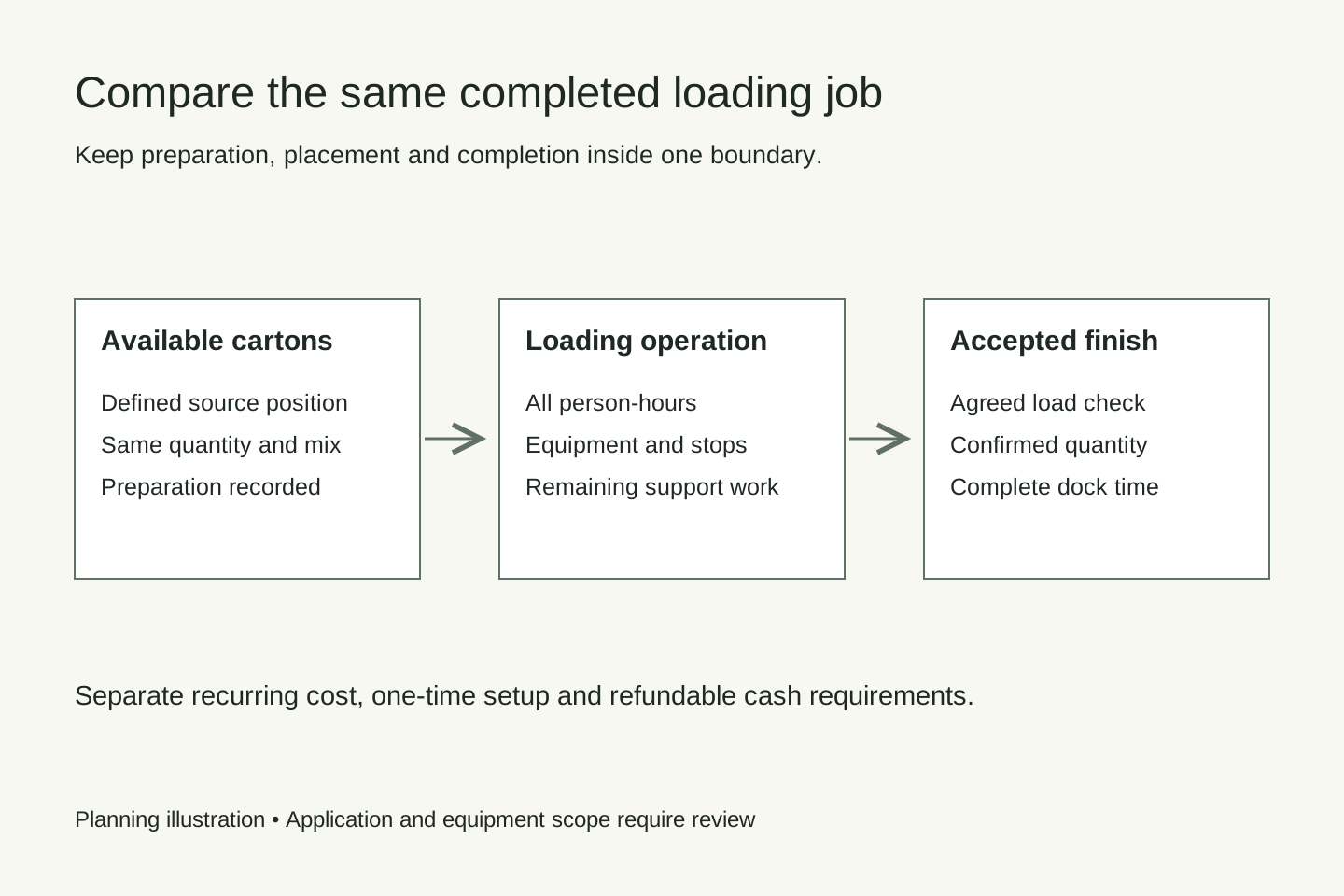
To compare container loading methods, measure the same completed job. Start with cartons available at an agreed supply point and finish when the load has completed the agreed loading and checking steps. Include the people, equipment and interruptions inside that boundary before comparing a manual, conveyor-assisted or robotic proposal.
This guide concerns the cost of handling cartons into the vehicle. Ocean freight, road transport and container shipping rates are separate purchasing decisions. Keeping them distinct makes it easier to see which costs a loading project can actually change.
Open the editable loading cost worksheet to record each method against one boundary. It keeps measured values, assumptions and quotation items separate. No default worksheet value is a KRONA offer or a researched market price.
Define the start and finish points
Specify the freight group, carton quantity, supply position and completed-load requirement. If one option starts with cartons already in sequence on a conveyor while another begins with mixed pallets in staging, include the preparation needed to make the comparison equivalent.
Choose a completion event that includes the agreed checks and handover. Active picking time is narrower than dock occupancy. A method can reduce lifting time while still waiting for the next pallet, a changed plan, an operator or final load review.
Record the number of completed loads and the treatment of partial loads. Use a consistent rule when the freight mix or carton quantity changes. A cost per carton can help explain variation, but it does not replace a whole-load comparison when preparation and fixed charges are significant.
Measure elapsed time and person-hours separately
Elapsed loading time describes the clock. Person-hours describe how much labor contributes to the operation. Three people working for two hours produce six person-hours, while a supervisor or forklift operator who joins briefly adds only the time actually contributed.
Use the complete employer cost appropriate to the operation, rather than a take-home wage. Record temporary labor or contractor charges in the same comparison period. If a contractor charges a fixed fee per load, do not add a second estimate for the same included labor.
Include carton preparation, feeding, identification, replenishment, manual exceptions, load checking and cleanup where they fall inside the boundary. Separate work that disappears from work that moves to another person or part of the line.
Compare what each method changes
| Method | Work to measure | Equipment or service scope |
|---|---|---|
| Manual | Preparation, carrying, placement, checking and support work | Handling aids and any charged equipment |
| Conveyor-assisted | Feeding, operator placement, stops and remaining support work | Conveyor, controls, installation and service |
| Robotic carton loading | Supply, assistance, exceptions, checking and equipment operation | Robot, conveyor scope, integration, software and support as quoted |
A conveyor changes transport to the working point; it does not by itself establish that carton placement becomes automatic. A robotic proposal also needs a defined supply process. Ask suppliers to name the human tasks and supporting equipment remaining after installation.
Compare quotations using the same loading-system RFQ. The equipment price, an installed package and a complete integrated loading process are different commercial scopes.
Work through a small labor example
Assume, for illustration, a manual load uses three workers for two hours at €20 per person-hour. The direct labor subtotal is 3 × 2 × €20 = €120 per load. These are selected inputs, not a warehouse wage benchmark or a quoted loading fee.
Suppose a different method uses two workers for 1.5 hours at the same selected cost. Its direct labor subtotal is €60. The difference of €60 is a labor-capacity comparison before adding that method’s equipment, service, preparation or other remaining costs.
If the alternative also incurs an assumed €35 of recurring equipment or service cost per completed load, the combined subtotal becomes €95. The €25 difference from €120 still excludes any unrecorded items. Enter actual observed labor and written quotation terms before using the worksheet for a decision.
The released three person-hours are not automatically cash savings. Explain whether the operation can avoid overtime or contractor expense, reduce staffing cost, or use the capacity for other work. Keep those mechanisms separate in the business case.
Include recurring and one-time costs
Record equipment rental or service charges, software, energy, maintenance and other recurring costs within the stated boundary. Distinguish confirmed inclusions from items not yet quoted. A blank field means unresolved, not free.
Keep one-time installation, integration, commissioning and training separate so the first-year view can include them once. A refundable deposit is cash required and should not be counted as an operating expense or a saving. State any financing assumptions independently.
KRONA’s public rental model uses a tailored hourly usage rate and a one-time installation fee. Conveyors can be included in the agreed project scope. Use the written KRONA offer for the actual rate, included service, utilization terms and equipment responsibilities; this guide does not supply a fixed tariff.
Test volume and eligible freight
Measure how much of the recurring freight is suitable for the proposed loading arrangement. Keep the remaining loads and their handling costs in the annual comparison. The eligible share is an application input, not a universal coverage claim.
Test lower, expected and higher volumes while holding the other assumptions visible. Include minimum charges or fixed service costs exactly as quoted. If a monthly minimum applies, model the actual months rather than assuming a seasonal operation uses the annual volume evenly.
Keep savings on dock time, labor and transport capacity from overlapping. A faster loading cycle can create scheduling value without reducing the number of vehicles or paid hours. Explain the actual mechanism before assigning money to each effect.
Replace assumptions with loading evidence
Record complete loading time, person-hours, stop causes, rejected cartons, assistance and package condition during representative runs. Use a consistent denominator and preserve the freight profile, method and equipment configuration with each result.
The loading pilot checklist provides an acceptance record. KRONA’s published unloading rates, container unload times and conditional unloading savings are not loading performance results. Keep outbound measurements separate.
Finally, consider the full freight route. The floor-loaded versus palletized comparison includes origin preparation and destination receiving work. Bring the worksheet and a current-process baseline to a loading assessment so the proposal addresses the costs your operation can change.
- container loading
- loading cost
- warehouse automation
- conveyors
KRONA U1 unloads boxes from containers onto pallets or conveyors and also loads containers with boxes from pallets or conveyors. Explore KRONA U1 →
Discuss a loading proposal