
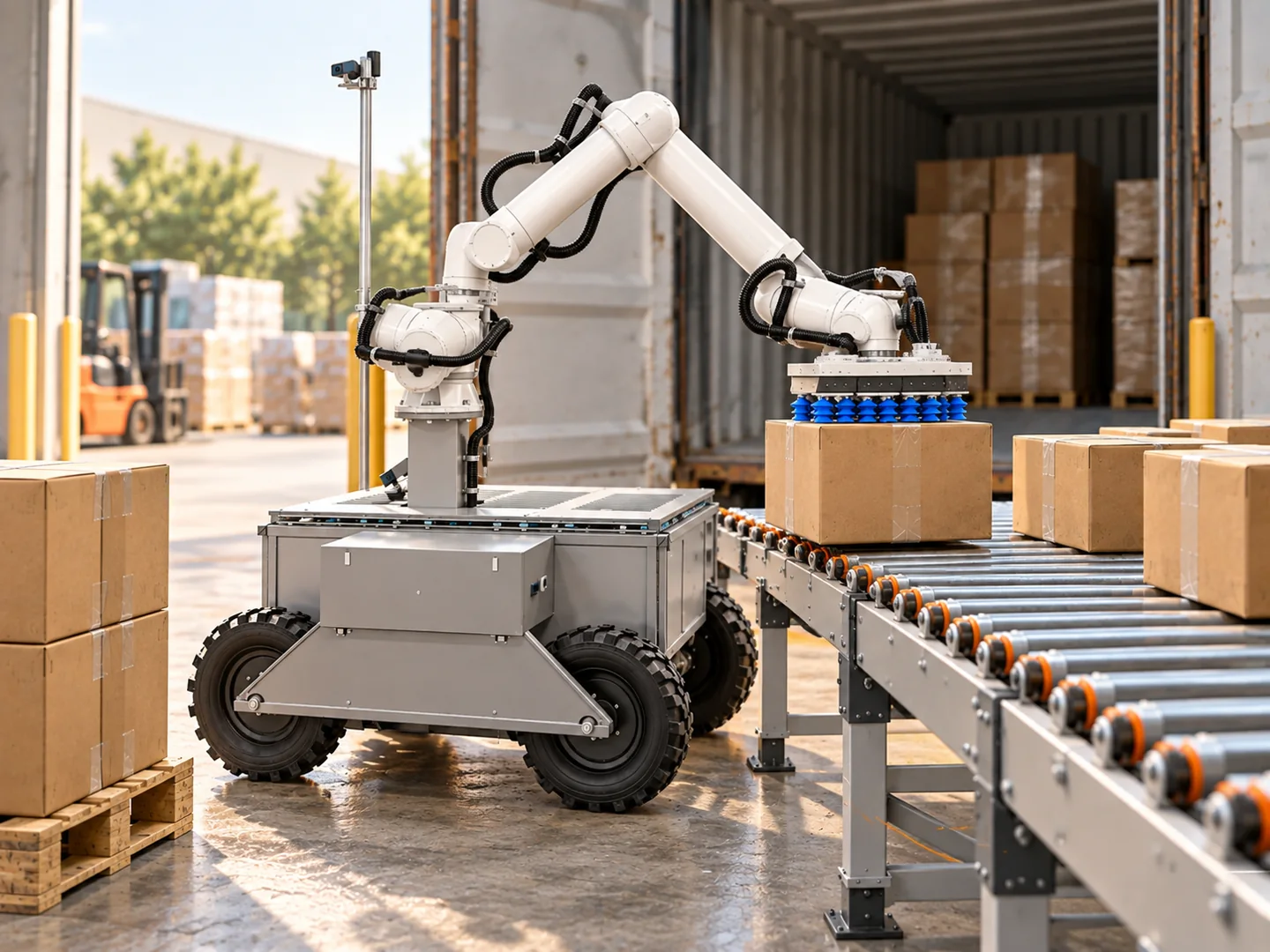
Container unloading equipment should match both the freight format and the task you want to change. For floor-loaded cartons, a conveyor moves boxes after extraction, a lifting aid assists the person handling them, and a carton-unloading robot can automate eligible extraction and transfer. A ramp provides access; it does not pick cartons from a load wall.
This guide compares equipment categories for emptying cartons from trailers and shipping containers at a warehouse. It does not cover lifting the shipping container itself, unloading a vessel or pumping goods from drums.
Identify the handling unit before choosing equipment
Ask what arrives at the dock: loose closed cardboard boxes, palletised cartons or another load format. Equipment described as a container unloader may address very different jobs.
For palletised freight, the handling unit is normally the pallet. For floor-loaded freight, individual cartons need extraction before they can enter a conveyor or pallet-building process. Review the floor-loaded freight and pallet comparison if the inbound format varies by supplier.
Also separate the job into extraction, transport, inspection, identification and palletising. Buying equipment for one stage does not establish that the other stages will become automated.
Compare what each equipment category actually changes
| Equipment category | Task it addresses | What still needs a plan |
|---|---|---|
| Ramp or dock access equipment | Access between the yard, vehicle and warehouse | Carton extraction and the approved access arrangement |
| Conveyor, including telescopic configurations | Transport from the extraction point to receiving | Who picks each carton and whether receiving can keep up |
| Operator-controlled lifting aid | Assistance with gripping and moving suitable goods | Operator coverage, application fit and downstream work |
| Carton-unloading robot | Automated extraction and transfer within the supported freight scope | Exceptions, receiving, site integration and support |
| Pallet-handling equipment | Moving freight already supported on pallets | A separate method for loose cartons |
TAWI’s Container Unloader is a manufacturer example of vacuum-assisted handling with a conveyor or pallet destination. Its operator-led workflow illustrates a different category from autonomous carton extraction. Confirm the exact model and application instead of treating every product called an unloader as equivalent.
For an autonomous category example, Boston Dynamics describes Stretch as a trailer and container unloading system. Compare supplier workflows and tested freight coverage using the robot comparison guide; this article owns the broader equipment-category decision.
Check the vacuum lifting application in detail
If an operator-guided lifting aid is on the shortlist, use the vacuum lifter container-unloading checklist to verify contact access, working envelope, equipment repositioning and the receiving route. The vacuum carton lifting guide explains the difference between lifting assistance and a robotic handling system.
Start with the constraint that causes the delay
If people spend most of their time carrying extracted cartons, shortening that transport path may address the constraint. If repetitive extraction occupies the team while the conveyor has spare capacity, investigate assisted or robotic handling. If receiving repeatedly stops the infeed, faster extraction alone may increase queues.
Observe complete loads and record where the time goes. Do not infer the bottleneck from a short clip showing the busiest person or fastest machine. The unloading-time guide separates extraction time from complete dock occupancy.
Record the remaining labour for every option: preparation, extraction, equipment operation, pallet exchange, sorting, damage review and final reconciliation. One operator on the equipment does not necessarily mean one person for the entire receiving job.
Compare two receiving layouts
These are responsibility diagrams for planning, not a drawing of a customer installation. Confirm dimensions, access, utilities, safe separation and interfaces against an actual site survey before selecting equipment.
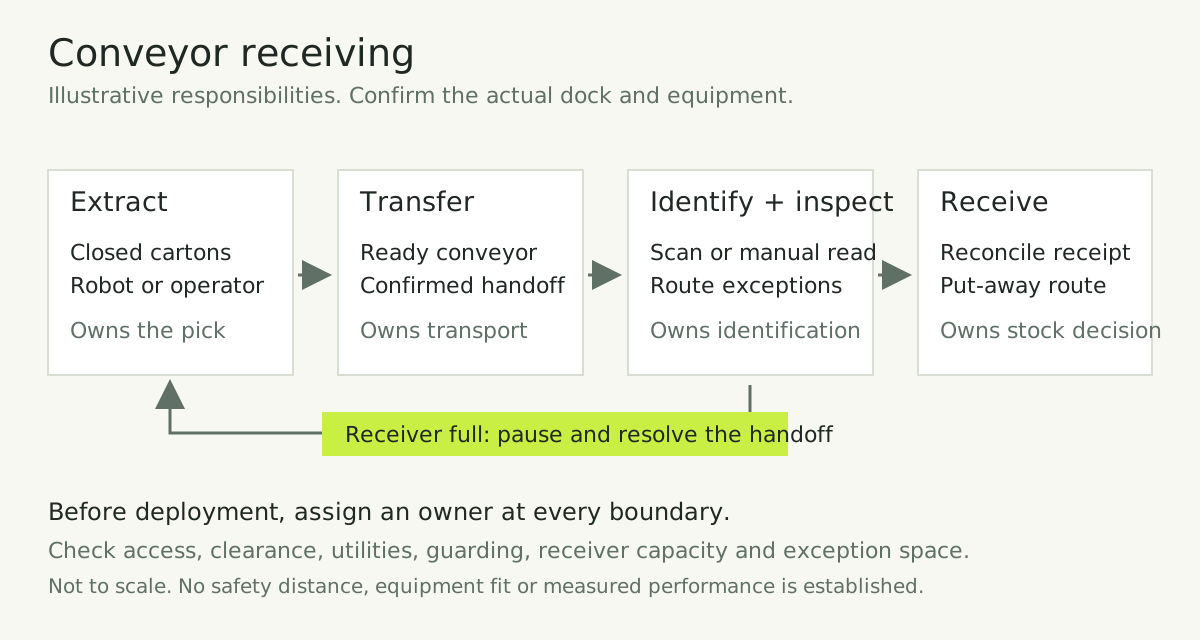
In the conveyor route, a person or assessed robot extracts cartons. The receiving-line owner provides the available transfer position and transport. Assign scanning or manual identification and exception routing to the receiving team or its specified equipment. Agree which signal stops extraction when the receiver is full.
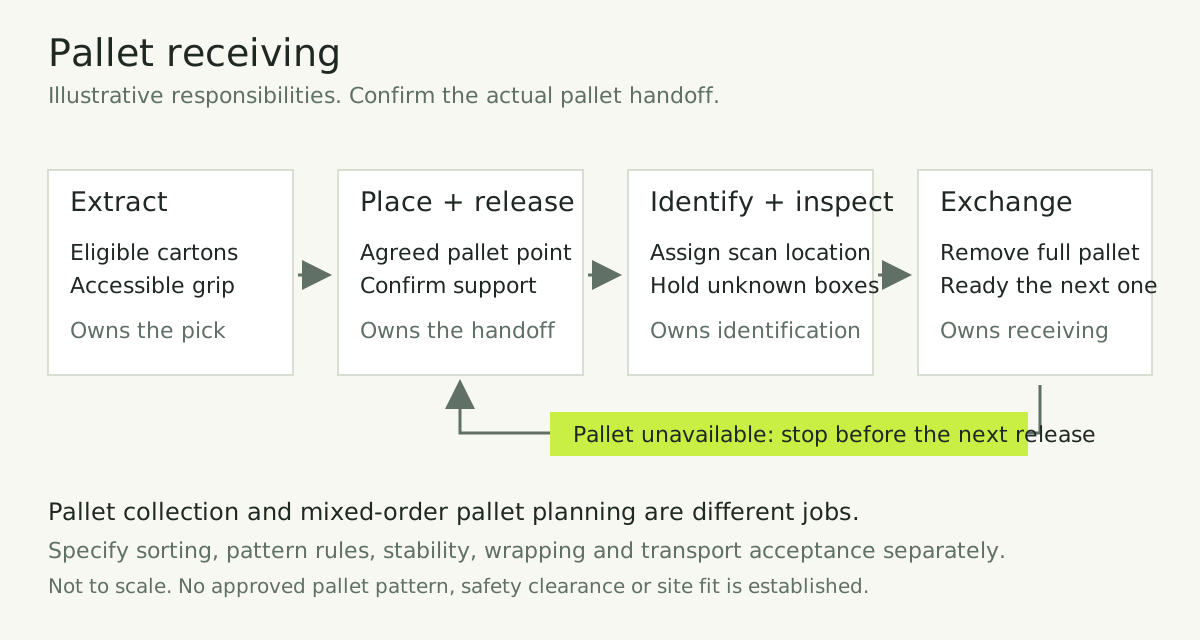
In the pallet route, the unloading supplier and warehouse agree the receiving position and release conditions. The warehouse or integrator assigns carton identification and pallet exchange. If a finished shipping pallet is required, separately specify its pattern, load rules, wrapping and acceptance. KRONA U1 provides conveyor or pallet handoff within its assessed scope; the handoff guide develops those boundaries.
Check the bottleneck with the same time boundary
Hypothetical example: extraction supplies six cartons per minute while identification and receiving accept four per minute during the same uninterrupted window. Over ten minutes, 60 arrive and 40 leave, adding 20 waiting cartons if all are retained. A buffer with 20 free positions covers only that ten-minute mismatch; it does not make the four-carton station a six-carton process. Allow separately for any carton already in transit and the physical layout.
Either raise the constrained stage’s accepted output, pace extraction, or change the agreed route. Use the dock survey and line-capacity guide before assigning a throughput benefit. If manual extraction is irregular but carrying dominates the workload, a conveyor or operator-controlled lifting aid can remain the appropriate trial.
Use a freight-and-workflow shortlist
Hypothetical equipment assessment: a warehouse receives ten deliveries a week. Six contain repeated closed-carton profiles, two contain pallets and two contain mixed loose goods. A carton-unloading robot proposal should investigate the six potentially relevant deliveries first, rather than use all ten as its automation volume.
If those six deliveries account for 18 of the warehouse’s 40 weekly unloading labour-hours, the initial addressable workload is 18 hours. It is not a forecast of 18 hours saved: preparation, assistance and receiving work may remain. The pallet and mixed-goods deliveries need their own handling routes.
Now ask whether the six carton deliveries share suitable dock access and a receiving destination. A good carton match at an unavailable dock is still an incomplete project.
Bring evidence to an equipment trial
Prepare representative filled cartons, dimensions, measured weights, packaging condition, photographs of load walls and the current receiving layout. Include troublesome cartons as well as the easiest profile.
Compare alternatives against the same finish point and load sample. Record elapsed time, labour-hours, cartons completed, waiting time and exception handling. A trial that excludes pallet exchange cannot support a complete receiving-time comparison against a manual job that includes it.
Download the equipment comparison worksheet to record scope, evidence and remaining work for each option. Keep unresolved compatibility questions visible until the supplier has assessed them.
Where KRONA U1 belongs in the shortlist
KRONA U1 is a mobile robot for eligible floor-loaded, closed cardboard boxes, with conveyor and pallet unloading modes. Its public maximum box weight is 25 kg and maximum working rate is 10 boxes per minute. Those limits do not establish fit for every carton or sustained receiving output.
The same KRONA U1 also loads containers with boxes from pallets or conveyors. For a loading project, share the carton profile, box-supply layout and required container loading sequence.
Use the freight-fit guide to qualify carton condition and access, then provide the load and dock evidence for a project assessment. KRONA U1 is relevant when the project needs carton extraction and transfer; a pallet-only workflow requires a different assessment.
Does adding a conveyor remove manual extraction?
A conveyor can transport boxes from the picking point while a person still removes each box from the container. Ask who performs the pick and which handling steps remain. Assess the whole workflow before assigning a labour benefit.
Can a warehouse use different equipment for different loads?
Yes, a project can plan separate routes for eligible cartons, pallets and freight needing manual or assisted handling. Confirm the layout, responsibilities and availability of each route. Equipment sharing across docks also needs a movement and scheduling plan.
Send KRONA your carton profiles and receiving layout to assess whether robotic unloading belongs in your equipment shortlist.
- container unloading
- warehouse operations
- equipment selection
KRONA U1 unloads boxes from containers onto pallets or conveyors and also loads containers with boxes from pallets or conveyors. Explore KRONA U1 →
Assess which unloading equipment fits your cartons