
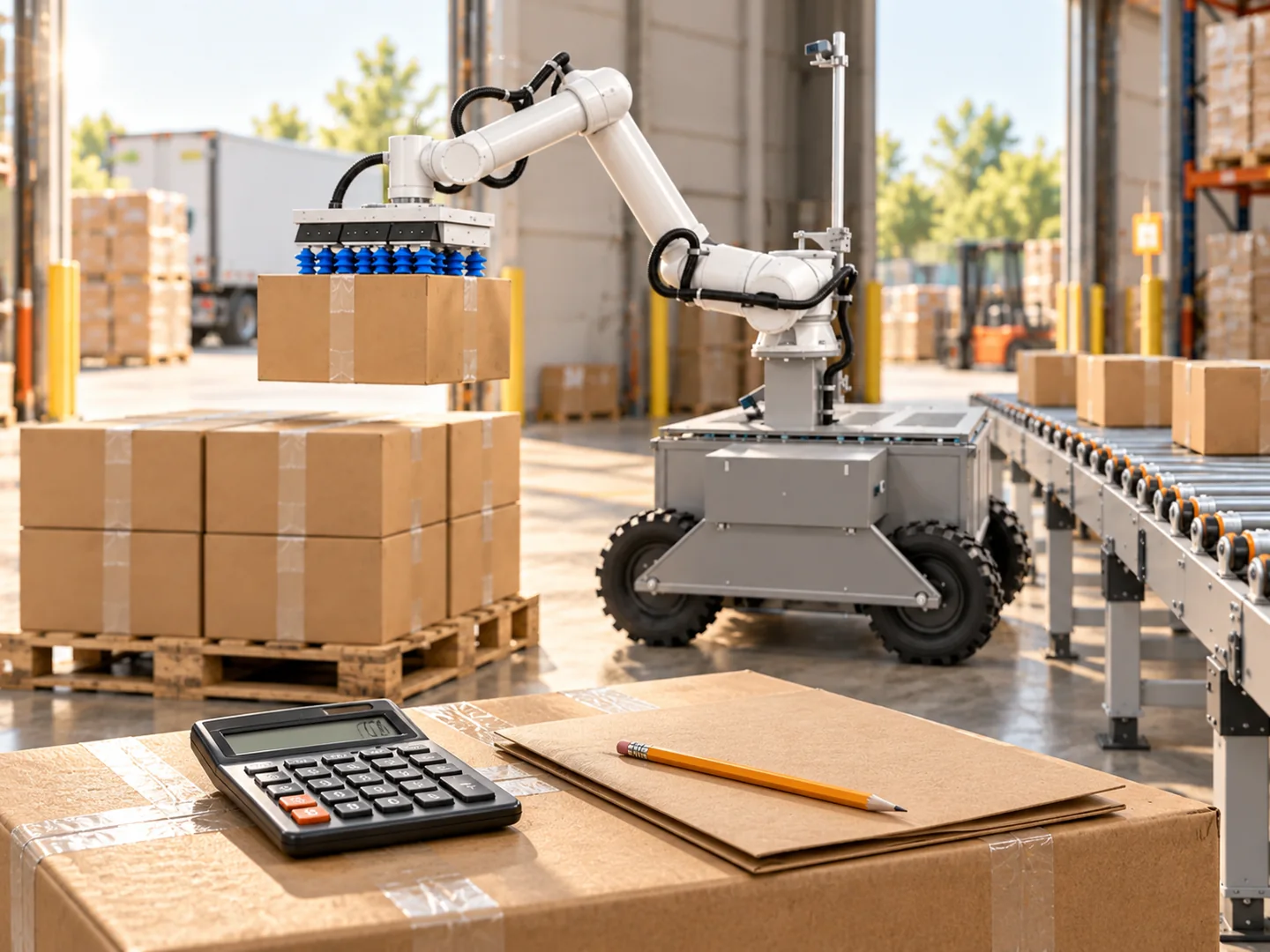
The cost of unloading a container is not simply the hourly wage of the unloading crew. An automation assessment has to measure the complete operation: the number of people involved, how long the dock is occupied, how often work stops, and how the task affects the rest of the shift.
What goes into cost per container?
Use total measured process cost ÷ completed containers for a consistent freight group and time period. Include the full crew, supporting activities and the equipment or service used within that boundary. Keep refundable deposits and financing cash requirements separate from operating expense.
For example, an assumed three-person crew working three hours at €10 per person-hour gives €90 of direct labour per container. That is a labour subtotal, not a market price: forklift time, contractor fees, damage handling and equipment may still need adding. The worked scenario below shows how those baseline inputs compare with a tailored KRONA rental quote.
Start with a representative load
Do not choose the cleanest or the most difficult container. Select a load that represents the package types, weights, and loading pattern your operation receives regularly.
Record:
- container or trailer type;
- total package count;
- package weight and size ranges;
- crew size;
- time from dock preparation to the final box;
- stops and their causes;
- packages that require damage handling or repacking.
One measurement describes a load, but not the variation of the process. A better baseline comes from several shifts and freight profiles.
Direct labour
The simple calculation is:
crew size × unload hours × the complete employer cost per hour
Use the complete cost to the employer rather than take-home pay. If a supervisor, forklift driver, or temporary worker contributes to the unload, measure that time separately.
For context, Eurostat’s 2025 whole-economy estimates, published in March 2026, range from about €12 to €57 per employer-paid hour across EU countries. They are not warehouse wages, an unloading-crew quote or a recommended KRONA input. A rounded €15–40 per person-hour sensitivity band is a planning choice within that broad context, not a published warehouse benchmark. Replace it with your country, shift and employer costs before making a decision.
Dock occupancy
A slow unload has a cost even when an additional labour hour appears inexpensive. An occupied dock can:
- delay the next inbound truck;
- create yard queues;
- move work into overtime;
- reduce receiving capacity;
- disrupt sortation and put-away.
Measure the complete dock-occupancy window, not only active lifting time.
Process variation
The average is not enough for an automation case. If one container takes two hours and a similar load takes four, the warehouse has to plan around the risk, not only the mean.
Track:
- median unload time;
- duration of the slowest 10% of loads;
- variation between shifts;
- days affected by labour shortages;
- number and duration of stops.
Package care
Damage does not always mean an immediate product write-off. Additional cost can come from:
- repacking;
- manual sorting;
- claim photographs and administration;
- a slowed conveyor;
- customer service.
Package damage must be measured alongside throughput during a robotic pilot. Speed is not valuable when boxes are regularly dropped or deformed.
Create the baseline
Before a pilot, maintain one table with these fields for every representative load:
- package count;
- complete unload time;
- labour hours;
- stopped time;
- damage events;
- additional handling;
- dock waiting time.
Only then can the manual and robotic processes be compared honestly.
Compare manual, assisted and robotic costs
| Approach | Cost categories to include |
|---|---|
| Manual unloading | All participants’ labour, agency or contractor fees, stops, damage and dock occupancy |
| Conveyor or lifting assistance | Equipment purchase/rental, installation, maintenance, utilities and the labour still required |
| Robotic unloading | Robot purchase or service, integration, utilities, supervision, exceptions and downstream handling |
A conveyor may reduce carrying while people still extract cartons. A robot may reduce lifting while preparation, pallet replacement and exceptions remain. Add these remaining activities to the business case.
Purchase versus a rental or service plan
With a capital purchase, compare the complete installed cost, financing or depreciation, maintenance and support. With rental or robotics as a service, compare recurring charges, minimum usage, deployment scope and responsibilities. Neither model alone proves savings.
For the service agreement itself, use the warehouse robotics-as-a-service checklist. It covers billing definitions, support ownership, changed freight and end-of-term questions separately from the unloading baseline.
KRONA offers pay-per-use rental at an hourly rate, with a one-time installation fee. We can also supply conveyors. Your rate, equipment scope and terms are confirmed in a tailored quote after freight and site assessment. Robot purchase offers are provided privately to integrators. Use the planning calculator to explore assumptions, then confirm project costs in your proposal.
Build a purchase-versus-rental ownership worksheet
Compare both options over the same operating period and include the activities that remain around the robot. Robotics as a service changes how equipment is paid for; it does not remove site, labour or support costs from the assessment.
| Cost or cash item | Purchase model | Rental model |
|---|---|---|
| Robot | Private integrator quotation | Usage charges at your quoted hourly rate |
| Recurring charge | Software terms in the private integrator offer | Operating hours and any commitment agreed in your offer |
| Initial deployment | Obtain the purchase implementation quote | One-time installation fee quoted for your site |
| Refundable cash requirement | Confirm in the applicable purchase offer | Any deposit and refund terms confirmed in your offer |
| Site and interfaces | Utilities, installation work and agreed receiving integration | The same application-specific categories |
| Residual operation | Preparation, supervision, exceptions and pallet/conveyor work | The same measured activities |
| Service and end of term | Confirm support, maintenance and ownership responsibilities | Confirm support, maintenance, return and deposit conditions |
For uneven rental usage, apply any agreed minimum month by month. At a constant rate r, annual usage charges are r × the sum of billable hours in each active month. Confirm how billable hours are defined in your offer.
Add the one-time installation fee, conveyor supply and receiving integration to the same operating period. Record any refundable deposit separately as upfront cash. Compare support scope, site work, utilisation, financing, service and residual value using project-specific inputs.
Confirm final terms in the deployment enquiry. For an integrator’s client quote, identify separately which costs belong to KRONA, the integrator and the warehouse; submit the project scope before committing to a commercial model.
Work through an unloading scenario
Start with your measured annual container volume, crew size, unload time and fully loaded labour cost. Estimate eligible freight coverage and robot operating hours using representative carton tests, then apply the hourly rate and installation fee from your quote.
Use the planning calculator to explore changes in volume and unload time. Its results are planning estimates. Confirm the commercial assumptions in your tailored offer before using them in a project budget.
Compare quiet, regular and busy utilization
The following hypothetical quote exercise is not KRONA pricing or a market average. It deliberately holds one deployed robot and twelve evenly used months constant. Assume €20 per operating hour, a 60-hour monthly minimum, two robot-hours per eligible container, €2,000 installation and a €1,000 refundable deposit. Allow another €10 per container for additional operation and compare with a €90-per-container manual baseline. These invented values demonstrate the arithmetic; replace them with measured costs and an actual offer.
| Twelve-month scenario | Quiet | Regular | Busy |
|---|---|---|---|
| Eligible containers/year | 120 | 480 | 960 |
| Actual robot operating hours | 240 | 960 | 1,920 |
| Billable hours after monthly minimum | 720 | 960 | 1,920 |
| Usage cost at the assumed rate | €14,400 | €19,200 | €38,400 |
| Additional operating allowance | €1,200 | €4,800 | €9,600 |
| First-year modeled cost, including installation | €17,600 | €26,000 | €50,000 |
| Same-volume manual baseline | €10,800 | €43,200 | €86,400 |
| First-year modeled difference | €6,800 more cost | €17,200 lower cost | €36,400 lower cost |
The deposit is excluded from cost and savings because it is assumed refundable; together with installation, it creates €3,000 of initial cash requirements before any usage payment. The table excludes tax, financing and unpriced site/interface work. The additional allowance is a budget input, not a measured staffing, energy or maintenance requirement. Confirm whether it covers all remaining work for the same baseline boundary.
The quiet case is uneconomical under these assumptions. Below 360 containers/year, the minimum fixes annual usage cost at €14,400. Including installation, the simplified first-year break-even equation is €90 × containers = €16,400 + €10 × containers, giving about 200 containers/year (205 with these exact inputs). More assistance, higher setup or uneven monthly use raises the threshold. The busy case also requires sufficient scheduled robot, dock and receiving capacity; this table does not establish that capacity.
Use the calculator’s editable rate, minimum, fees, eligible share and additional annual cost to explore your own offer. This table explicitly compares deploying one robot even when it loses money; a fleet model may instead recommend retaining manual handling at low volume. Neither option turns released employee time into cash savings unless overtime, contractor charges or other actual payments fall. Keep useful additional capacity as a separate outcome.
Keep recurring usage costs, first-year installation costs and any refundable cash requirements separate. Add site changes, utilities, remaining operator assistance, damage and receiving activities before making a deployment decision. Verify freight coverage, sustained unload time and staffing during the pilot.
What does Boston Dynamics Stretch cost?
Public Stretch pricing was not verified on the manufacturer unloading page reviewed on 2 October 2026. Obtain a current project quote including installation, integration and support. Do the same for Pickle Robot or any other shortlisted system.
Open the calculator with your baseline, then request a freight assessment. The selection guide and supplier comparison cover the operational questions behind the numbers.
To turn a verified baseline into an investment decision, use the warehouse automation ROI and payback guide. If a separate downstream palletizing cell is required, build its own budget with the palletizing robot quote checklist.
- container unloading
- warehouse automation
- ROI
KRONA U1 unloads boxes from containers onto pallets or conveyors and also loads containers with boxes from pallets or conveyors. Explore KRONA U1 →
Open unloading calculator