
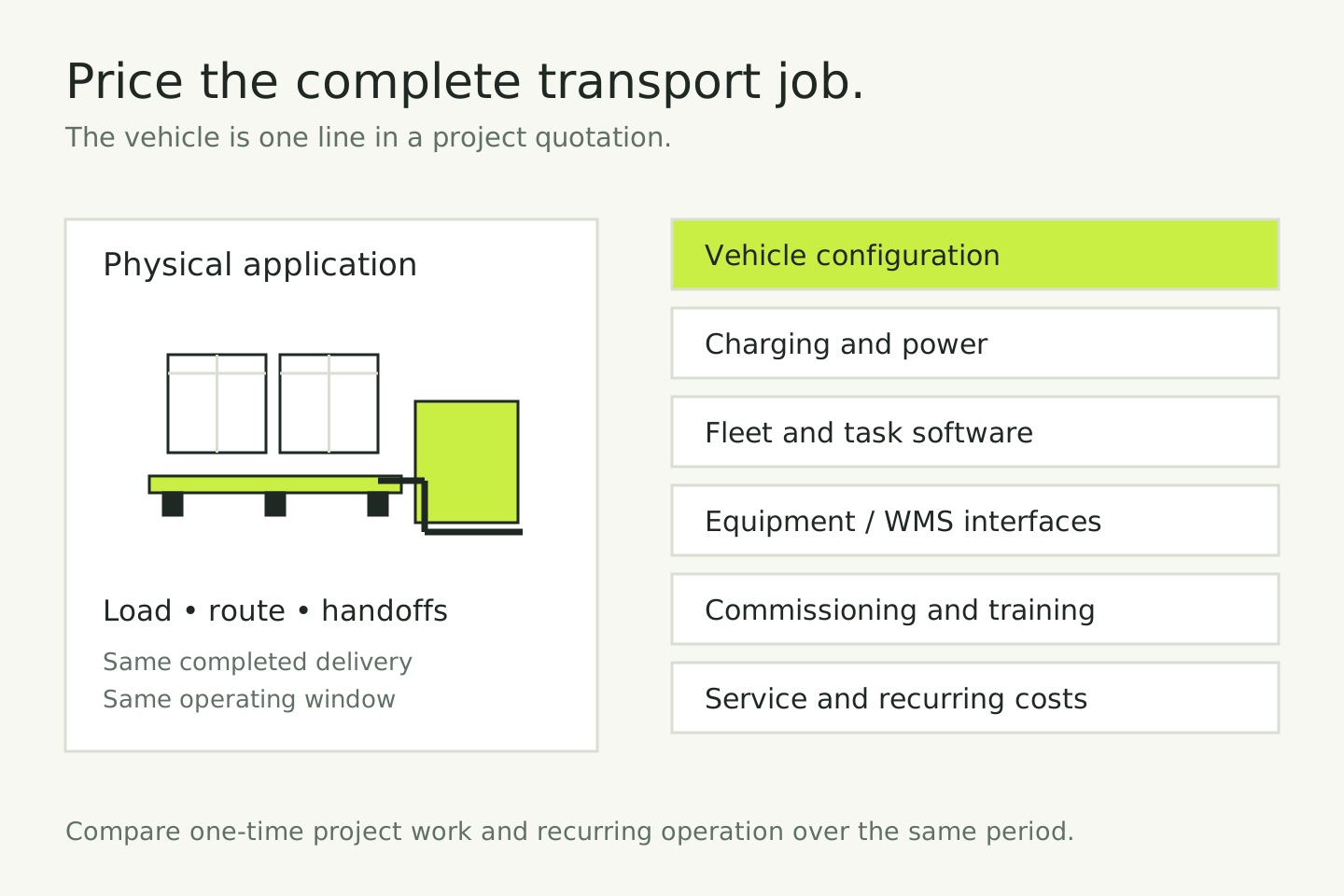
An AGV forklift price can describe a vehicle, an automated handling package or a commissioned warehouse application. Compare proposals against the same pallet moves, shift workload and acceptance requirements. The vehicle price alone does not show the cost of obtaining the required flow.
KRONA supplies KRONA-branded AGV and autonomous-forklift solutions. A project proposal identifies the selected equipment and the work needed around it; use this guide to prepare comparable scope rather than relying on an unqualified online price range.
Define one transport job before requesting prices
Record the load unit, pickup and delivery positions, route, storage requirements and operating schedule. Floor-to-floor pallet movement differs from rack access or trailer loading. Include pallet openings, load overhang, mass distribution and the condition of the actual pallets.
Count loaded deliveries and the other work needed to perform them: return travel, empty-pallet movements, waiting at a handoff and charging. Record peaks within the shift rather than only a daily total. A lower-priced vehicle that cannot perform the required pickup or meet the busiest window is not a like-for-like alternative.
The AGV versus AMR comparison separates navigation behaviour from load-handling capability. Use the KRONA forklift application page to identify the operating questions behind the model selection.
If the job uses a low-profile lifting AGV, include the compatible carriers and stations in the quotation. Price the carrier quantity, lifting interface, entry clearance and return/circulation arrangement alongside the vehicle. A carrier-based offer should not be compared with direct floor-pallet fork handling as though the supplied work were identical.
Ask for a complete quotation breakdown
| Cost category | Ask the proposal to identify | Comparison check |
|---|---|---|
| Vehicles and load handling | Number, selected configuration and included equipment | Same load, pickup, delivery and storage duty |
| Charging and power | Charging hardware, installation and operating arrangement | Same working schedule and available charging windows |
| Navigation and site preparation | Mapping, route setup and required physical changes | Same route and working environment |
| Fleet and task software | Licences, supported functions, hosting and updates | Same number of vehicles, missions and interfaces |
| Equipment handoffs | Pallet positions, sensors, conveyors, doors and control work | Named supplier for every interface |
| Warehouse-system integration | Task exchange, status reporting and recovery behaviour | Defined records and transaction owners |
| Commissioning and training | Representative application tests and operator/maintenance training | Agreed completion evidence |
| Service and recurring costs | Maintenance, consumables, support, software and energy | Same time period, operating assumptions and exclusions |
Keep equipment purchase, one-time project work and recurring operation separate. Mark an unresolved item as unpriced or excluded; a blank cell does not establish that it is included at no charge.
BALYO’s integration FAQ describes IT integration as project-specific. It is a useful market example of why software and site work need their own scope, rather than evidence of a particular KRONA interface or tariff.
Check the workload behind the proposed fleet size
This hypothetical workload example demonstrates arithmetic, not vehicle performance or a fleet recommendation. Suppose a shift requires 180 completed loaded deliveries. The assumed full mission averages nine minutes, including collection, loaded travel, placement and allocated empty travel. That is 1,620 vehicle-minutes of work.
If the planning assumption allows 420 productive minutes per vehicle in that window, the workload alone requires at least four vehicles: 1,620 ÷ 420 = 3.86, rounded up. This simplified calculation does not resolve traffic conflicts, concentrated peaks, charging constraints or unavailable pickup positions. Actual mission measurements and scheduling can change the selected fleet.
Ask each proposal to state its mission boundaries and assumptions. Comparing a fleet sized using travel alone with one sized using completed deliveries can make the first offer appear cheaper without buying the same output.
Compare cost over the same period
For a purchase comparison, a simple undiscounted cost structure is:
period cost = one-time project costs + recurring costs over the selected period
List vehicle-related costs, fleet-wide costs and site-wide costs separately. A software or integration line may be shared across the fleet; do not multiply it by the number of vehicles unless the commercial terms require that. Include replacement, finance or end-of-term costs when they apply to the proposal being compared.
For rental or another usage-based offer, compare the actual quoted commitment, included work, service, operating limits and exit terms. Do not carry the U1 container-handling rental assumptions into an AGV proposal. They concern different equipment and applications.
Separate a saving from time released
A robot may release operator time while the same people remain on the same paid schedule. That can improve capacity or working conditions without immediately reducing cash expenditure. Include overtime, agency labour or other avoidable costs only when the operating plan can actually change them.
Use the same boundary for the current and proposed workflow. If the proposal still requires pallet preparation, inventory confirmation and exception handling, retain that work in the model. The warehouse automation ROI guide covers benefit categories and payback without double-counting.
Submit a quote-ready KRONA application brief
Bring a route layout, actual pallet/load examples, shift and peak movement counts, pickup/drop details, storage duty, charging opportunities and the warehouse-system owner. Add the destinations that must remain available and the expected response when a mission cannot finish.
Ask for an itemised offer with explicit inclusions, responsibilities and a representative acceptance test. For carton unloading, pallet building and onward pallet movement together, request a warehouse AGV systems assessment so the quotation addresses the complete receiving flow.
- autonomous forklifts
- warehouse automation
- ROI
KRONA U1 unloads boxes from containers onto pallets or conveyors and also loads containers with boxes from pallets or conveyors. Explore KRONA U1 →
Request a KRONA forklift project proposal