
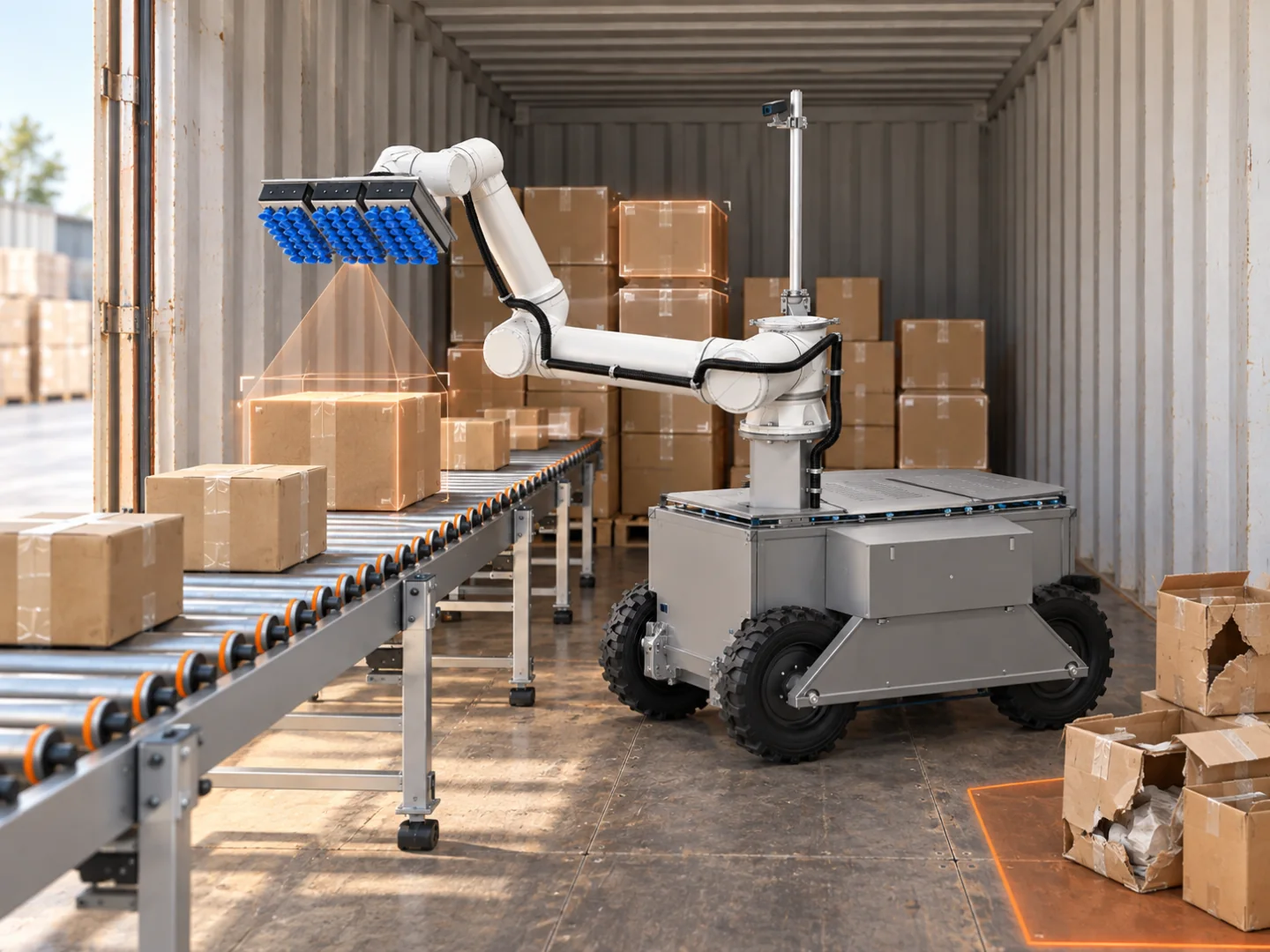
Container devanning means removing goods from a shipping container. Destuffing, de-stuffing and stripping are also used for the process. For floor-loaded boxes, it often involves taking cartons out individually and transferring them into receiving.
A devanning operation can use people, lifting assistance, conveyors or robotic unloading. The practical choice depends on the freight, the dock and what happens after the goods leave the container.
If you need a crew to empty one delivery, that is a different purchase from equipment for recurring carton unloading. KRONA assesses the complete unloading robot for eligible closed cartons; it does not offer an outsourced manual devanning crew. Start with the share of your recurring loads that match the freight-fit criteria, then compare their measured unloading costs.
Separate the container from its contents
Unpacking goods is different from lifting a shipping container off a vehicle. It is also different from driving out a stable pallet with a forklift or discharging bulk material.
An industry explanation from THG Warehousing describes devanning as unloading the goods. In an automation brief, go further and specify whether those goods are floor-loaded cartons, pallets or another freight type.
A project labelled only “automatic container unloading” may otherwise attract proposals for a different handling task.
Compare the carton-unloading methods
| Method | Main role | What to measure |
|---|---|---|
| Manual carton handling | People select, lift and transfer the boxes | Total labour time, damage, stops and dock occupancy |
| Conveyor-assisted handling | A line carries cartons after people or equipment extract them | Extraction work and receiving-line capacity |
| Vacuum-assisted manual lifting | A lifting device assists an operator handling suitable packages | Operator work, accessible grip faces and package suitability |
| Robotic carton unloading | A system detects, grips and transfers eligible boxes | Freight coverage, sustained flow and exception handling |
A conveyor can reduce carrying distance while leaving extraction manual. A vacuum lifter can assist lifting without automating the whole task. Distinguish those changes when estimating the remaining work.
For the freight-format comparison, read floor-loaded freight vs pallets.
Which freight can fit robotic devanning?
Start with a sample of the closed cartons that actually arrive: filled weights and sizes, board condition, tape, labels and the loading pattern. Determine which faces are accessible and whether a box can be extracted without destabilising the surrounding freight.
Open, wet, heavily damaged or unstable packages may need another process. A system’s payload limit alone does not establish grip suitability.
The carton-gripper selection guide explains how the accessible surface and complete movement affect a vacuum pick. The freight-fit guide covers the broader container and site conditions.
Decide where the cartons go
Devanning does not end at the container door if receiving still has to scan, inspect, sort or palletise the goods. Define the handoff and include its capacity in the unloading assessment.
A continuous carton stream may suit an existing conveyor. A batch receiving process may collect cartons on pallets. A separate palletizing cell adds another interface and an owner for pallet patterns.
Use the conveyor-or-pallet workflow guide to compare these routes. Measure the availability of receiving during the actual shift, including other work sharing the same line.
Build a baseline for the complete operation
For several representative containers, record the package count, preparation, active unload time, interruptions, operator hours and time to clear the dock. Record damage and extra handling separately.
If a contractor charges per container, identify what that charge includes. If your team performs the task, include all participants’ time rather than only the person lifting the boxes.
A faster extraction rate does not automatically reduce total cost if receiving waits for pallets or a blocked conveyor. The unloading cost guide and calculator help compare the same process boundaries.
Retain a record for each recurring delivery
The container-unloading checklist separates preparation, extraction, exceptions and receiving closure. Use its printable load record to retain the actual finish point and unresolved cartons for the next shift.
This creates the process evidence needed to compare devanning options. A delivery count alone does not show whether the work ended at extraction, inspection or accepted receipt.
Questions for a 3PL or automation integrator
Before requesting a robotic-devanning proposal, confirm:
- Who operates the dock and can change the process?
- How many containers or trailers arrive regularly, and on which shifts?
- What share contains floor-loaded closed boxes?
- What carton types, weights and conditions dominate that share?
- Where must the extracted goods go?
- Who prepares the freight and handles exceptions?
- Which measures will determine whether a pilot can proceed?
A logistics coordinator may arrange transport without controlling the warehouse operation. Include the person who owns unloading and receiving in the assessment.
Estimate the unload window without treating container size as capacity
Container length does not tell you carton count. Build the estimate from the actual count and a rate whose time boundary is stated.
Hypothetical example: a load has 1,200 cartons and the proposed process completes six cartons per minute during uninterrupted flow. The flow-time estimate is 1,200 ÷ 6 = 200 minutes. If separately measured preparation and clearance take 20 minutes and non-overlapping stops total 25 minutes, the dock window becomes 245 minutes, or four hours and five minutes.
Do not add the 25-minute stop allowance if the six-carton rate was already measured across those stops. Also identify who handles excluded freight: six cartons per minute for eligible boxes does not establish the duration of the complete mixed load.
For recurring arrivals, compare that window with the next booked vehicle and the receiving line’s availability. Use the line-capacity worksheet for queues and buffers, then collect actual load times during the pilot.
Assess the complete KRONA unloading robot
KRONA U1 is designed for eligible closed cardboard boxes up to 25 kg in trailers and shipping containers, with conveyor or pallet handoff. It is a complete unloading robot rather than an outsourced manual devanning crew.
A freight and site assessment checks the operation before a trial. Bring representative carton details, recurring inbound volume, current unload times and the intended receiving route.
Does robotic devanning work for every container?
Suitability depends on the contents and site. A container with closed floor-loaded cartons presents a different application from one containing pallets, bags, drums or loose material. Confirm the eligible freight and exception process before using a robot scenario in the business case.
- container unloading
- floor-loaded freight
- warehouse automation
KRONA U1 unloads boxes from containers onto pallets or conveyors and also loads containers with boxes from pallets or conveyors. Explore KRONA U1 →
Request a freight assessment