
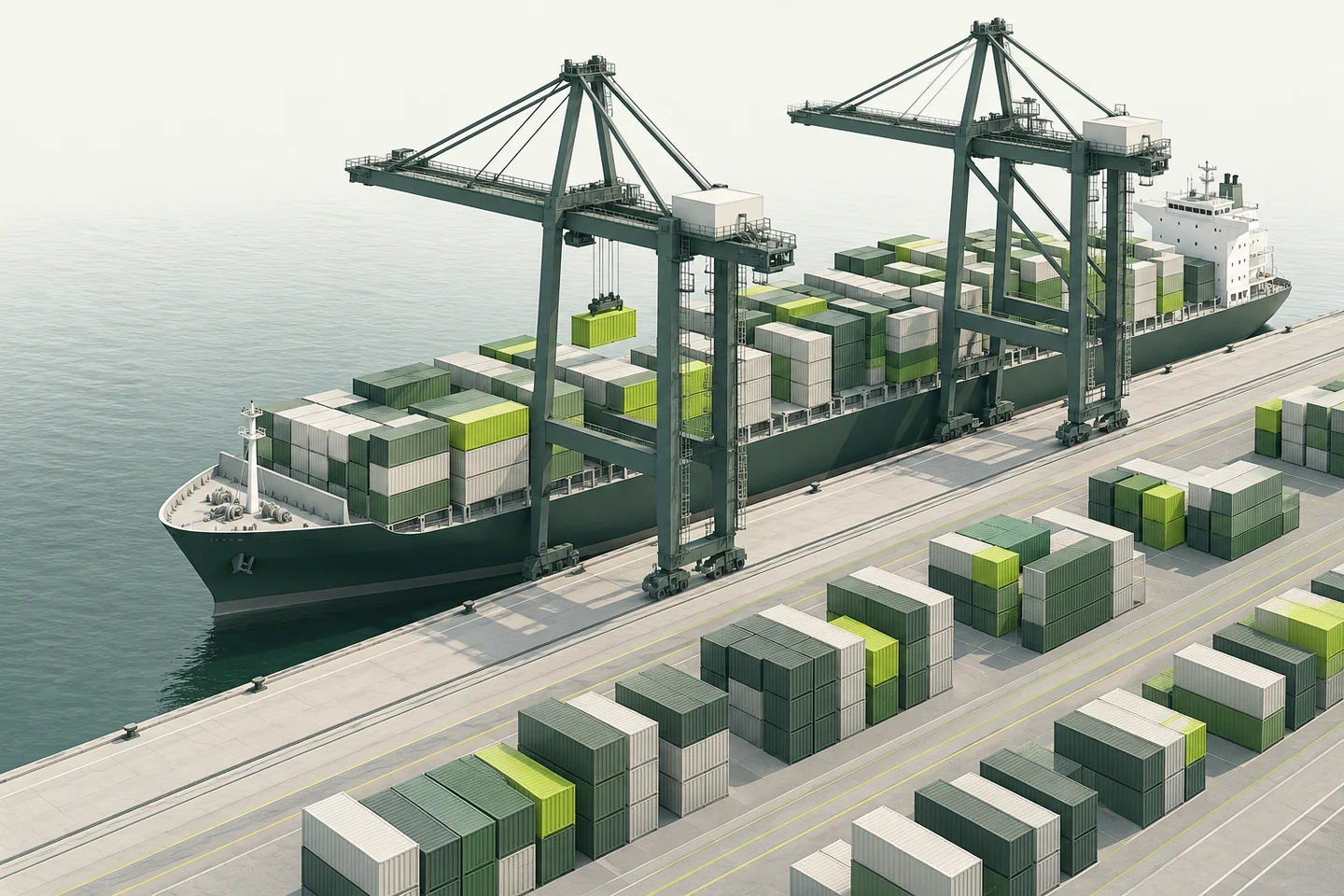
Unloading a container ship is a matter of hours to several days, depending on the cargo exchanged at that port and the cranes and terminal resources available. Time spent lifting containers is only part of the ship’s visit. Waiting for a berth, loading export containers and departure preparation can make the overall call much longer.
For a measured reference, World Bank data for 2024 show average total port times of 31.9–37.4 hours for calls involving 1,001–1,500 container moves in Spain, the UK and Germany. These are country-level port-call averages, including more than discharge. They do not predict when one imported container will be available for collection.
What published port data actually tells us
Table 5.1 of the World Bank’s Container Port Performance Index 2020 to 2024, published in 2025, gives the following measured averages. Call size counts container moves exchanged at the port, not the vessel’s total carrying capacity.
| Country | 1,001–1,500 moves per call | More than 6,000 moves per call |
|---|---|---|
| Spain | 31.9 hours | 119.0 hours |
| United Kingdom | 36.4 hours | 103.9 hours |
| Germany | 37.4 hours | 116.9 hours |
The larger-call averages above are approximately 4.3–5.0 days. These selected country averages illustrate variation; they are neither global discharge-time ranges nor warehouse booking allowances. The table does not give individual-call variability, so it cannot establish a safe buffer for a particular shipment.
The newer CPPI 2025 report, published in 2026, defines port time from arrival at the port limits or anchorage to departure from berth. It distinguishes that interval from cargo operations between the first and last container moves. The hour figures above remain explicitly 2024 observations, not 2025 measurements.
Separate the ship’s clock from your container’s clock
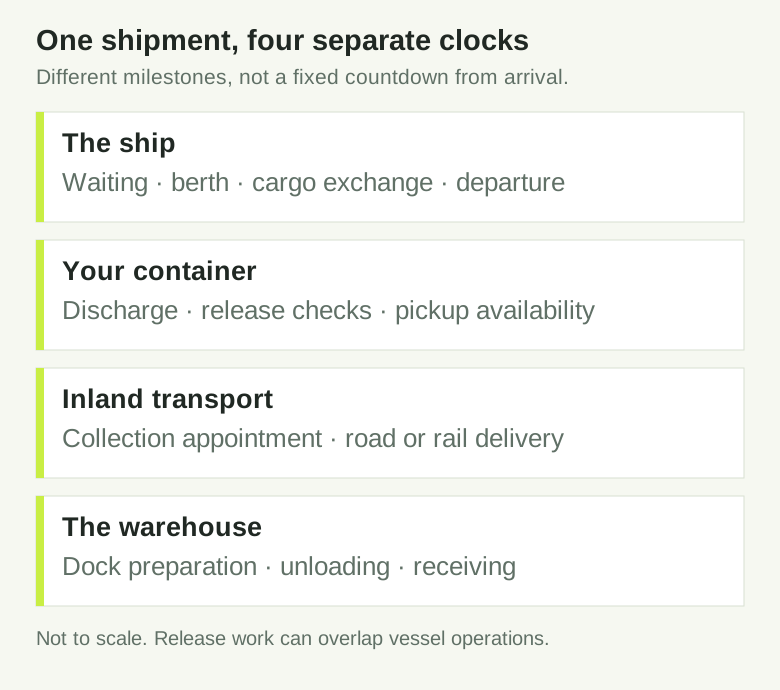
The ship may still be loading after your import container has been discharged. Equally, a discharged container can remain unavailable because a release, hold or collection requirement is unresolved. Maersk’s discharge explainer separates berthing, discharge, terminal transfer and release for this reason.
Use four milestones for the individual shipment: actual discharge, release or outstanding holds, pickup availability, and the confirmed inland delivery window. The fourth milestone belongs in the warehouse appointment plan.
Calculate crane discharge time from the work plan
For a discharge-only estimate:
Discharge interval = planned discharge crane moves ÷ average combined discharge moves per elapsed hour
Hypothetical example: the call requires 1,600 discharge moves, with one container per move. If the cranes together average 100 completed discharge moves per elapsed hour, the interval is 16 hours. At 80 combined moves per hour it becomes 20 hours. These are calculation examples, not terminal benchmarks.
Use the rate for the same measurement window. A combined elapsed-hour rate already includes the interruptions within that interval. An uninterrupted single-crane rate excludes other work, interference and stops; multiplying it by the maximum crane count can overstate sustained output. If the plan includes later loading, add that work when estimating completion of the vessel’s cargo operations.
The CPPI glossary distinguishes call size, cargo operations and gross crane productivity. Those boundaries help identify whether a supplier’s quoted rate answers your timing question.
Why ship capacity is the wrong denominator
A vessel’s advertised TEU capacity is not its discharge workload at the next port. TEU means twenty-foot equivalent unit: one 40-foot container represents two TEU, but does not automatically need two crane lifts. Some cargo remains aboard for another destination, and loading or restowage can add work during the call.
Use the actual planned moves and container sequence. The World Bank’s call-size definition includes discharge, loading and restowage. A total-call productivity figure therefore should not be labelled an import-discharge rate unless its scope supports that interpretation.
What can extend the unloading interval?
Five operational questions explain most of the inputs to request:
- Workload: how many discharge, loading and restow moves are planned at this call?
- Crane assignment: how many cranes can work productively at once, and over which shifts?
- Stow sequence: when is the relevant bay accessible, and where is your container in the plan?
- Landside flow: can terminal vehicles and storage areas accept the output from the quay?
- Interruptions: what weather, equipment or other restrictions affect the current operation?
The 2025 CPPI report’s discussion of supply-chain stress also describes how irregular arrivals and vessel bunching disrupt resource allocation. An annual average is useful context; it cannot replace the terminal’s current status for the specific call.
What to ask before booking the warehouse dock
Send the container number and vessel/voyage reference to the logistics provider handling the shipment. Request:
- The actual or expected discharge milestone for that container.
- Its release status and the owner of any outstanding documentation, inspection or hold.
- The pickup appointment or other terminal collection requirement.
- The booked inland transport and warehouse delivery window.
Record whether each update is estimated or confirmed and who will send the next change. If port availability is unresolved, keep the dock slot provisional and plan an alternative for delayed or bunched deliveries. Your container can become available before the vessel finishes all cargo work, so waiting for the ship’s departure is not a universal collection rule.
How long will unloading take at the warehouse?
For floor-loaded cartons, use carton count and the measured completed-carton rate, plus preparation and clearance outside that rate’s window. For example, 1,200 cartons ÷ six cartons per minute = 200 minutes. Adding 35 minutes for preparation and clearance gives 235 minutes, or 3 hours 55 minutes.
That example assumes extraction waits and carton exceptions are already included in the six-carton rate. It is hypothetical, not KRONA performance evidence. Palletized goods require a different handling assessment.
Use the warehouse unloading-time guide for the full method and recording worksheet. If several containers arrive together, the peak-arrival capacity guide tests complete-load occupancy, dock windows and receiving resources.
KRONA U1 addresses assessed closed-carton unloading after delivery to a warehouse. It does not handle intact containers at a seaport or accelerate port release. For a seasonal warehouse shortfall, the robot rental guide explains deployment, complete cost and return arrangements.
Common container-ship timing questions
Does a larger ship always take longer to unload?
No fixed multiplier follows from vessel capacity. Compare the cargo exchanged at the port and the resources assigned. A large vessel need not discharge its entire cargo at one call.
Is vessel arrival the same as container availability?
No. Berthing, your container’s discharge, terminal transfer and release still have separate milestones. Use the shipment’s pickup and transport status to plan inland delivery.
Can the port-call averages above predict my container’s pickup day?
No. They describe past country-level averages for defined workloads. They do not identify your container’s position in the discharge sequence, outstanding holds or booked inland transport.
- container unloading
- warehouse operations
- capacity planning
KRONA U1 unloads boxes from containers onto pallets or conveyors and also loads containers with boxes from pallets or conveyors. Explore KRONA U1 →
Assess unloading after the container reaches your warehouse