
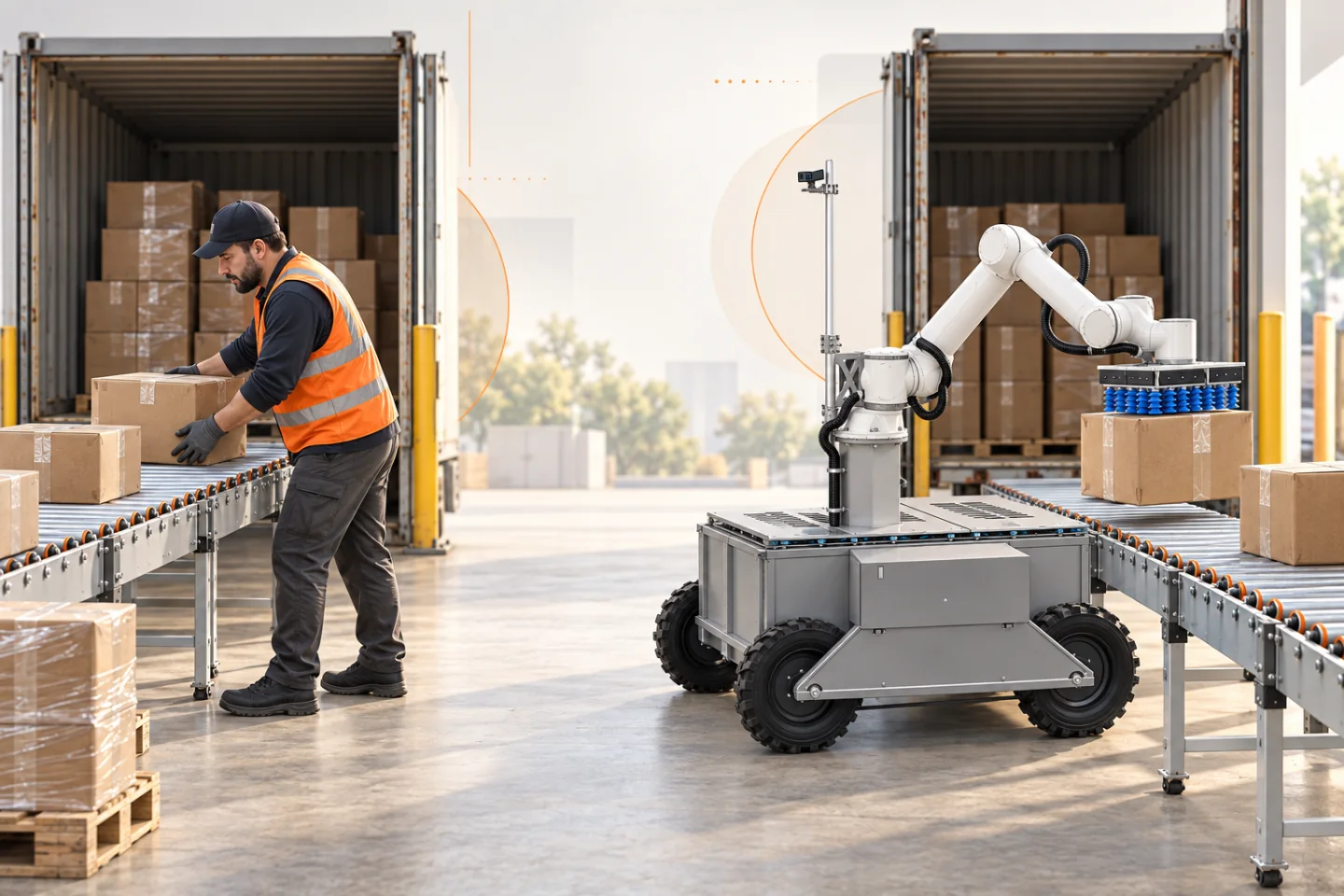
Boston Dynamics Stretch and Pickle Robot are familiar names in robotic trailer unloading. Other approaches include KRONA U1, Contoro, XYZ Robotics and Mujin TruckBot. A useful comparison asks how each system handles your freight and receiving process, rather than choosing a winner from headline throughput.
This guide is published by KRONA ROBOT. Manufacturer pages were reviewed on 2 October 2026; the descriptions below are supplier statements, not results from a shared independent test.
Compare the workflow first
Floor-loaded carton unloading is different from unloading pallets or moving a container off a vehicle. Before reviewing a supplier, define the filled carton weights, dimensions and conditions, the load wall, the receiving destination and the assistance available.
Shortlist the architecture against that receiving job:
- Mobile unloading: check movement between docks, access through the whole load and the equipment that receives the cartons.
- Conveyor-attached extraction: check the existing telescopic conveyor, reach, geometry and responsibility for a stopped handoff.
- Unloading plus pallet building: identify separately who owns scanning, sorting, sequencing and an accepted pallet pattern. Collecting boxes on a pallet does not establish a mixed-order palletizing system.
These categories can overlap in a supplier’s configuration. Compare the proposed installation, rather than assign capability from a brand label. The conveyor-or-pallet handoff layouts show the responsibilities to resolve.
Ask each supplier to assess the same representative freight. Use the robot-selection guide to prepare the brief.
| System | Manufacturer-described approach and source | Key assessment question |
|---|---|---|
| Boston Dynamics Stretch | Mobile floor-loaded case handling: manufacturer workflow | Which carton envelope, receiving route and assistance apply to this load? |
| Pickle Robot | Mobile unloading with a stated package envelope: truck-unloading page | Which packages, operator work and downstream tasks are in the proposal? |
| KRONA U1 | Eligible closed cartons, conveyor or pallet handoff: product scope | Which cartons and receiving arrangement pass the project assessment? |
| Contoro | Unloading with AI and human support; service model: manufacturer page | Who provides assistance, and what service coverage and charges apply? |
| XYZ Robotics | Carton unloading with conveyor placement and palletizing configurations: manufacturer workflow | Which extraction, identification and pallet-building functions are included? |
| Mujin TruckBot | Conveyor-attached unloading: manufacturer application | Does the actual conveyor fit, and who owns faults across the interface? |
The six workflow links in this table were checked on 24 October 2026. They document supplier-described approaches, not comparable performance tests. Support territory, installed quote, service response and the accepted package envelope for your site remain unconfirmed until a supplier proposal resolves them. Use the supplier-assessment sheet to retain confirmed, conditional, outside-scope and unknown answers with their sources.
Boston Dynamics Stretch
The official Stretch unloading page describes autonomous box handling in floor-loaded trailers and containers. It identifies a mobile system and a case-handling gripper.
For a project, ask Boston Dynamics to confirm the eligible carton mix, site preparation, sustained flow and intervention requirements. A manufacturer capability description is not a guarantee for a particular load.
Pickle Robot
Pickle Robot’s manufacturer site describes trailer and container unloading of non-palletised goods. It also discusses operational dashboards and deployment at the dock.
If considering Pickle Robot alternatives, compare the proposed receiving flow and commercial scope rather than the brand name alone. Obtain the freight envelope, operator responsibilities and country-specific service arrangements directly.
KRONA U1
KRONA U1 handles eligible closed cardboard boxes up to 25 kg with conveyor or pallet handoff. Its maximum specification is up to 10 boxes per minute; actual unload time and assistance depend on freight and site conditions.
The same KRONA U1 also loads containers with boxes from pallets or conveyors. For a loading project, share the carton profile, box-supply layout and required container loading sequence.
KRONA offers pay-per-use rental at an hourly rate, with a one-time installation fee. We can also supply conveyors. Your rate, equipment scope and terms are confirmed in a tailored quote after freight and site assessment. Robot purchase offers are provided privately to integrators. The assessment determines whether the complete robot fits the operation.
Contoro
Contoro describes unloading non-palletised boxes and a human-in-the-loop approach to handling difficult situations. Its site also presents an unloading service model.
For comparison, ask how assistance is triggered, who provides it, what support is available during your shifts and which activities the proposed service includes.
XYZ Robotics
XYZ Robotics’ truck-unloading page describes a workflow from floor-loaded containers towards pallets. This makes the downstream integration scope an important part of the evaluation.
Clarify whether the proposal covers extraction alone or also scanning, routing and pallet building. Record ownership at each handoff between machines.
Mujin TruckBot
The TruckBot manufacturer page describes attachment to standard telescoping conveyors and carton flow into downstream handling.
Investigate conveyor compatibility, geometry, capacity and the response to interruptions. A conveyor-attached architecture should be compared with a mobile system using the actual dock constraints.
Compare sustained operation, not isolated peak rates
A “boxes per hour” figure can describe a picking cycle, a selected freight demonstration or an entire unload. A container-time figure may include a different package count and preparation boundary.
Ask all suppliers to report:
- carton count and the tested size/weight mix;
- preparation and positioning time;
- elapsed unloading time, including agreed stops;
- assistance events and active operator minutes;
- damage, dropped cartons and additional handling;
- downstream capacity and time to clear the dock.
The pilot acceptance checklist makes those definitions explicit. Never compare one system’s peak picking rate with another’s whole-container average as equivalent.
What about Stretch or Pickle Robot prices?
The manufacturer pages reviewed did not establish a public purchase price for Stretch or Pickle Robot. Request a current quotation that identifies equipment, installation, support and operating responsibilities.
Compare that proposal with a rental or service scenario over the same period. The container-unloading cost guide explains labour, dock occupancy, utilisation and the effect of an assumed usage minimum. Numerical calculator defaults are illustrative planning inputs, not a KRONA quotation; the pricing page explains the tailored commercial scope.
Availability, support coverage and commercial terms for Germany, France, Poland, the UK and Nordic countries should be confirmed with each supplier. This guide does not establish deployment availability in every country.
Compare evidence quality as well as architecture
A brochure limit, a video and a whole-load acceptance test provide different evidence. Put the evidence type beside each figure in the supplier worksheet. A demonstration shows that an action occurred; it rarely supplies all the stop time, carton variation or remaining labour needed for your business case.
The Stretch lab article explains customer-freight testing and container geometry. Pickle’s product page combines package requirements with descriptions of operator interaction. These are useful questions to carry into a proposal, while remaining manufacturer accounts.
For each bidder, ask for the same evidence pack: written package envelope, dock layout, intended handoff, assistance responsibilities, sustained-test definition and quote exclusions. Mark absent information as unknown rather than awarding it an assumed pass. A vendor that gives a clear exclusion may provide a more usable scope than one with a larger headline rate and no application boundary.
When should assisted manual unloading stay on the shortlist?
If suitable carton volume is limited, loads vary sharply or the dock cannot support the proposed receiving route, compare lifting assistance and conveyors before committing to robotic extraction. They can reduce parts of manual work without automating selection. Granta’s gripper guide concerns downstream palletising tools; a palletiser is an adjacent process, not automatically an alternative for extracting a container’s cartons.
Use the manual-versus-robotic guide to keep the extraction and receiving boundaries consistent across those options.
Use one project-assessment sheet for every supplier
Download the supplier-assessment sheet. Give each supplier the same filled carton sample, load-wall information, measured dock layout and desired finish point. The worksheet separates a supplier statement from a test result and records the date and source of each answer.
Record confirmed, conditional, outside-scope and unknown answers for freight coverage, sustained-test boundaries, human assistance, receiver ownership, support territory, installed quote scope and recurring charges. Keep an evidence link or planned test next to every conclusion.
A quoted arm price is not necessarily an installed unloading-system price. A brochure rate without a tested load and time boundary is not a comparable whole-container result. The sheet gives the project team a place to resolve those differences before scoring proposals.
Bring the comparison back to your freight
For carton handling, read the vacuum-gripper guide. For receiving design, compare conveyor and pallet handoff.
To evaluate KRONA alongside another proposal, send the same representative freight and layout information: filled carton dimensions and weights, recurring load volume, current unload and operator time, dock layout and required conveyor or pallet destination. Include exception samples, not only the easiest cartons. The useful result is a documented operating fit and a comparable pilot, with open questions recorded before deployment.
- container unloading
- robot selection
- warehouse automation
KRONA U1 unloads boxes from containers onto pallets or conveyors and also loads containers with boxes from pallets or conveyors. Explore KRONA U1 →
Request a freight assessment