
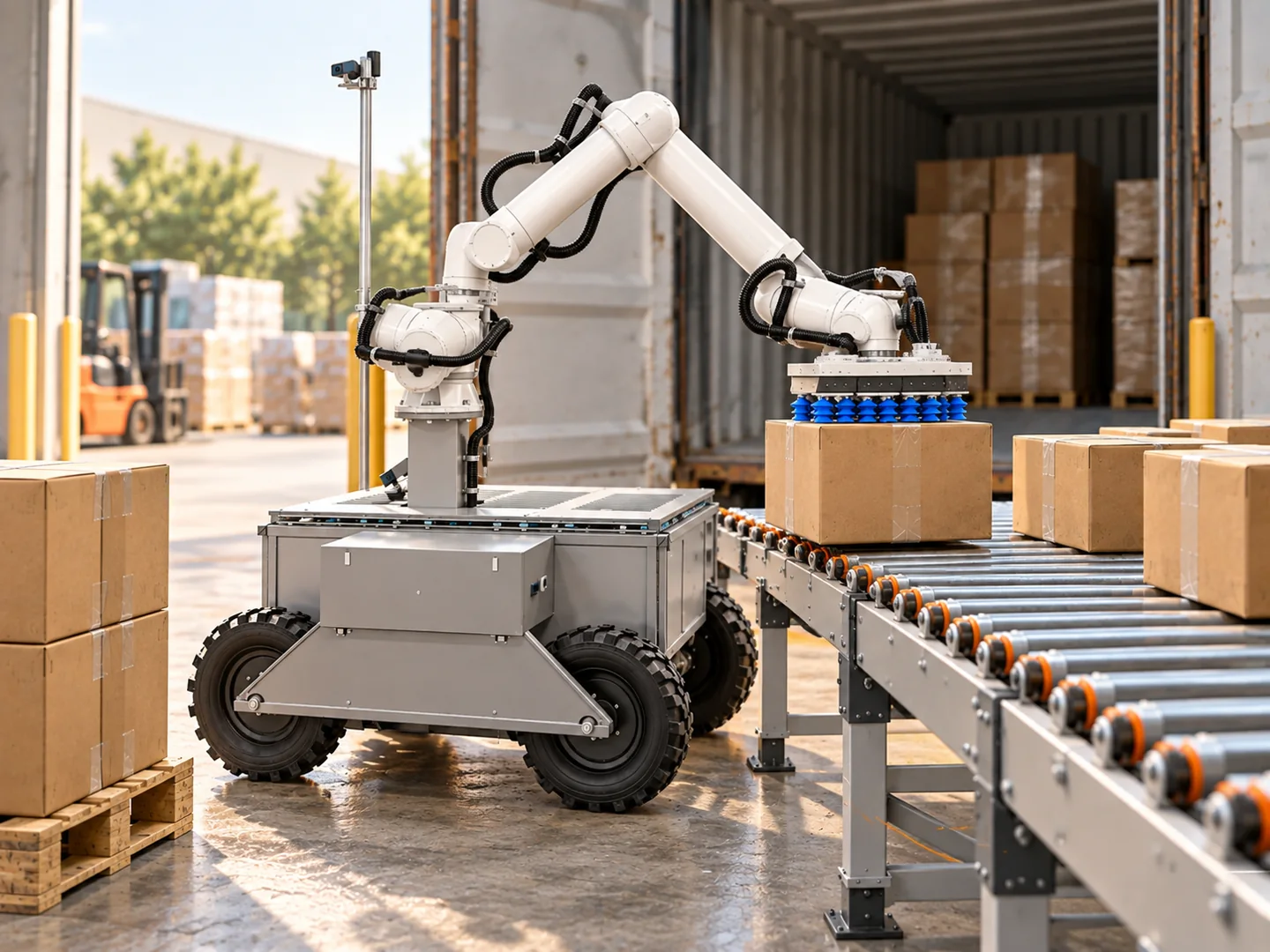
A vacuum lifter for container unloading needs to reach and release cartons throughout a changing load wall, within the vehicle’s available space. Check the filled cartons, accessible gripping faces, working height, equipment movement and receiving route together. A vacuum lifter that works beside an open pallet is not automatically suitable inside a loaded container.
This checklist concerns removing individual boxes from floor-loaded shipping containers and trailers. It does not concern equipment that lifts the container itself. Start with the vacuum carton lifting selection guide if you are still comparing assisted handling and robotics.
Confirm the unloading task and who controls it
In an operator-guided vacuum unloading system, the person chooses and directs each lift while the equipment supports the carton. A conveyor can carry boxes away after release, but that does not make extraction autonomous.
TAWI’s container-unloading systems illustrate lifting arrangements intended for work inside containers and trailers. Evaluate the proposed lifter, tooling and mounting as a complete configuration rather than borrowing the capacity of an unrelated workstation lifter.
Write down the intended finish point: on a conveyor, released onto an inbound pallet, or fully identified and ready for storage. That boundary determines which people and equipment need to be included in a trial.
1. Describe the cartons and the load wall
Prepare measured filled weights and dimensions, carton construction, tape and label positions, surface condition and photographs of actual arrivals. Separate regular package profiles from occasional exceptions.
Photograph the load wall at the start and, where available, later in unloading. Include tight stacking, high rows, floor-level cartons, gaps and visible transport damage. The lifter must reach the relevant contact face as the wall recedes.
Distinguish carton suitability from extraction access. A box may hold a vacuum grip when isolated but still require review when adjacent freight blocks the tool or constrains removal. Use the existing carton-gripper assessment guide for the package-level evidence.
2. Check top, side and edge access
Identify which face is reachable at each representative pick. In a tightly stacked wall, the top panel may be unavailable until the carton above has been removed. The supplier should assess any required side-contact or turning configuration.
ANVER’s cardboard-carton applications show that different attachments are used for different handling geometries. They are examples of tool options, not evidence that side gripping works on every transported box.
Retain photographs showing the actual contact patch. A successful test on the clean centre of an exposed top panel does not answer a trial question about a taped side panel deep inside a load.
3. Survey the complete working envelope
Measure the vehicle opening, internal working space, obstructions and the transition from dock to vehicle. Include the space occupied by the lifter support, its tube or arm, the operator and the receiving conveyor.
Check the full range from floor-level cartons to the highest accessible row. Review handle position, lifting travel, headroom, overhead fittings and the route to release with the supplier and site team.
Also establish how the equipment follows the retreating load face. Record repositioning time and any utilities that must move with it. A quoted reach at one equipment position does not describe coverage of an entire trailer.
The loading-dock requirements guide provides a wider survey structure; use the dimensions and access requirements of the specific assisted or robotic system under review.
4. Define the conveyor or pallet handoff
For a conveyor, specify release height, available space, carton orientation and how a full receiving line is handled. Assign carton identification, inspection, sorting and removal of exceptions to named process owners.
For pallet receiving, include empty-pallet availability, placement limits, full-pallet removal and any separate pallet-building task. Releasing a carton onto a pallet is different from delivering a finished shipping pallet.
Use the conveyor-or-pallet handoff guide to keep those boundaries visible. Faster lifting cannot raise complete receiving output if the downstream stage remains the constraint.
5. Record all labour and waiting time
Count preparation, equipment positioning, active operation, receiving, pallet changes, exception handling and close-out. Include people working outside the container as well as the operator at the lifter.
Measure elapsed unloading time and total labour-hours separately. Two people working for two hours use four labour-hours; a shorter elapsed job does not automatically have lower labour cost.
Retain stops by cause. A pause for equipment movement, a full conveyor and a carton requiring separate handling are different planning questions. The unloading-time guide explains how to keep the measurement boundary consistent.
6. Compare lifting assistance with a robotic route
Use the vacuum container unloader versus KRONA U1 comparison for a direct view of pick control, operator involvement, freight limits, handoff and commercial scope.
A vacuum lifting aid may be appropriate when an operator should continue directing the varied task and the application has suitable reach and carton contact. A robot is worth assessing when regular eligible freight and a defined receiving route support automated extraction and transfer.
KRONA U1 is a mobile robotic option for eligible floor-loaded closed cartons up to 25 kg, with conveyor or pallet handoff. Its specified maximum rate is up to 10 boxes per minute; sustained output depends on the freight, motion, stops and receiving conditions.
Compare alternatives on the same sample and finish point. Include the freight each option cannot handle and the agreed exception route. Use the manual versus robotic comparison for the complete measurement method.
7. Put the trial and quote in one brief
Send suppliers a brief containing:
- filled carton profiles, sample quantities and transported condition;
- representative load-wall photographs and accessible contact faces;
- vehicle, dock, headroom and working-envelope measurements;
- proposed receiving destination and downstream capacity;
- arrival frequency and current complete-task labour-hours;
- required equipment scope, utilities and installation responsibilities;
- agreed measures for accepted cartons, damage, assistance, stops and completion;
- exception, maintenance and support responsibilities.
Ask each supplier to identify assumptions and exclusions beside its proposal. The vacuum box lifter cost guide explains how to compare an attachment price with a complete installed handling system.
Container-unloading questions
Can a normal warehouse vacuum lifter unload a container?
It needs an application assessment. Verify reach, headroom, mounting, carton contact and the complete operator-to-receiver workflow rather than assuming that a workstation test proves vehicle suitability.
Does a vacuum unloader remove all manual work?
An operator-guided system still requires task control. Preparation, receiving and exceptions can also remain. Measure the complete crew and process before making a labour-saving claim.
What is the next step for a KRONA robotic alternative?
Request a freight and site assessment with the same carton and receiving brief. That supports a fair comparison of assistance and automation using your operation’s conditions.
- vacuum lifting
- container unloading
- equipment selection
- cardboard cartons
KRONA U1 unloads boxes from containers onto pallets or conveyors and also loads containers with boxes from pallets or conveyors. Explore KRONA U1 →
Assess a robotic alternative for your unloading operation