
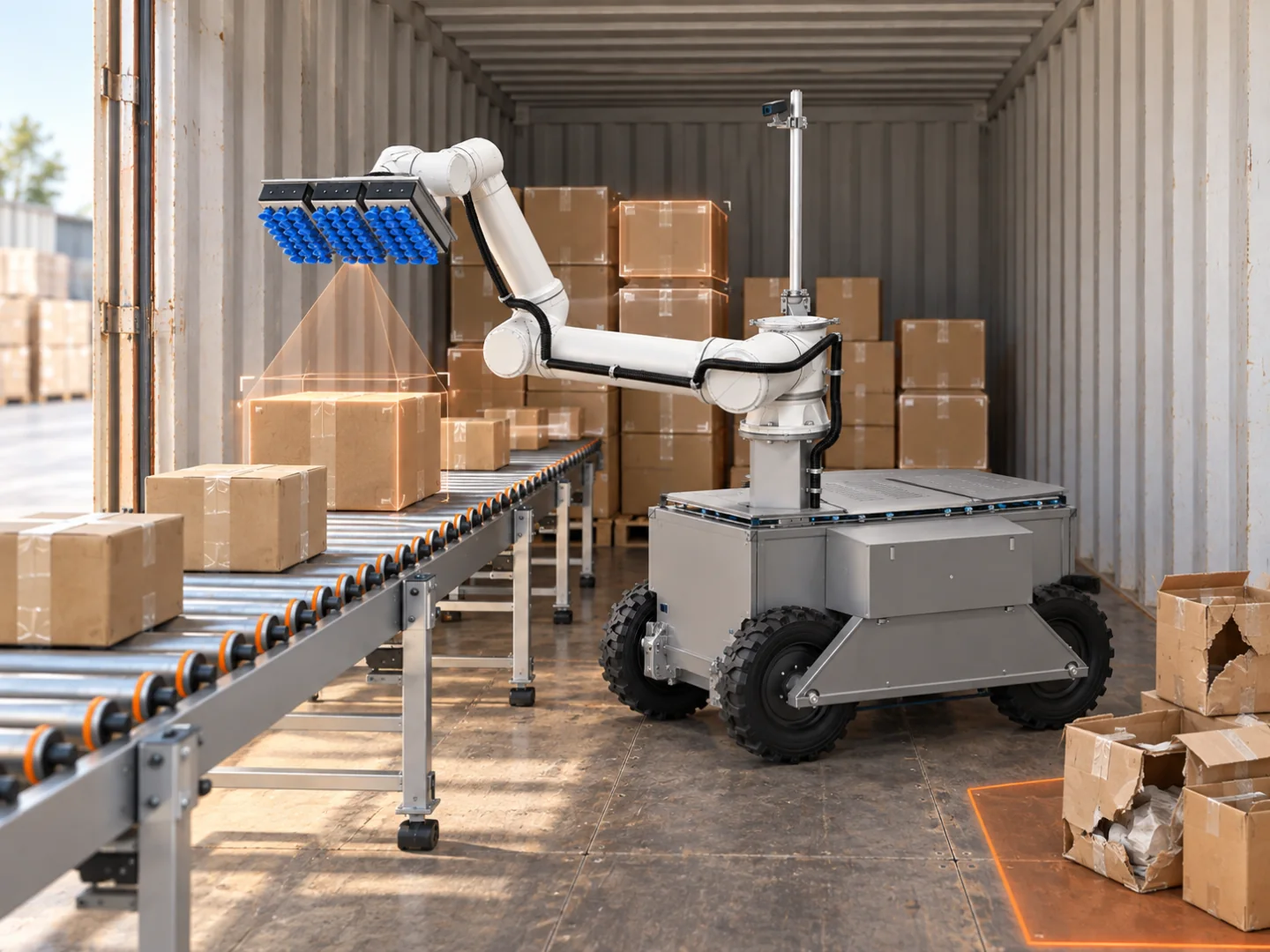
A floor-loaded container can suit robotic unloading when its cartons can be gripped, extracted and transferred within the complete system’s verified limits. Closed, dry cartons with accessible faces are a useful starting point. Carton weight alone cannot establish eligibility: damaged packaging, tight loading and blocked receiving can prevent a workable unload.
Use this guide to build a freight screening sheet before selecting a pilot. A screening result identifies what to test; it does not approve a deployment.
Screen the carton, load wall and dock separately
| Check | Promising starting condition | Condition needing separate assessment |
|---|---|---|
| Package | Closed carton with stable contents | Open carton, sack, netting or loose item |
| Filled weight | Known range within the chosen system’s limit | Unknown weight, heavy outlier or shifting contents |
| Contact face | Accessible, dry panel with usable contact area | Tears, holes, severe dents, moisture or obstructing wrap |
| Extraction | A visible carton with a clear removal path | Wedged carton, overhanging load or unstable wall |
| Handoff | Available conveyor space or prepared pallet position | Receiving queue with no defined waiting sequence |
| Site | Measured access, floor and utilities | Unmeasured thresholds, clearances or operating conditions |
Record an unknown as not yet assessed. Do not count it as eligible because another carton with the same product label worked.
Why a closed cardboard box can still fail
A vacuum tool must establish contact and retain the filled carton through movement. Porous board can leak, a panel can deform, and tape or labels can change the available surface. An exposed front face inside a container presents a different load direction from a top pick on a conveyor.
Schmalz’s holding-force reference defines suction force as pressure difference multiplied by effective area and identifies it as theoretical. It does not establish the strength of a carton panel or prove retention during extraction. Use the carton-gripper guide for the complete contact-to-release assessment.
For KRONA U1, the published application limit is closed cartons up to 25 kg. Assess the heaviest filled carton, its dimensions and contents distribution. A load averaging 12 kg can still contain boxes above the limit; those boxes need a separate handling route.
Check accessibility through the entire container
Photograph more than the first wall. Record cartons near the floor, side walls and ceiling, tight gaps, deformation, straps and changes deeper in the load. A suitable face can still be unreachable or trapped by neighbouring cartons.
Include container and door dimensions, floor condition, thresholds and gradients in the site pack. Show people and forklift routes and the intended receiving position. A carton test cannot settle whether the complete installation fits the dock.
Calculate coverage with a defined denominator
Keep carton coverage, load coverage and successful test picks separate. They answer different questions:
- Carton coverage: verified eligible cartons divided by all inbound cartons in the stated period.
- Load coverage: loads that meet the agreed operating rule divided by all inbound loads.
- Test completion: completed picks divided by attempted picks within the recorded test profile.
Hypothetical screening example: 1,000 inbound cartons include 720 in a verified profile, 180 in profiles awaiting tests and 100 outside the selected system’s package requirements. Confirmed carton coverage is 720 ÷ 1,000 = 72%. Testing the additional 180 may raise it, but the initial estimate must retain that uncertainty.
If those 100 excluded cartons are spread across every container, none of the loads is automatically an unattended whole-load candidate. Record where exceptions occur and whether the agreed process can handle them. Do not convert 72% carton coverage into 72% fully automated containers in a financial model.
Build a representative sample pack
Group freight by filled weight, dimensions, board condition, contact face and loading pattern. Assign each group its observed share of inbound volume. Include the common profiles and relevant difficult cases, rather than equal numbers of every format irrespective of frequency.
For every sample record the profile identifier, actual mass, dimensions, condition, source load and test outcome. Retain unknowns and exclusions. Repeat tests with ordinary transported cartons when packaging changes; a fresh empty box is weak evidence for a compressed filled carton.
Boston Dynamics describes testing customer freight and different container geometries in its Stretch lab article. The useful principle is to reproduce the application. Its results do not validate another robot or your warehouse.
Turn the screening result into a pilot decision
Proceed to a scoped pilot when a recurring freight group, site layout and receiving route can be tested together. First resolve missing dimensions or package data when they determine whether the test is feasible. Keep a separate route for out-of-scope goods such as open objects, sacks or cartons above the limit.
Agree the test’s throughput, assistance and damage measures using the pilot acceptance checklist. Send the profile sheet, real load photographs and receiving layout to request a KRONA freight assessment.
- robotic unloading
- freight eligibility
- pilot
KRONA U1 unloads boxes from containers onto pallets or conveyors and also loads containers with boxes from pallets or conveyors. Explore KRONA U1 →
Assess your freight