
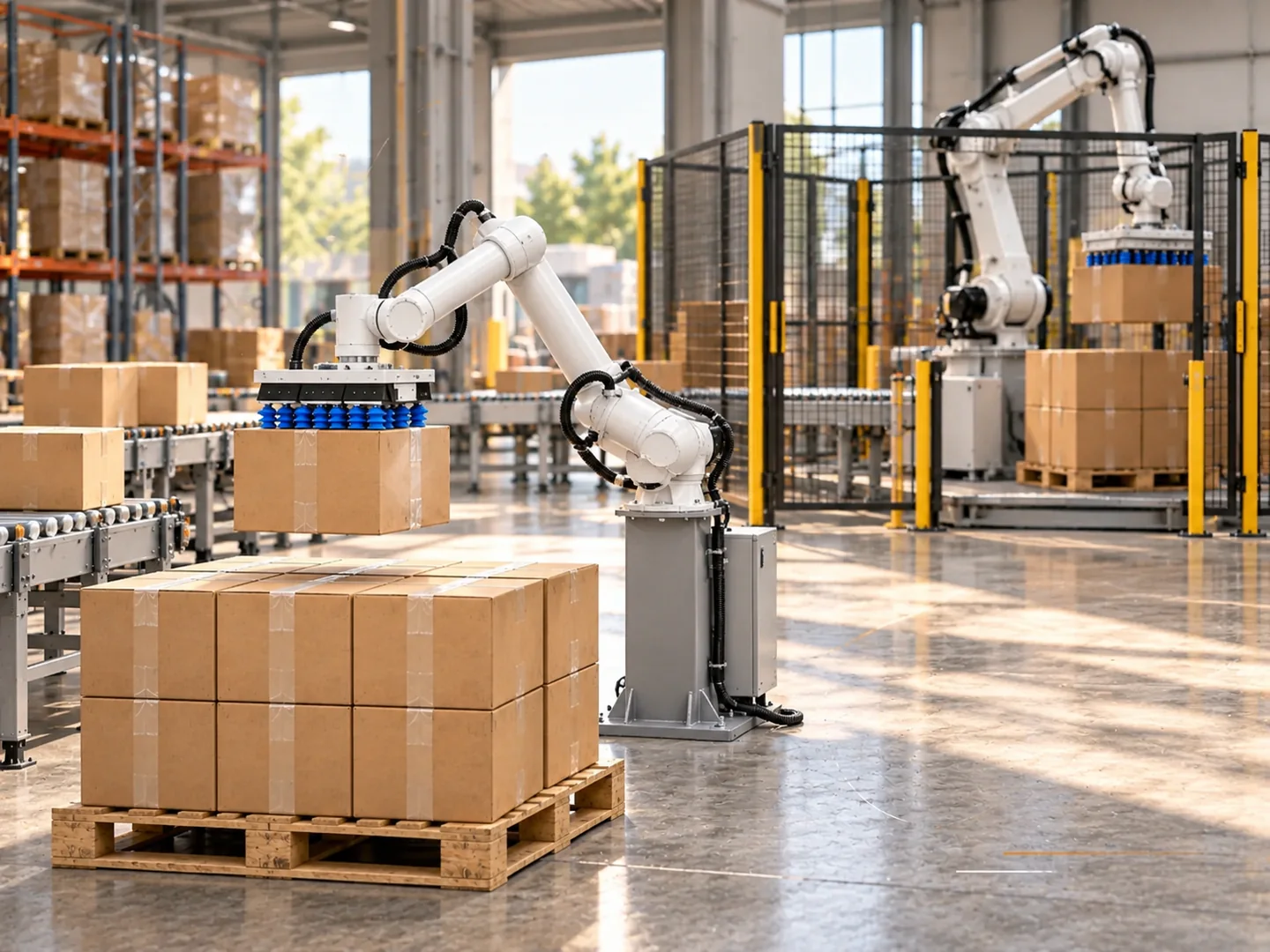
Cobot palletizing uses a collaborative robot arm in a pallet-building application. Industrial robot palletizing often uses a dedicated arm and cell configured around the required loads and production rate. A useful comparison starts with the whole carton-handling job, including tool mass, reach, infeed and pallet exchange.
Neither label predicts the throughput or site fit of a complete installation. Compare proposed systems against the same carton sample, layout and acceptance measures.
Start with the loaded tool
The arm carries the gripping tool and the carton together. Add flange adapters, sensors and any support mechanism to the tool mass before comparing payload ratings.
Calculate the combined centre of gravity, then check the selected manufacturer’s load envelope, inertia requirements and intended motion. A light box held far from the wrist can present a different load from the same box held close to it. The payload calculation guide provides a worked example.
Check the heaviest filled carton and the least convenient grip position. Empty packaging and a neutral arm posture are weak evidence for the actual job.
Compare reach and the working layout
Record the pick location, pallet corners, maximum placement height and required withdrawal paths. Include tool length and the carton dimensions, not only the arm’s quoted reach.
A compact installation still needs space for incoming boxes, empty pallets, completed loads, service and the site’s operating access. A larger arm can serve a different arrangement, but its footprint must also be evaluated as a cell rather than a bare robot base.
FANUC’s cobot palletizing application page discusses how load capacity, reach and pallet-building software affect these applications. Its product-specific claims should be checked for the exact proposed model and configuration.
Use the same selection worksheet for both
| Requirement | What to obtain from each supplier | What to test |
|---|---|---|
| Loaded tool | Carton-plus-tool mass, centre of gravity and load limits | Worst-case loaded movement |
| Placement envelope | Reachable positions with the intended tool | Highest and tightest pallet placements |
| Production | Defined cycle conditions and sustained-output assumptions | Output including agreed interruptions |
| Pallet exchange | Layout, sequence and remaining operator activity | Full-to-empty pallet transition |
| Product changes | Allowed carton variations and changeover procedure | Representative size and product changes |
| Operating access | Application assessment and proposed protective measures | Agreed commissioning and operating procedure |
Treat an unfamiliar capability as a question for the supplier. Do not convert a promotional category description into a promise in a client proposal.
Evaluate cycle time at the application level
A pick-and-place cycle includes approaching the carton, establishing and confirming the grip, moving the loaded tool, releasing and returning. The line also encounters carton presentation delays, faults and pallet replacement.
A quoted movement rate does not account for every one of those activities. Record the test load, tool, placement height, operating configuration and observation window when comparing alternatives.
Use the line-capacity guide to calculate a hypothetical production scenario, then validate it against a representative test. Buying a faster arm cannot remove a slower receiving or inspection step.
Assess the complete installation
Collaborative features describe a robot’s capabilities; the suitability of the complete carton-handling application depends on the tooling, carried load, motion, surrounding equipment and operating access. Agree the application’s assessment and protective measures with the responsible supplier and integrator.
Do not assume that a cobot automatically permits people beside every moving load, or that a particular layout is suitable because it appears in a demonstration. Obtain the documentation for the actual installation and operating configuration.
Keep mobility and collaboration separate
A collaborative arm, a movable palletizing cell and an autonomous forklift describe different characteristics. A cell may be repositioned between lines without supporting people beside every moving load. A forklift can move a loaded pallet without picking or arranging the cartons on it.
For a two-station proposal, ask how the equipment is moved, how the pick and pallet references are established again, and what must be checked before production resumes. Include reconnection, alignment and the first accepted pallet in the changeover comparison. Do not turn a robot’s ability to travel into an assumed automatic station change.
Use the warehouse robot types guide to choose the task first, then compare the proposed palletizing installation against the same brief. The AGV-versus-AMR guide covers navigation terminology; neither navigation label establishes carton-palletizing capability.
Distinguish palletizing from container unloading
A palletizing arm normally receives cartons at a defined pick location. Floor-loaded container extraction must first find accessible faces and remove boxes from a load wall. Selecting downstream palletizing equipment does not settle that upstream task.
KRONA U1 is a complete mobile unloading robot with conveyor or pallet handoff for eligible closed cardboard cartons. This does not classify KRONA as a cobot or establish compatibility with a particular arm brand.
Use the container-to-pallet workflow guide to define the boundary. Integrators can submit a client project with the unloading freight, receiving requirements and proposed downstream cell.
- palletizing
- robot selection
- system integration
KRONA U1 unloads boxes from containers onto pallets or conveyors and also loads containers with boxes from pallets or conveyors. Explore KRONA U1 →
Compare your carton palletizing options