
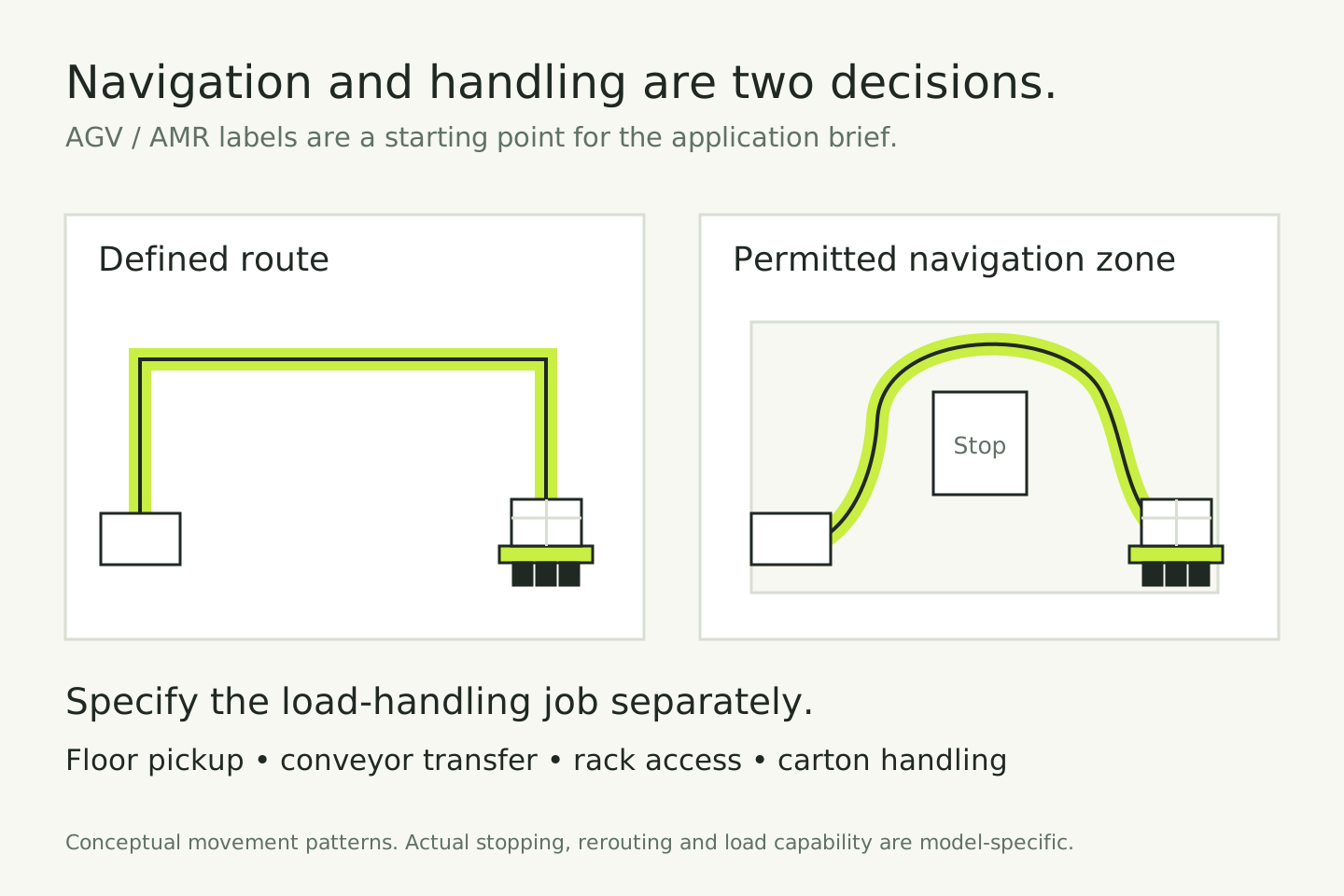
AGV and AMR usually describe different approaches to automated movement. An automated guided vehicle is commonly associated with defined routes; an autonomous mobile robot with more dynamic route planning. Those labels do not tell you whether a machine can collect a pallet from the floor, lift it into a rack, unload a carton or enter a trailer.
Choose warehouse robots on two connected questions: how must the machine move, and what physical handling must it complete? A strong answer to only one leaves the application unfinished.
Use navigation labels as a starting point
Daifuku’s guide to AGVs and AMRs explains the traditional fixed-route and dynamic-navigation distinction while noting that current systems increasingly blur it. Avoid treating the letters on a brochure as a complete behaviour specification.
Ask the supplier to describe the selected configuration: how it localises, which routes or zones are permitted, what happens at an obstruction and how a changed layout is introduced. Defined routes can be physical or virtual; dynamic navigation still operates within an agreed environment and operating rules.
| Decision | Defined-route emphasis | Dynamic-navigation emphasis | Evidence to request |
|---|---|---|---|
| Working route | Repeatable movement through designated paths | Movement within permitted routes or zones with route choices | Demonstration on the proposed layout |
| Obstruction response | Agreed stopping, waiting and recovery sequence | Agreed replanning where another route is permitted | Blocked route and unavailable destination tests |
| Layout change | Route/configuration changes may be required | Maps, zones and tasks may still need updates | Change procedure and responsible team |
| Fleet coordination | Conflict resolution on shared paths | Conflict resolution across shared paths and route choices | Busy-window traffic and handoff test |
These are selection questions, not universal properties of every AGV or AMR. A detour may be technically possible while being unsuitable for a particular load, traffic arrangement or receiving point.
Specify the handling unit on a separate line
A floor carrier, tugger, pallet truck and autonomous reach truck can have different pickup, load and storage duties even when their navigation descriptions sound similar. Likewise, a mobile manipulator adds a handling arm but does not automatically acquire every palletizing or picking function.
| Required job | Physical details to verify |
|---|---|
| Floor-to-floor pallet delivery | Pallet openings, fork or transfer arrangement, pickup tolerances and load presentation |
| Under-load carrier lifting | Carrier footprint, underside and leg clearance, lifting contacts, loaded stability and approach/withdrawal space |
| Conveyor-to-pallet transport | Transfer geometry, load availability, stop/ready signals and completed-handoff confirmation |
| Rack pickup or placement | Supported rack geometry, load conditions, reach and required placement positions |
| Trailer or container pallet handling | Vehicle access, floor/threshold conditions, permitted geometry and the specific application |
| Individual carton handling | Filled carton properties, accessible surfaces, tool, pick presentation and destination |
For fork-based pallet work, review KRONA autonomous forklifts. For compatible load stands or carriers, review KRONA lifting AGVs: the vehicle enters below the support and raises it through an agreed interface, rather than assuming fork entry or arbitrary floor-pallet pickup. For floor-loaded boxes, KRONA U1 addresses individual eligible cartons. They can belong to one workflow while handling different units at different stages.
Test a blocked route without losing the task
Consider an illustrative acceptance scenario. A pallet transport task runs from receiving position A to storage position B. Another load blocks the usual route. The system must retain the mission and load state, apply its agreed stop or reroute behaviour, and report a result that operations can act on.
The important questions are practical. Is an alternative route allowed for this loaded vehicle? Who resolves a blockage if there is no suitable path? What happens if B becomes unavailable after pickup? When communication returns, how does the site avoid issuing a duplicate task for a pallet already collected?
The receiving-system integration guide covers event and inventory ownership. The navigation demonstration should show the selected system’s actual behaviour rather than a generic animation of obstacle avoidance.
Include charging, empty travel and the busiest window
Movement capacity depends on completed missions over the required operating period. Include the trip to collect a load, empty repositioning, pickup/placement time, traffic, destination waits and charging arrangements. A headline travel speed does not answer how many accepted pallet deliveries the route can sustain.
Two systems may therefore solve the same job differently. One might use a tightly controlled route and predictable handoffs; another might use permitted route choices. Compare their complete application output and support requirements using the same workload. The AGV forklift cost guide provides the quotation structure.
Bring the full task to the assessment
Start with a scaled layout, actual loads, pickup/drop positions, peak tasks, human and vehicle traffic, and the required recovery decisions. State the operational outcome before specifying that the answer must be called an AGV or an AMR.
For carton unloading, palletizing and onward pallet transport, use the KRONA warehouse systems assessment. It connects navigation, physical handling and equipment handoffs within one defined project brief.
- AGV
- AMR
- autonomous forklifts
KRONA U1 unloads boxes from containers onto pallets or conveyors and also loads containers with boxes from pallets or conveyors. Explore KRONA U1 →
Assess the KRONA forklift application