
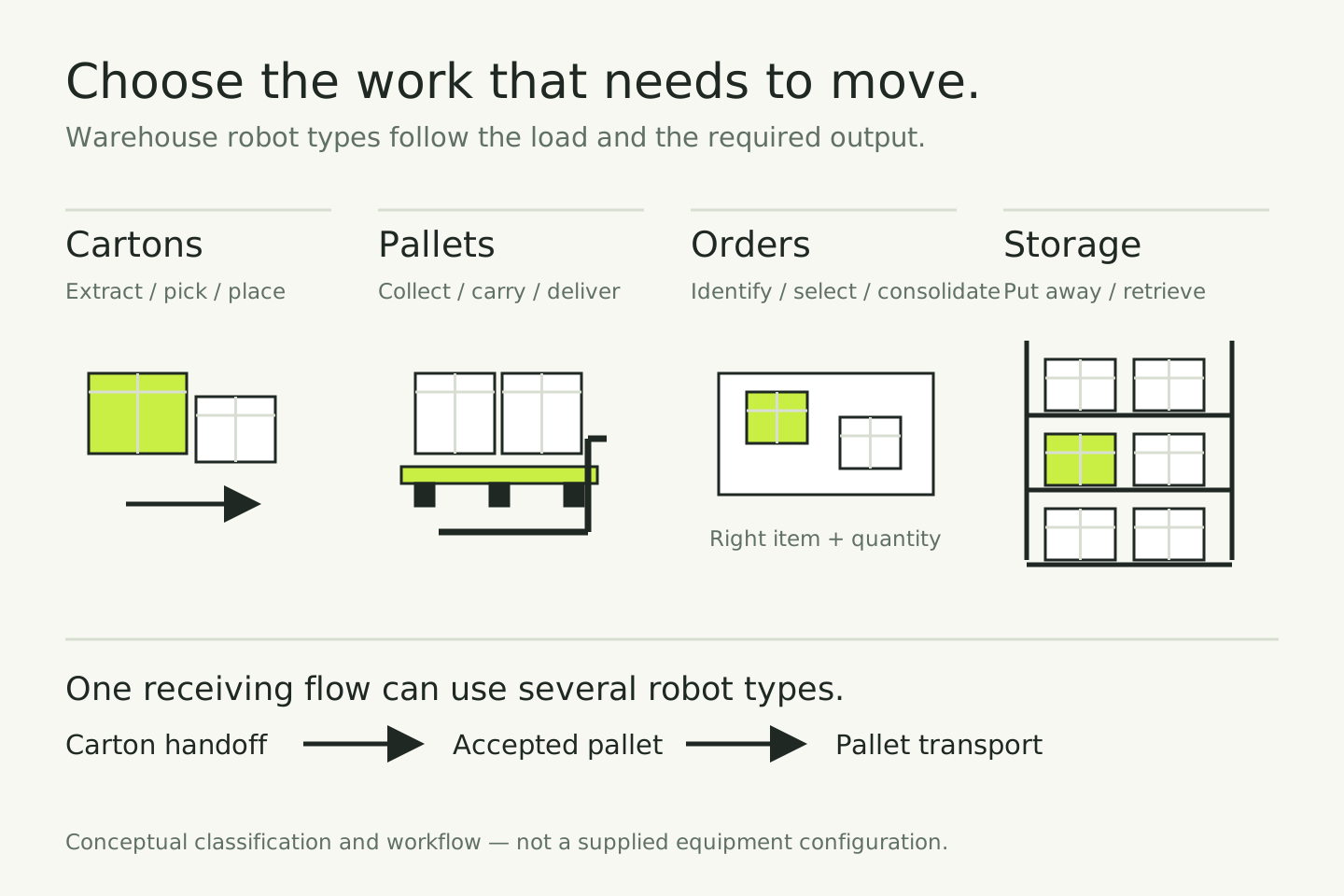
Warehouse robots perform different jobs: extracting loose cartons, moving pallets, building pallet loads, presenting stock for picking or moving goods into storage. Start with the physical unit and the required result. A robot that transports a pallet does not necessarily remove cartons from it, and a carton-handling arm does not necessarily carry a finished pallet to a rack.
For an equipment shortlist, write one sentence describing the job: move this load, from this presentation, to this accepted destination. Then compare the complete workflow around that move.
Compare warehouse robot types by the work they finish
| Robot or system type | Handling unit | Useful output to specify | Work to define around it |
|---|---|---|---|
| Container unloading robot | Individual floor-loaded cartons | Cartons accepted on a conveyor or pallet | Receiving, scanning, exceptions and pallet removal |
| Autonomous forklift or pallet truck | A pallet or approved load carrier | Load delivered to a floor position, transfer point or supported storage location | Load presentation, traffic, charging and task confirmation |
| Under-load lifting AGV | A compatible load stand or carrier | Supported load raised and delivered between defined stations | Under-carrier clearance, lifting contacts, carrier circulation and station availability |
| Carton palletizing cell | Cases from a declared infeed | A pallet built to an accepted pattern | Product sequence, pallet supply, wrapping and exchange |
| Carton depalletizing system | Cases presented on a pallet | Cartons supplied to a conveyor or another process | Wrap and interlayers, accessible boxes, identity and replenishment |
| Picking robot | An item, tote or case | The right quantity placed in an order container | Stock presentation, recognition, order data and exceptions |
| Goods-to-person mobile system | Shelf, tote or other supported carrier | Stock brought to a picking station | Human or robotic picking and returned-stock handling |
| Automated storage and retrieval system | Pallet, tote or tray | Stock stored and retrieved at defined interfaces | Building/storage design, inventory control and downstream capacity |
These categories can work together. A warehouse automation project may need one of them, a staged combination, or a simpler change to how goods are presented.
Separate navigation from load handling
AGV means automated guided vehicle; AMR means autonomous mobile robot. These terms describe aspects of movement and navigation. They do not identify the tool that picks up a pallet, the lift height, the carton gripper or the storage application.
Daifuku’s explanation of AGVs and AMRs notes that current systems can blur the traditional distinction between fixed routes and dynamic navigation. Ask how a proposed vehicle behaves on your actual route rather than selecting it from a label alone.
For a pallet task, specify whether the vehicle collects directly from the floor, interfaces with a conveyor or accesses a rack position. A low-profile lifting AGV instead enters beneath a compatible carrier and raises its supported load; the carrier’s entry clearance and lift interface are part of the equipment selection. For cartons, specify the accessible surfaces, filled size and mass, orientation and required destination. The AGV versus AMR guide develops those selection questions.
Draw the handoffs, including the work left for people
- Handle the cartonExtract it or present it to receiving in the required orientation.
- Accept the receiving unitIdentify, inspect and assemble the load that can move onwards.
- Move the palletRelease the accepted load to its agreed storage or production destination.
Name the event that makes each stage complete. A carton placed on a conveyor may still require a scan. A pallet may be physically full but awaiting a label or a stability check. A forklift can reach a destination while the receiving system has not yet accepted the stock.
Agree who handles damaged cartons, unreadable labels, unavailable pallet positions and blocked destinations. These decisions affect capacity and staffing just as much as the robot’s active cycle. Use the receiving-system guide for inventory events and the unloading handoff guide for the carton route.
Count cartons and pallet movements separately
Consider a hypothetical planning example, not a tested pallet pattern or KRONA result. A receiving window contains 720 eligible cartons. Assume the agreed pallet build contains 30 cartons: the window produces 24 completed pallets.
That is 720 carton placements and 24 loaded-pallet deliveries. The transport plan may also include empty-pallet delivery, empty travel and replenishment. Treating all of these actions as “720 robot moves” would give the wrong workload to the pallet-transport system.
Likewise, a 720-carton unload is not complete merely because extraction finishes. The line-capacity guide explains how receiving, pallet exchange and interruptions affect the finished output.
Choose the next assessment by the bottleneck
If people spend most of their time removing loose closed cardboard boxes from vehicles, assess the carton extraction and handoff first. KRONA U1 handles eligible cartons up to 25 kg and can unload to a conveyor or pallets; the assessed freight and receiving arrangement determine the application.
If repeatable pallet travel is the bottleneck, start with the route, pallet format and pickup/drop geometry for KRONA autonomous forklifts. If cartons need an accepted pallet pattern, use the carton palletizing assessment and the existing cell-design guide.
If the material moves on a compatible stand or carrier between workstations, assess a KRONA lifting AGV. A pallet supported on a designed carrier is a different pickup arrangement from a bare pallet on the floor, so record the support structure and the complete loaded footprint.
For a combined flow, bring a scaled layout, load examples, a shift-level workload and the responsibilities at every handoff to the warehouse AGV systems assessment. This gives the equipment selection a defined job and gives the finished system an outcome that can be tested.
- warehouse robots
- warehouse automation
- system integration
KRONA U1 unloads boxes from containers onto pallets or conveyors and also loads containers with boxes from pallets or conveyors. Explore KRONA U1 →
Explore KRONA warehouse robot solutions