
A reorder buffer holds cartons until the palletizing cell can place them in the required order. Its size depends on which cases arrive, when they arrive and how quickly the cell can use them.
A waiting-count peak is the starting point. The physical buffer also needs space for the simultaneous carton mix and a way to retrieve the required carton.
Use the timed sequencing worksheet for the complete traces below and a blank observation row.
For the broader choice between collecting cartons and building a planned mixed pallet, use the mixed-case and single-SKU overview. This guide owns the narrower timing and waiting-space question; a buffer does not by itself establish an accepted load plan.
Track extraction, arrival and placement separately
- Extraction order: which accessible carton comes out of the container next.
- Arrival order: which identified carton reaches the buffer next.
- Placement order: which carton the pallet plan requires next.
Sorting, inspection and transfer delays can change the stream between extraction and the buffer. Measure arrivals at the actual buffer entrance. The unloading and sorting guide covers the identity and destination decisions upstream.
Two arrangements are common. A system may prepare a known order and release cases in a calculated sequence, as in Swisslog’s ACPaQ example. An adaptive planner may revise placements as cases arrive.
Adaptive planning can still need storage when no suitable immediate placement is available. Photoneo’s mixed-palletizing example includes a dedicated buffering robot for storing, retrieving and reordering cases. Any revised placement plan must still meet the finished-load requirements.
Set the model’s rules
The following hypothetical examples build in the order A1 → B1 → A2 → C1. A1 and A2 are separate cartons of type A.
Assumptions:
- One cell places one carton at a time; each placement lasts eight seconds.
- Identification and retrieval take no time.
- Any required waiting carton can be retrieved.
- A carton leaves the waiting count when placement starts. The carton in service is counted separately.
- At a shared timestamp, finish the current placement and start the next required waiting case before admitting the new arrival.
Real scanning, retrieval and transfer timing must be added when sizing equipment.
Compare two arrival sequences
| Measure | Sequence 1 | Sequence 2 |
|---|---|---|
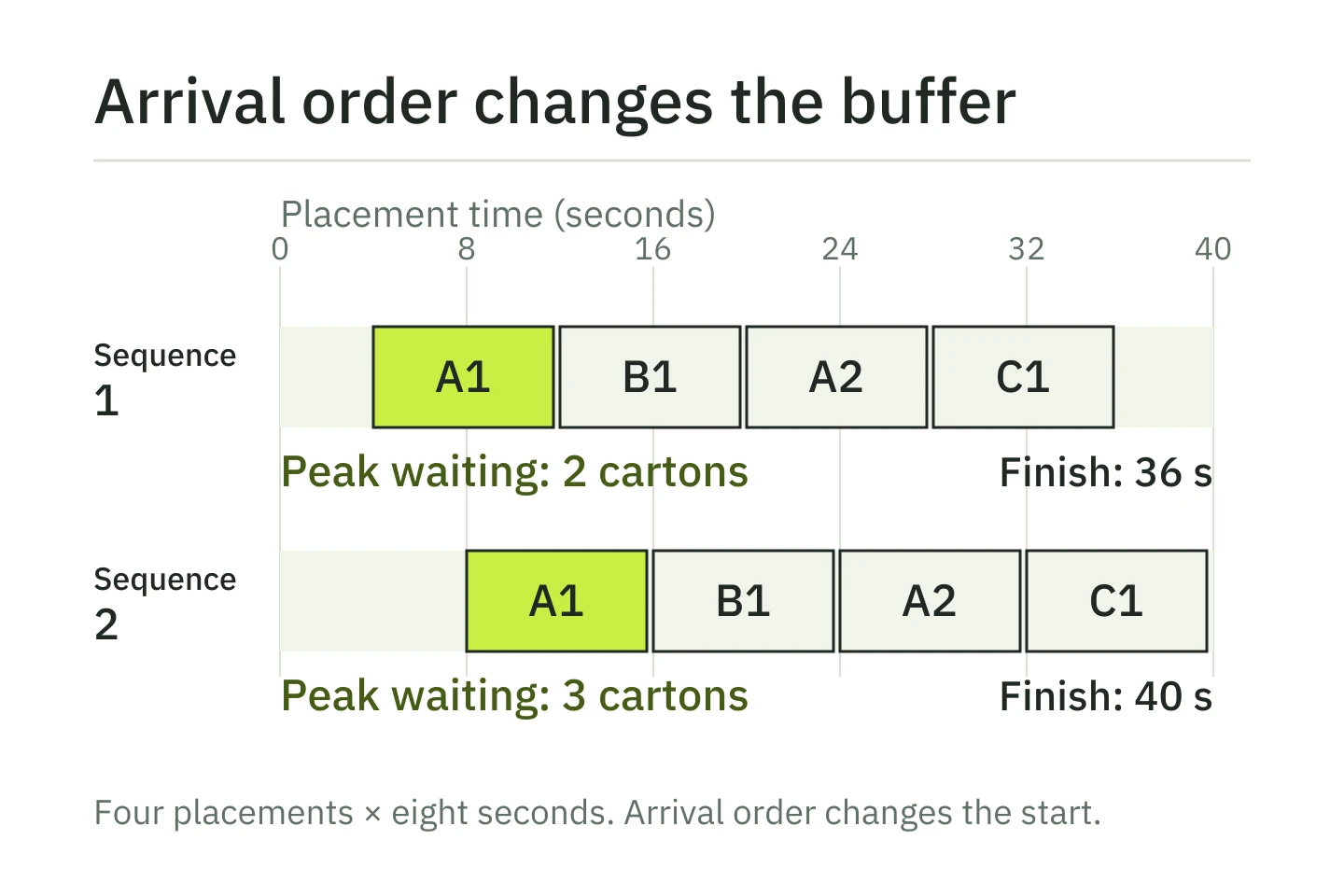
| Arrivals at 0, 4, 8, 12 seconds | B1, A1, C1, A2 | B1, C1, A1, A2 |
| First placement starts | 4 seconds | 8 seconds |
| Maximum waiting cartons | 2 | 3 |
| Final placement completes | 36 seconds | 40 seconds |
The cover timeline shows the eight-second placements. The waiting-count plot below includes every arrival and completion event.
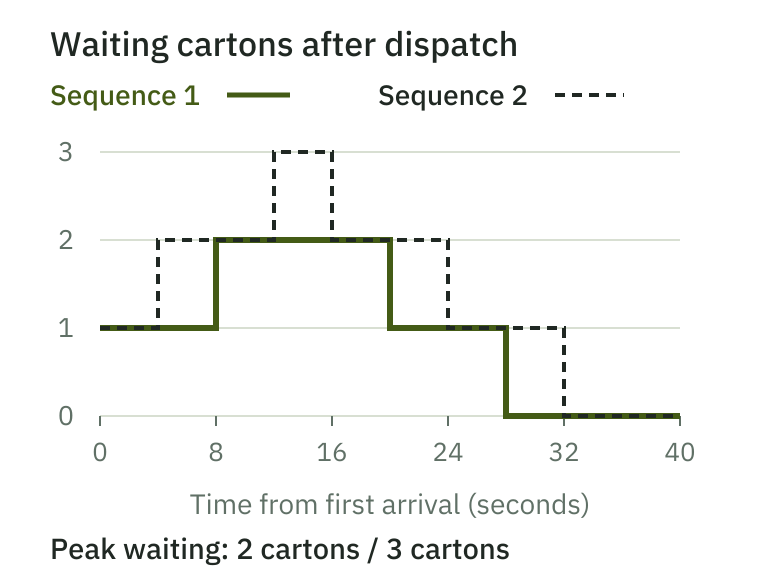
Sequence 1 cannot start until A1 arrives at four seconds. Its placements run A1 from 4–12, B1 from 12–20, A2 from 20–28 and C1 from 28–36.
At 12 seconds, A1 finishes and B1 starts before A2 is admitted. C1 and A2 then wait together: two positions. At 20 seconds, A2 must be retrieved ahead of C1, which arrived earlier.
Sequence 2 delays A1 until eight seconds. At 12 seconds, A1 is still in service and B1, C1 and A2 are all waiting. The same carton set now needs three waiting positions and finishes four seconds later.
A first-in, first-out lane cannot release A2 ahead of C1 in these traces. It needs another lane or a retrieval mechanism. Storage capacity and access are separate requirements.
Turn the peak into a layout
List the cartons present at each peak, with their dimensions, permitted orientation and mass. Choose slots, lanes or shelving that can store that mix and retrieve the required next case.
For a hypothetical length estimate, allow 400 mm for each carton plus 100 mm per position for spacing:
- Two positions: 2 × (400 + 100) = 1,000 mm.
- Three positions: 3 × (400 + 100) = 1,500 mm.
These lengths exclude transfer zones and the position in service. They also do not supply the out-of-order retrieval required above.
Add width, sensing, stopping accuracy, retrieval travel and the response when all positions are full. Use the cell design guide to fit those requirements into the layout.
Test the events that fill the buffer
| Event | Decision needed |
|---|---|
| Required case never arrives | Set a wait limit, revise the plan or route the partial order elsewhere |
| Buffer reaches capacity | Stop input or use an assessed alternative route |
| Case needs identification or damage review | Remove it from available cases until released |
| Pallet exchange runs long | Control new arrivals while placement is stopped |
| Move completion is uncertain after interruption | Reconcile physical cartons and confirmed placements before restarting |
More storage cannot repair a sustained rate mismatch. With an arrival every four seconds, input is 900 cartons/hour; eight-second placements provide 450/hour before other losses. If both continue, the queue grows. Use the line-capacity guide for that throughput check.
Likewise, a larger buffer cannot complete a fixed sequence when the required next case never arrives. Someone must resolve the missing case or authorize a suitable revised plan.
Questions about buffer sizing
Is a reorder buffer the same as a downtime buffer?
A reorder buffer makes the next required case accessible despite its arrival order. A downtime buffer absorbs arrivals during an interruption. One installation can serve both purposes, but must provide both the retrieval behavior and the capacity.
Can the unloading robot supply the placement sequence?
That depends on freight access and the offered configuration. Floor-loaded extraction can be limited by accessible carton faces. Observe the stream before assigning arbitrary case selection to the unloading robot.
Model pallet collection as a separate queue
The reorder buffer holds cartons before placement. A completed-pallet queue holds loads after the cell finishes them. Extra space in one does not automatically replace capacity in the other: a full pallet position can stop placement even when the carton reorder buffer still has room.
Add the events that change pallet availability to the timing record: final carton accepted, load released for collection, transport requested, pallet collected, empty pallet positioned and receiving permission restored. Record a late vehicle or blocked destination as a distinct cause of waiting, rather than treating every stop as a sequencing fault.
The line-capacity guide converts that pallet-removal cycle into a flow bound. For a coordinated KRONA warehouse AGV system, use the actual collection and delivery task alongside the carton trace. This keeps the planner’s reorder decision separate from the transport system’s release and pickup decisions.
Bring arrival data to the assessment
Collect arrival timestamps, carton references, type, dimensions, routing decisions, placement starts and finishes, and exception intervals. Include representative unfavorable sequences.
KRONA U1 provides eligible carton extraction with conveyor or pallet handoff. Downstream mixed-case sequencing needs a defined planner and buffer. Share the arrival log and receiving layout, using the software requirements guide to assign planning and restart decisions.
Apply sequencing to outbound loading separately
The truck loading sequence and conveyor buffer guide traces carton supply for a vehicle load. Keep that outbound placement order separate from a mixed-pallet recipe, and validate the waiting and retrieval arrangement for the actual equipment.
- mixed case palletizing
- palletizing
- system integration
KRONA U1 unloads boxes from containers onto pallets or conveyors and also loads containers with boxes from pallets or conveyors. Explore KRONA U1 →
Review your arrival sequence and downstream buffer