
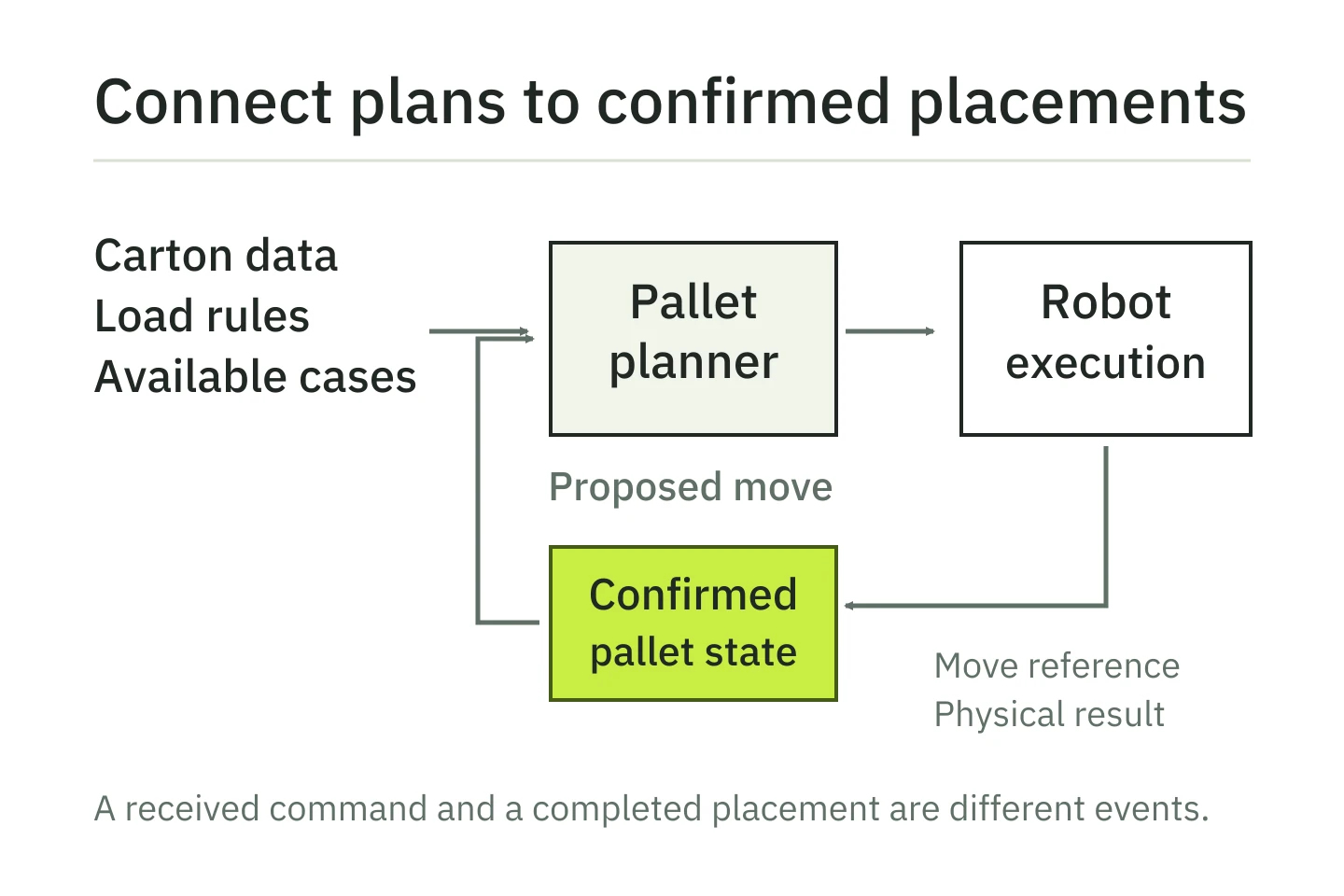
Mixed-case palletizing software chooses placements for a pallet containing different products or carton formats. An automated cell must also connect that plan to available cases, executable robot moves and a reliable record of the pallet’s contents.
Start by assigning those responsibilities. A layout calculator, warehouse system and robot controller may cover different parts of the process.
If the first decision is whether you need collection, single-SKU stacking or a planned mixed order pallet, start with the mixed-case and single-SKU overview. This guide focuses on the planner’s data, interfaces and acceptance; it does not establish that an unloading robot supplies those software functions.
Use the software requirements worksheet to compare suppliers against the same data, outputs and recovery tests.
Name the system that owns each decision
The four functions are:
- Identify the carton: link a physical reference to its SKU, profile and condition.
- Plan the load: choose a destination, position, orientation and next case.
- Execute the move: check access and equipment constraints, then perform the placement.
- Confirm the state: record the completed action and update the pallet’s contents.
One supplier may combine these functions. A project with separate systems needs an interface and an owner at every handoff.
A warehouse management system (WMS) may own orders and inventory transactions. The WMS receiving guide explains why a completed robot move and an accepted stock receipt can be different events.
Supply the data the planner actually uses
| Data | Minimum definition | Question for the supplier |
|---|---|---|
| Carton profile | Filled dimensions, mass, orientation and packaging version | What happens when a profile is unknown or changes? |
| Physical identity | Carton reference, SKU, stock owner and condition | How do retries remain tied to the same carton? |
| Order and availability | Required quantities, destination and cases present or expected | What happens when a case is late, extra or missing? |
| Load rules | Pallet geometry, height, mass, support and destination restrictions | Which rules does the planner check, and which need external review? |
| Cell constraints | Gripper access, supported moves and buffer retrieval | Who checks that the placement can be executed? |
| Current pallet state | Confirmed placements, pending moves, holds and pallet identity | How is this state recovered after an interruption? |
Use measured filled-carton data and retain its version. Ask which uncertainty or variation the model permits. Leave missing packaging-strength data unresolved until the packaging owner supplies it.
A plan that fits geometrically still needs the load support and stability assessment. Specify the planner’s checks and the physical evidence they depend on.
Choose known-order or live-arrival planning
Known-order planning starts with the required case set. It can calculate a sequence and ask storage or retrieval equipment to supply it. Define how incomplete orders and changed carton profiles affect that plan.
Live-arrival planning makes or revises decisions as cases become available. Ask what the planner needs to know about future cases, when it buffers or diverts a carton, and which already completed placements remain fixed.
Mujin’s palletizing description gives an example of planning that responds to arrivals using a live cell model. Swisslog’s ACPaQ description describes stored cases released in a calculated sequence.
Compare either architecture against the actual arrival stream. The timed buffer examples show how changed arrivals affect waiting positions even with the same carton set.
Define the move and its confirmation
TOPS’ MaxLoad description distinguishes placement and orientation outputs for robots from sequence outputs for case retrieval. Ask each supplier to show its actual interface contract.
For a placement, agree:
- Plan reference and revision, carton reference and target pallet.
- Position and orientation, including units, axes, origin and rotation convention.
- Carton-profile version used by the plan.
- Equipment response and the event that confirms completion.
A position measured from a pallet corner must be translated correctly into the robot’s reference frame. “Command received” also differs from “carton placed”: name exactly what each acknowledgement confirms.
Keep the proposed move until it is resolved, then update the completed-pallet record. The conveyor handshake guide covers the neighboring physical transfer.
Test a changed carton and a lost response
In this hypothetical test, plan P17, revision 7 uses profile B-02: 400 × 300 × 200 mm, 10 kg. Carton B104 is observed at 450 × 300 × 200 mm.
The software should apply the agreed mismatch rule, such as holding B104 for review or requesting a revised plan based on an approved profile. No acceptable tolerance or replacement pattern is supplied in this example.
If profile B-03 and plan revision 8 are approved, retain the link from B104 to its observation, profile and plan. Replan pending moves around the cartons already physically placed.
Now suppose B104 is placed, but the completion response is lost. Resending the request must not be treated as evidence that a second carton was placed. Resolve the physical location and stable move reference before continuing.
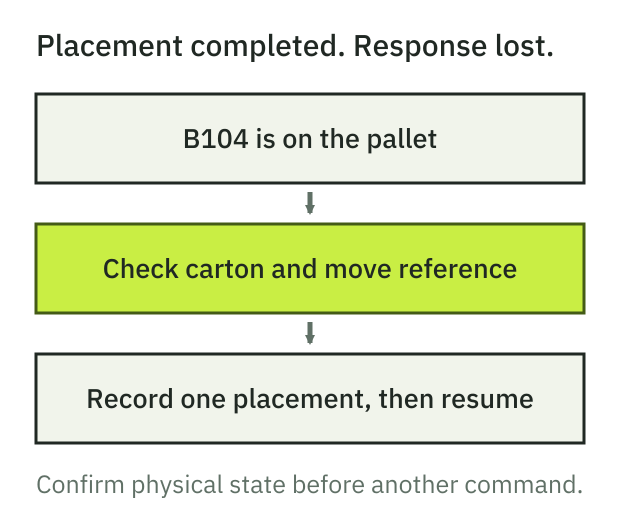
Test interruptions before a move starts, while its completion is uncertain, and after completion but before the response arrives. Specify when automatic recovery is supported and when an operator must verify the pallet.
Define the finished-pallet release to transport
Keep three events distinct: the final carton move is confirmed, the finished load is accepted for movement, and the pallet reaches its destination. Wrapping, inspection or an inventory hold can sit between the first two. A vehicle’s pickup confirmation does not establish that the contents were accepted into stock.
Give the transport task a pallet identity, collection and delivery locations, release status and completion reference. Agree what happens if a released pallet is moved manually, its destination becomes unavailable, or the response to a completed delivery is lost. Reconcile the physical pallet and the stable task reference before requesting another collection.
The KRONA warehouse AGV system brief connects pallet-building, vehicle and warehouse responsibilities. Assign the interface owner and test the proposed exchange; these requirements do not imply that every software connection is already supplied.
Compare offers with the same acceptance tests
| Test | Outcome to agree | Evidence to request |
|---|---|---|
| Approved carton mix | Valid plan and executable moves | Inputs, plan revision and completed-load record |
| Unknown or changed profile | Defined hold, rejection or approved revision | Observation and applied rule |
| Missing case or full buffer | Controlled alternative within the equipment’s scope | Sequence decision and buffer state |
| Lost placement response | Physical state resolved without assuming an extra carton | Move reference and reconciliation record |
| Resume a partial pallet | Actual contents checked before continuing | Pallet identity, confirmed and pending moves |
| New rule or software version | Review and repeat-test scope defined | Version history and test results |
Ask suppliers to classify each requirement as supported, needs testing, needs development or excluded, with evidence for the quoted configuration.
Compare the complete cost: data preparation, integration, commissioning, licenses, updates, support and recovery ownership. The cell budget guide helps align quote inclusions. The worksheet records responses without assigning untested products a score.
Questions about palletizing software
Is a pallet calculator enough?
It may help explore geometric arrangements. Check whether it also handles case identity and availability, equipment constraints, confirmed placements and recovery. Assign any missing function to another part of the system.
Does the WMS choose the pattern?
Some solutions combine order and pallet-planning functions; others separate them. Specify who chooses the pattern and what carton and cell data that system receives.
Bring a requirements pack to the integrator
KRONA U1 provides eligible carton extraction with conveyor or pallet handoff. Mixed-case planning and third-party software connections require a separately confirmed integration scope.
Bring carton profiles, finished-load rules, order examples, arrival records, the cell layout, current software versions and the completed worksheet. Use the mixed-case overview to confirm the finished-load job, then send the project brief.
When the finished load is a vehicle
For outbound carton loading, use the container and truck loading optimization requirements. Vehicle access, carton supply and confirmed container placements need their own application definition alongside the pallet-building requirements above.
- mixed case palletizing
- system integration
- palletizing
KRONA U1 unloads boxes from containers onto pallets or conveyors and also loads containers with boxes from pallets or conveyors. Explore KRONA U1 →
Discuss your pallet-planning and integration scope