
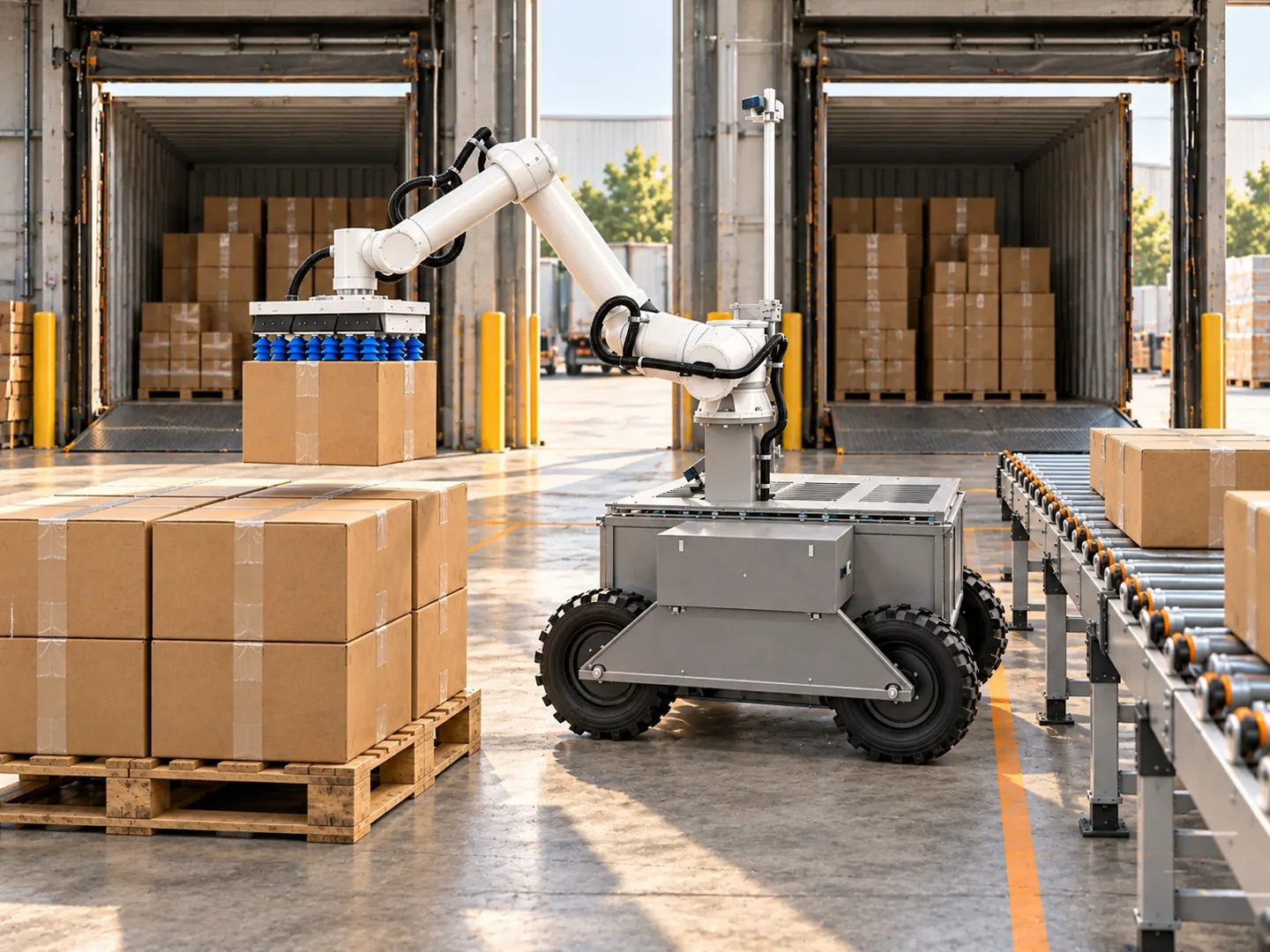
For a third-party logistics provider, or 3PL, warehouse automation has to fit several clients’ goods and changing workloads. Container unloading can be a useful first project when the warehouse repeatedly receives suitable floor-loaded cartons, controls the dock operation and can move the extracted boxes onwards without creating a new queue.
The decision starts with a client freight profile. Storage automation, order picking, transport planning and unloading address different parts of a warehouse. A robot at the dock will not solve a receiving bottleneck caused by slow inspection or unavailable pallet space.
Identify the work you can actually automate
Count floor-loaded containers or trailers separately from palletised arrivals. Record the hours spent extracting cartons, carrying them to the receiving point and managing exceptions. A load that is already on pallets presents a different handling task.
For each client, collect filled carton weights and dimensions, board condition, accessible faces and loading photographs. Include ordinary transported boxes, not only clean samples selected for a demonstration. The freight suitability guide explains the package and access questions.
A useful initial brief is specific: “We unload sealed cardboard cartons from four floor-loaded trailers each week and transfer them to a shared scanning conveyor.” That identifies a job an equipment supplier can evaluate.
Qualify the client and the dock together
| Question | Information to collect | Why it changes the decision |
|---|---|---|
| Is the freight eligible? | Actual filled cartons, weights, dimensions and condition | Repeated unsuitable packages reduce usable coverage |
| Who controls unloading? | Dock operator, site owner and operational decision maker | A transport booking alone does not establish deployment authority |
| Is volume recurring? | Weekly arrivals, seasonal peaks and daily schedules | Annual totals can hide long idle periods or overlapping demand |
| What follows extraction? | Scanning, inspection, conveyor capacity and pallet removal | Receiving can constrain the whole line |
| How long is the client contract? | Contract term, forecast confidence and change process | Equipment costs and responsibilities must fit the expected workload |
| Who handles exceptions? | Named operator, escalation route and recovery procedure | Residual work belongs in staffing and cost estimates |
Treat these as project questions, not universal pass/fail thresholds. A shared warehouse may need a workable schedule more than another machine: two clients arriving at the same dock simultaneously cannot both use its full capacity.
Record assessed volume by client
Keep a client qualification sheet with the recurring arrivals, handling-profile versions, assessed conditions, unknown freight and receiving owner. Download the client qualification worksheet; its empty evidence fields are meant to be completed from the actual operation.
Hypothetical screening example: Client A expects 600 cartons, of which 420 belong to profiles covered by the stated assessment. Client B expects 400, of which 200 are covered. The combined assessed-profile volume is 620 of 1,000 expected cartons, or 62%. The remaining 380 are pending or outside that assessment.
This is an eligibility planning denominator, not a completed-pick rate or measured KRONA result. Keep the two clients’ records separate: A’s 70% coverage does not transfer to B’s carton mix. Unknown volume belongs in the brief even when it is inconvenient for the business case.
Reserve a dock and receiving slot together
Hypothetical schedule: Client A reserves one shared dock from 08:00 to 10:00, followed by 20 minutes for the separately planned changeover. Client B’s 90-minute slot can start at 10:20 and finish at 11:50 if its receiver and assigned team are available.
A 09:30 start for B conflicts with A for 30 minutes before changeover is considered. An annual capacity total cannot resolve that conflict. Reserve the dock, robot, receiving route and exception support together, and record which assumption changes if one resource is unavailable.
Use the line-capacity guide to estimate interruptions. After initial qualification, the multi-client profile-change guide covers changed packaging and assessed-profile versions across successive loads.
Connect carton handling and pallet movement
A 3PL can receive floor-loaded cartons for one client and intact pallets for another. Keep the handling units separate in the project brief, then plan the shared scanning, staging and put-away work together. An unloading robot extracts cartons; an autonomous forklift moves an accepted pallet load between defined points.
The KRONA warehouse AGV system assessment connects those tasks to a common receiving outcome. Record which client owns each carton and finished pallet, which staging positions may be shared, and who releases a load for movement. A full pallet waiting for inspection is different from a pallet ready for put-away.
Include pallet removal in the dock reservation and client contract. Name the party responsible for empty-pallet supply, wrapping or load checks, blocked destinations and vehicle exceptions. Automation should not silently transfer those tasks into another client’s labour allocation.
For palletised arrivals, compare KRONA autonomous forklifts against the actual pallet, route and pickup arrangement. For clients with temperature-controlled goods, use the food and cold-storage application guide to define the environment for the proposed model.
Compare three practical approaches
Manual unloading can remain appropriate for infrequent, highly variable or unsuitable freight. Measure the full crew time, including preparation and finishing work, before using it as the baseline.
Conveyors and vacuum lifting assistance can reduce carrying or repeated lifting while people still select and extract the cartons. Assess the remaining labour and the room needed for the equipment.
Robotic unloading adds automated carton extraction for freight within its operating envelope. Its assessment still includes positioning, receiving flow, assistance, maintenance and recovery. Use the manual-versus-robotic comparison to define equivalent start and finish points.
Build a client-specific business case
Consider this hypothetical planning example, not a customer result. A client sends four containers each week over 48 operating weeks. That is 192 annual containers. If the current crew has three people working three hours per load, the baseline is nine person-hours per container, or 1,728 person-hours annually.
Those figures are workload inputs, not potential labour savings. The robotic model also needs eligible volume, actual unload time, remaining operator work, robot availability and the applicable commercial terms. Peak-week scheduling can require a different equipment count from the annual average.
Use the unloading cost worksheet and calculator to explore assumptions. Identify which entries are measured and which still need a pilot.
Compare the client contract with the equipment commitment
A robot can serve several clients, but the equipment agreement and each client’s commitment are separate. Record who pays for site work, unused capacity, reassessment, additional receiving work and the alternative process if a client’s freight changes.
For a six-month client contract, compare the client’s committed operating volume with the equipment offer for each active month. Use the quoted hourly rate and any agreed minimum commitment to calculate usage charges, then add the one-time installation fee and any conveyor supply.
Record any refundable deposit separately as an upfront cash requirement. Confirm integration, energy, remaining labour and other exclusions before presenting the client business case.
Confirm the applicable rate, commitment, setup scope and deposit terms in the offer. Ask how client cancellation, extra clients sharing the robot and changes in freight affect the agreement. The rental-contract guide owns billing and service terms; the ROI guide owns financial benefit calculations.
Agree responsibilities before commissioning
Assign responsibility for dock preparation, robot positioning, conveyor availability, carton exceptions and finished-pallet removal. Define who supplies site information, approves changes and makes the post-pilot decision.
For a 3PL, include the client in package qualification and acceptance. A warehouse-level throughput result does not establish that every client’s carton mix will work equally well. Record eligible coverage and assistance by freight group.
The pilot acceptance checklist helps compare sustained flow, damage, recovery and complete dock occupancy across representative loads.
Where KRONA fits in a 3PL project
KRONA U1 is a complete mobile unloading robot for eligible closed cardboard cartons weighing up to 25 kg, with conveyor or pallet handoff. Its maximum specification is up to 10 boxes per minute; actual operation depends on the freight and receiving process.
The same KRONA U1 also loads containers with boxes from pallets or conveyors. For a loading project, share the carton profile, box-supply layout and required container loading sequence.
If you are an integrator sourcing a system for a client, send the client freight profile, weekly arrivals, unload baseline and receiving layout. Discuss the project before choosing the deployment model or promising a client an outcome.
- warehouse automation
- container unloading
- system integration
KRONA U1 unloads boxes from containers onto pallets or conveyors and also loads containers with boxes from pallets or conveyors. Explore KRONA U1 →
Assess your shared warehouse flow