
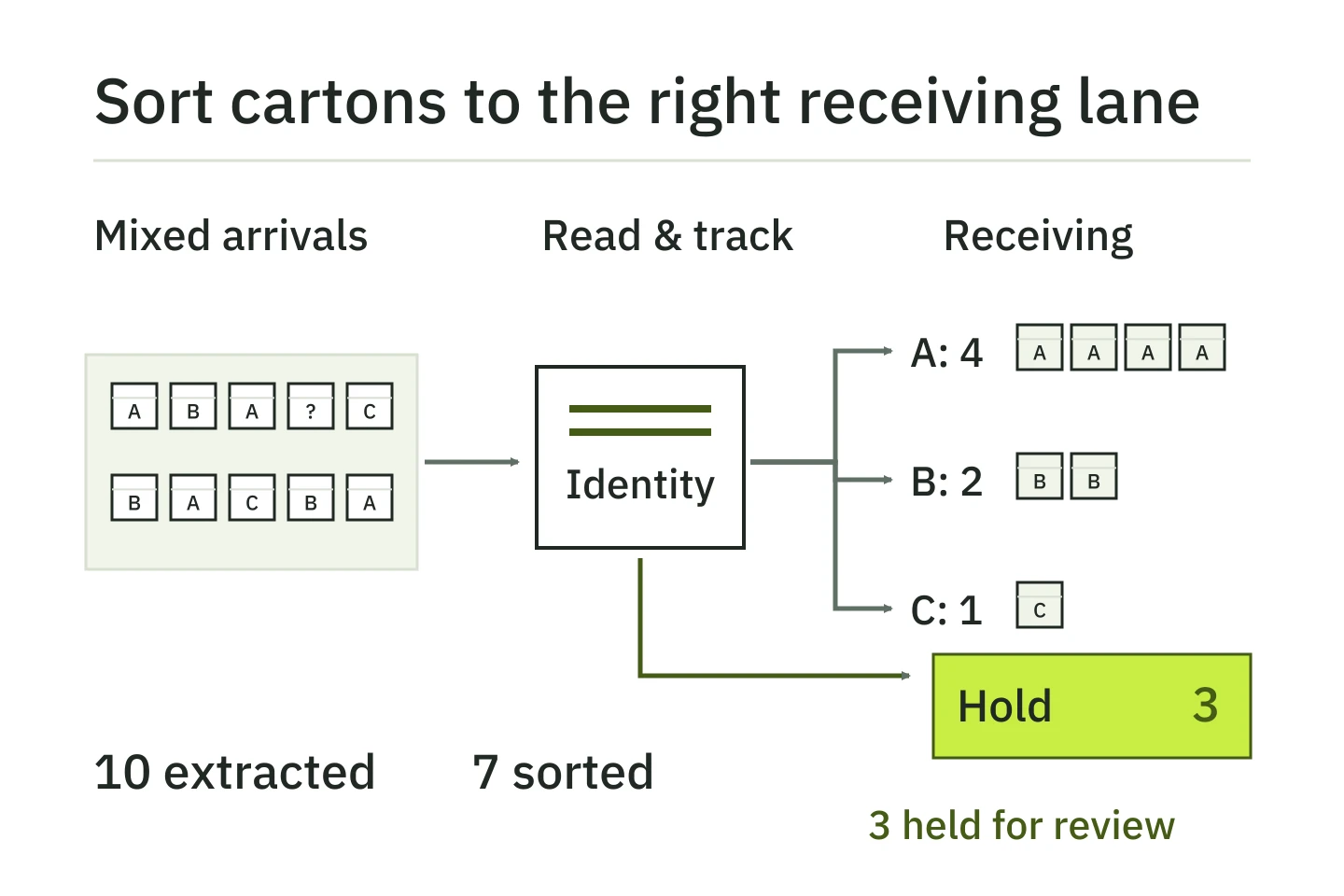
Mixed SKU container unloading needs a receiving route for cartons containing different products. After extraction, each carton must either reach the correct destination or enter a tracked hold for identification, inspection or an unavailable receiving position.
SKU means stock-keeping unit: the business’s identifier for a product variant. Different SKUs can use identical-looking cartons, so carton size and camera position alone may not reveal the product.
Start with the required receiving output, then work backwards through identification and handling. Use the routing worksheet to capture the route and its exceptions.
Choose the receiving output
Three common outputs need different equipment and controls:
| Output | What sorting must do | What the layout needs |
|---|---|---|
| Mixed receiving pallet | Keep the load together and record its contents | A receiving position and a process for unresolved cartons |
| Separate single-SKU pallets | Match each carton to its SKU and stock owner | Available pallet positions, replacement space and a hold route |
| Planned mixed order pallet | Allocate cases to an order and supply the required sequence | Identification, reordering and a verified finished-load plan |
Inspection can interrupt any of these routes. Give it a physical destination and a release procedure.
The mixed-case palletizing overview explains the finished-load choices. A pallet used to collect inbound cartons may still need sorting or rebuilding before shipment.
Place identification where the label can be read
Decide where identity is established: inside the container, at the unloading handoff, at a conveyor scan point or at an operator station. Check label position, visibility and condition on representative filled cartons.
If scanning happens after extraction, the first receiving position must accept cartons whose final destination is still unknown. Define how that position handles a missed read and how long it can hold the arriving stream. The handoff guide covers the physical transfer.
Keep two identifiers separate:
- Product identity: which SKU and pack quantity the carton contains.
- Physical identity: which individual carton is being tracked through scans, holds and transfers.
The GS1 logistics-label guideline distinguishes a trade-item identifier, the Global Trade Item Number (GTIN), from a logistics-unit identifier, the Serial Shipping Container Code (SSCC). Mixed-unit contents can be linked to the SSCC through electronic information.
Do not assume every incoming carton already has a unique SSCC. Agree a tracking method that distinguishes two cartons sharing a product barcode from two scans of the same carton.
Reserve the destination before releasing the carton
“SKU B goes to pallet B” fails when pallet B is full or being removed. The route needs a clear available/full signal, a reservation for the next transfer, and confirmation that the carton arrived.
Choose a response for each interruption:
- Unreadable or unexpected label: hold for identification.
- Damage requiring inspection: route to the inspection position.
- Full or unavailable destination: use an assessed alternative position, wait in a controlled buffer, or stop the upstream transfer.
- Missing transfer confirmation: check the carton’s location before repeating the move.
Size the hold positions and assign someone to clear them. An exception lane can become the receiving bottleneck even while the main conveyor remains available.
For separate single-SKU pallets, include pallet removal and replacement in the layout. For planned mixed pallets, define the reorder-buffer requirements downstream.
Follow ten cartons through the route
This hypothetical example begins at the identification point. P-A, P-B and P-C are receiving destinations; a hold is a separate tracked location.
| Carton | Observation | Destination |
|---|---|---|
| C01 | SKU A; destination available | P-A |
| C02 | SKU B; destination available | P-B |
| C03 | SKU A; destination available | P-A |
| C04 | Identity unresolved | Identification hold |
| C05 | SKU C; damage review | Inspection hold |
| C06 | SKU B; P-B unavailable | Destination hold |
| C07 | SKU A; destination available | P-A |
| C08 | SKU C; destination available | P-C |
| C09 | SKU B; P-B available again | P-B |
| C10 | SKU A; destination available | P-A |
Seven cartons reached their destinations; three remain held. P-A received four, P-B two and P-C one. The warehouse has ten extracted cartons and seven completed destination transfers. The WMS may report a different goods-receipt count, depending on its acceptance rules.
When C06 is released to P-B, completed transfers rise to eight and held cartons fall to two. Extraction remains ten: C06 is the same carton, not another arrival.
The worksheet contains this example and a blank observation row. Add timestamps to measure identification delays, inspection time and destination waits. Keep retries attached to the original carton reference.
Measure the route, not just the robot
SKU count does not describe gripping difficulty. Two products may share suitable packaging; one product may arrive in several carton versions with different weights, tape or deformation.
Record filled dimensions and weights, carton condition, accessible faces, mix by load and actual arrivals. Multi-client warehouses should also retain the stock owner and packaging version; the 3PL profile guide covers that change history.
During a trial, report:
- Unique cartons extracted, identified, transferred and held.
- Time spent waiting for identification or a destination.
- Operator assistance and unresolved exceptions.
- Complete elapsed unload time, including receiving stops.
Test a full pallet, an unreadable label and recovery from a lost transfer confirmation. Use the line-capacity guide to check the slowest stage and the WMS guide to define receipt events.
Questions before a trial
Can a 3D camera identify the SKU?
A camera may locate or measure the carton. Product identification still needs a supported label read or another verified association with the product data. Ask the supplier which information the offered system actually reports.
Does mixed SKU unloading require mixed-case palletizing?
Only when the required output is a planned mixed pallet. Receiving may instead collect cartons, sort them into single-SKU pallets or send them to inspection.
Send a routing brief for your freight
KRONA U1 unloads eligible floor-loaded closed cardboard cartons up to 25 kg onto a conveyor or pallets. Highly mixed freight needs individual review. Identification, sortation and mixed-pallet planning must be specified as part of the downstream project.
Provide filled-carton samples, load-wall photos, the destination layout and a routing log that includes holds. Send the integrator project brief to assess the complete receiving route.
Planning the outbound job
Identifying and sorting inbound cartons is different from forming an outbound load. The mixed-SKU container loading example follows required cartons through supply, placement and confirmation; the loading solution guide connects that plan to conveyors and robotic handling.
- mixed case palletizing
- container unloading
- system integration
KRONA U1 unloads boxes from containers onto pallets or conveyors and also loads containers with boxes from pallets or conveyors. Explore KRONA U1 →
Assess your mixed freight and sorting route