
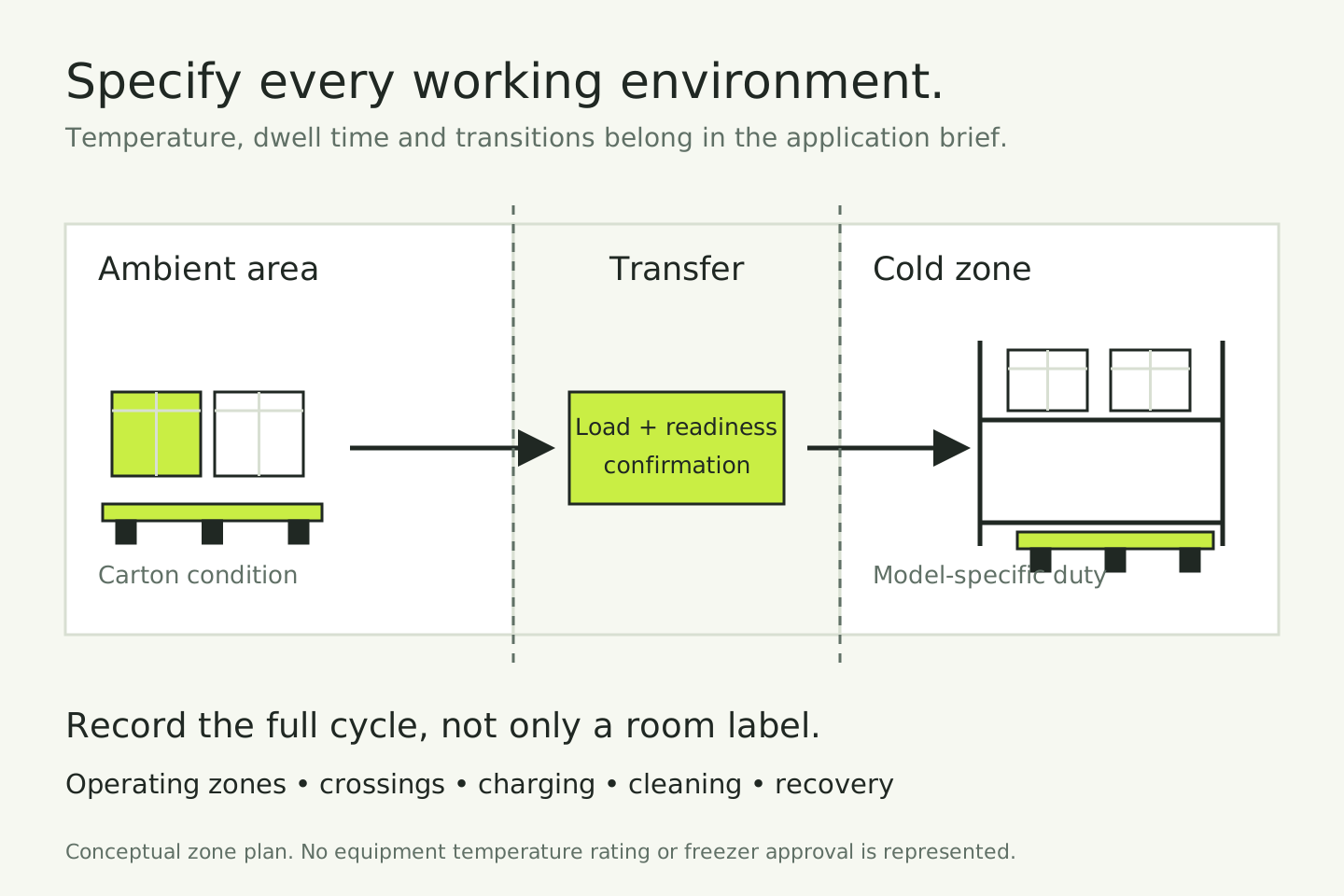
Food warehouse automation starts with the handling unit and its environment. Sealed dry cartons at an ambient receiving dock, chilled pallets and products stored frozen can require different equipment configurations. Name the actual temperature exposure and carton condition at each stage before selecting a robot.
For KRONA, eligible closed-carton handling and pallet transport can form part of one assessed workflow. The selected model, operating conditions and interfaces determine the scope; a food application does not automatically establish frozen-operation or washdown suitability.
Map the environment for each task
| Working area | Record from the site | Selection question |
|---|---|---|
| Ambient dry receiving | Filled carton condition, load range, floor and working space | Can the proposed carton handling and pallet handoff work with transported samples? |
| Chilled area | Actual temperature range, exposure time, humidity and cleaning process | Is the complete selected configuration approved for that duty? |
| Frozen storage | Actual temperature and duration, load/floor condition and recovery access | Is there model-specific support for the defined environment and mission? |
| Warm-to-cold transition | Route, number of transitions and dwell periods | How are condensation and the operating cycle addressed? |
| Cleaning or wet area | Applied method, substances, frequency and exposed components | Does the equipment configuration match the actual cleaning regime? |
Use measured ranges and durations rather than a single label such as “cold store.” Include charging, parking and maintenance locations because the vehicle or carton-handling equipment may experience those areas too.
Toyota’s cold-room guidance identifies condensation during temperature changes as an equipment concern. Its cold-storage equipment overview also illustrates why environment suitability belongs to a selected configuration, not the generic word forklift.
Keep carton handling separate from pallet transport
For carton handling, inspect the filled box as it arrives at the pick point. Record wet or softened board, film, accessible gripping surfaces, labels, damage and any restricted contact areas. A carton suitable when dry may present a different grip after its actual storage and transport cycle.
For pallet movement, specify the load carrier, mass distribution, overhang, stability, pickup geometry and route. Include the condition of pallets and the permitted storage interface. A suitable pallet-transport configuration does not, by itself, solve individual case extraction or product identification.
The warehouse robot types guide separates these tasks. The carton-gripper guide addresses the contact and tooling questions for box handling.
Decide where the handoff belongs
- Ambient carton workUnload, identify and prepare an accepted load within the assessed environment.
- Defined transfer pointConfirm the load, receiving permission and the equipment allowed at the boundary.
- Qualified cold-zone movementUse the selected configuration for its approved storage route and operating cycle.
An ambient-to-cold handoff can allow different equipment to serve different areas. It also introduces another receiving position, availability decision and recovery case. Compare that arrangement with a model-approved cross-zone route using the same loads and operating window.
Count the complete cycle. In an illustrative route, six missions each enter a cold area and return through the same boundary: twelve crossings. That exposure differs from six movements performed entirely inside one zone. The appropriate operating arrangement depends on the selected equipment and the real temperature/humidity cycle, not this example count.
Define stock rotation and traceability decisions
Identify which system owns lot, expiry, stock status and storage destination. If the warehouse applies first-expiry-first-out or another rotation rule, the task released to the equipment must reflect that site’s decision. A robot moving the correct physical pallet is only one part of the process.
GS1’s logistics-unit identification guidance describes linking a physical logistics unit to information through its identifier. Confirm the actual labels and records used by the site, and test their readability after the representative handling cycle.
Use the WMS receiving guide for the event, quantity and acceptance contract. Product-quality and stock-release decisions remain with the defined site process.
Test the complete operating cycle
Build the application test from representative filled packaging, pallets, pickup positions and approved environmental conditions. Include a full receiving/delivery cycle, the expected temperature transitions, waiting, charging arrangements and recovery from a blocked destination.
Record carton condition, successful pick/place or pallet transfer, readable identity, remaining manual work and output over the complete window. Separately record stops for doors, pallet exchange, receiving checks and stock availability. Do not transfer an ambient demonstration rate into a cold-storage capacity calculation.
Food automation may also involve storage cranes, shuttles, conveyors or other systems. Swisslog’s food and beverage overview provides examples across those categories. Their existence does not establish the environmental rating or integration scope of another supplier’s robot.
Bring the environment into the KRONA brief
For ambient eligible closed cardboard boxes, review KRONA U1 carton loading and unloading and the required pallet or conveyor handoff. For pallet travel, use the KRONA autonomous-forklift assessment with the actual temperature and load requirements.
If the site presents material on compatible stands or carriers, include the KRONA lifting AGV option in the handling comparison. Its under-load entry and lifting interface differ from mast-and-fork handling. The carrier and selected vehicle still need to match the actual environment; the lifting arrangement alone establishes no cold-storage rating.
Bring an annotated zone layout, exposure records, filled packaging and pallet examples, cleaning requirements, stock-rotation rules and the intended receiving/delivery finish point to the warehouse systems assessment. Model-specific application review will determine which KRONA equipment and interfaces fit that job.
- food and beverage
- cold storage
- warehouse automation
KRONA U1 unloads boxes from containers onto pallets or conveyors and also loads containers with boxes from pallets or conveyors. Explore KRONA U1 →
Discuss the food warehouse application