
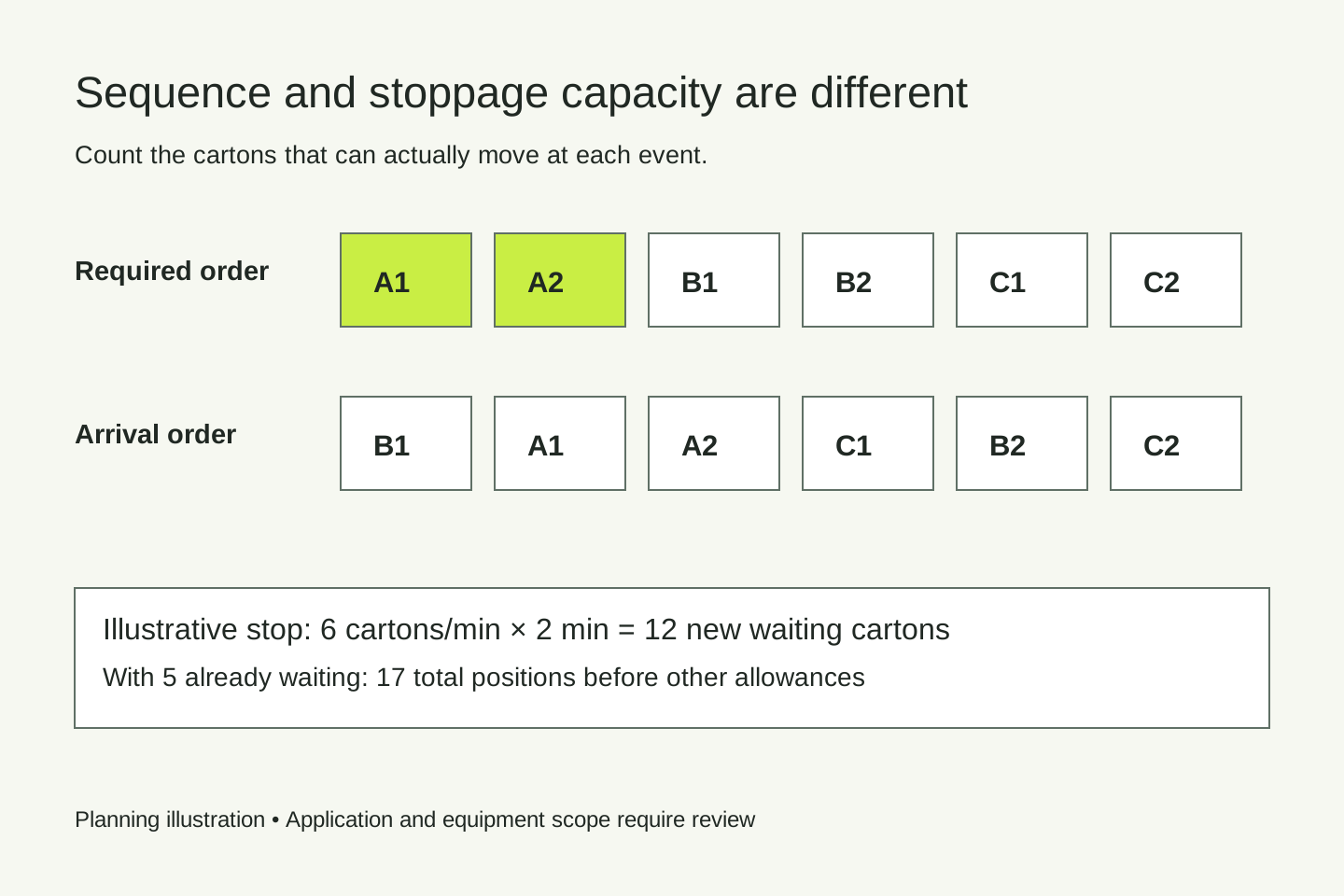
A loading pattern describes where cartons finish; the supply sequence determines whether the loading equipment can reach that result. Trace what arrives, what can be placed and what must wait. Keep positions used to reorder cartons separate from capacity reserved for a temporary stop.
This guide concerns outbound carton loading into a truck or container. The existing mixed-case palletizing buffer guide addresses pallet building. The underlying queue questions are related, but a vehicle introduces its own access, loading direction and finished-load requirements.
Use the editable outbound sequence worksheet to record arrival times, required order, available placements, waiting cartons and interruptions. The worksheet helps document a model; it does not choose a conveyor or validate robot motion.
Begin with the approved placement order
Identify the required cartons and plan revision before tracing their supply. Record which placements must precede others and the reason: access, approved support, destination order or the loading method. Distinguish a mandatory precedence rule from a preference the planner can change.
For each step, identify the carton reference, target location and completion event. A carton visible upstream is not necessarily available to the robot. It may still need identification, transfer into the pick zone or confirmation that the next destination can accept it.
Describe how supply is released. A controlled retrieval system can potentially send a requested carton; a simple conveyor may deliver an order that cannot be changed. A queue with 20 positions also does not establish that the fifth waiting carton can be selected without moving the four ahead of it.
Trace two arrival orders for the same load
Take the six-carton example from the mixed-SKU loading plan: required placement order A1, A2, B1, B2, C1, C2. Assume each arrival is separated by enough time to complete all available placements, and a waiting carton can be retrieved independently.
In the first case, supply arrives in the required order. No carton waits because of sequence under these simplified assumptions. There can still be waiting because of a slow placement, interruption or unavailable transfer point.
In the second case, supply arrives B1, A1, A2, C1, B2, C2. Hold B1 until A1 and A2 are placed. Later, hold C1 until B2 is placed. The peak waiting count is one. This is a result of that arrival trace and retrieval assumption, not a general buffer-size recommendation.
Now change the arrivals to B1, B2, C1, C2, A1, A2. Four cartons wait before A1 arrives. If the waiting arrangement cannot release A1 and A2 without obstruction, the same final pattern may require a different supply route, order or temporary holding method.
Add time to the count model
An event trace should distinguish arrivals from completed placements. Record when each carton becomes available, when it enters a waiting position and when it leaves. Include retrieval and transfer time rather than assuming those movements are free.
At each event, the simplified waiting count is previous waiting + arrivals admitted − cartons released from waiting. Keep cartons in motion or in the robot’s active pick position in a separately defined state so the same carton is not counted twice.
Use measured intervals for representative mixes. A uniform average can conceal a burst of arrivals or a slower group of placements. Test the sequence against the intervals and stoppages that the operation actually sees, including replenishment and changes of loading position.
Size temporary stoppage capacity explicitly
Consider a hypothetical feed that continues at six cartons per minute while placement stops for two minutes. An initially empty buffer receives 12 cartons during the stop. If five cartons are already waiting when the stop begins, the simplified scenario requires 17 total usable positions to accept all of those arrivals.
| Input or result | Value | Meaning |
|---|---|---|
| Continued feed | 6 cartons/min | Assumed admitted arrivals during the stop |
| Placement interruption | 2 min | Assumed period with no releases |
| New waiting cartons | 12 | 6 × 2 |
| Already waiting | 5 | Occupied positions at the start |
| Required total in this model | 17 | 5 + 12, before other allowances |
This calculation assumes the feed does not stop and the stated positions are available for these cartons. Real controls may stop supply sooner; another dock or destination may consume shared positions. Document those conditions rather than adding arbitrary spare capacity and calling the result a design.
Check whether the backlog can clear
If supply continues at six cartons per minute after the stop and placement resumes at six, the backlog cannot shrink in that simplified model. The line needs surplus placement capacity, a controlled feed pause or another agreed route to recover.
If placement can sustain eight cartons per minute while supply stays at six, the net clearing rate is two per minute. The 12 cartons accumulated during the stop would take six minutes to clear, assuming no further losses. Clearing the full queue of 17 would take 8.5 minutes under the same assumptions.
Those are arithmetic scenarios, not KRONA rate claims. Confirm whether an observed faster rate can be sustained for the actual mix and whether the waiting arrangement permits the required retrieval sequence during recovery.
Convert positions into a physical arrangement
A count of positions does not specify conveyor length. Filled carton dimensions, orientation, gaps, accumulation behavior and the permitted contact between cartons determine the physical route. Mixed sizes can consume different lengths even when the carton count is unchanged.
Draw the smallest and largest cartons at each transition. Review roller support, belt-to-roller gaps, transfer heights and the agreed stopping zones. Mark operator access and the route for rejected cartons. A waiting area that blocks access to the next required carton cannot be assessed by capacity alone.
Krona offers both inclined belt and supported-roller loading conveyors and telescopic belt conveyors. Select the construction against the working envelope and support requirements; a buffer calculation does not make the mechanisms interchangeable.
Test release, blockage and restart
Agree which system grants permission to release a carton and which event confirms that the receiving zone has accepted it. Define full-buffer behavior before commissioning: upstream stop, alternative destination, operator intervention or another explicitly supported response.
Test a late required carton, unreadable identity, blocked transfer, unavailable robot and loss of a placement response. On restart, reconcile the cartons in waiting, in motion and already placed. Do not rebuild state from the intended sequence alone.
Bring the arrival trace, usable waiting positions and interruption records to the loading-system review. Use the robot-conveyor handshake checklist for the local transfer and the loading pilot protocol for the complete operation.
- container loading
- mixed SKU
- loading sequence
- conveyors
KRONA U1 unloads boxes from containers onto pallets or conveyors and also loads containers with boxes from pallets or conveyors. Explore KRONA U1 →
Review a loading sequence