
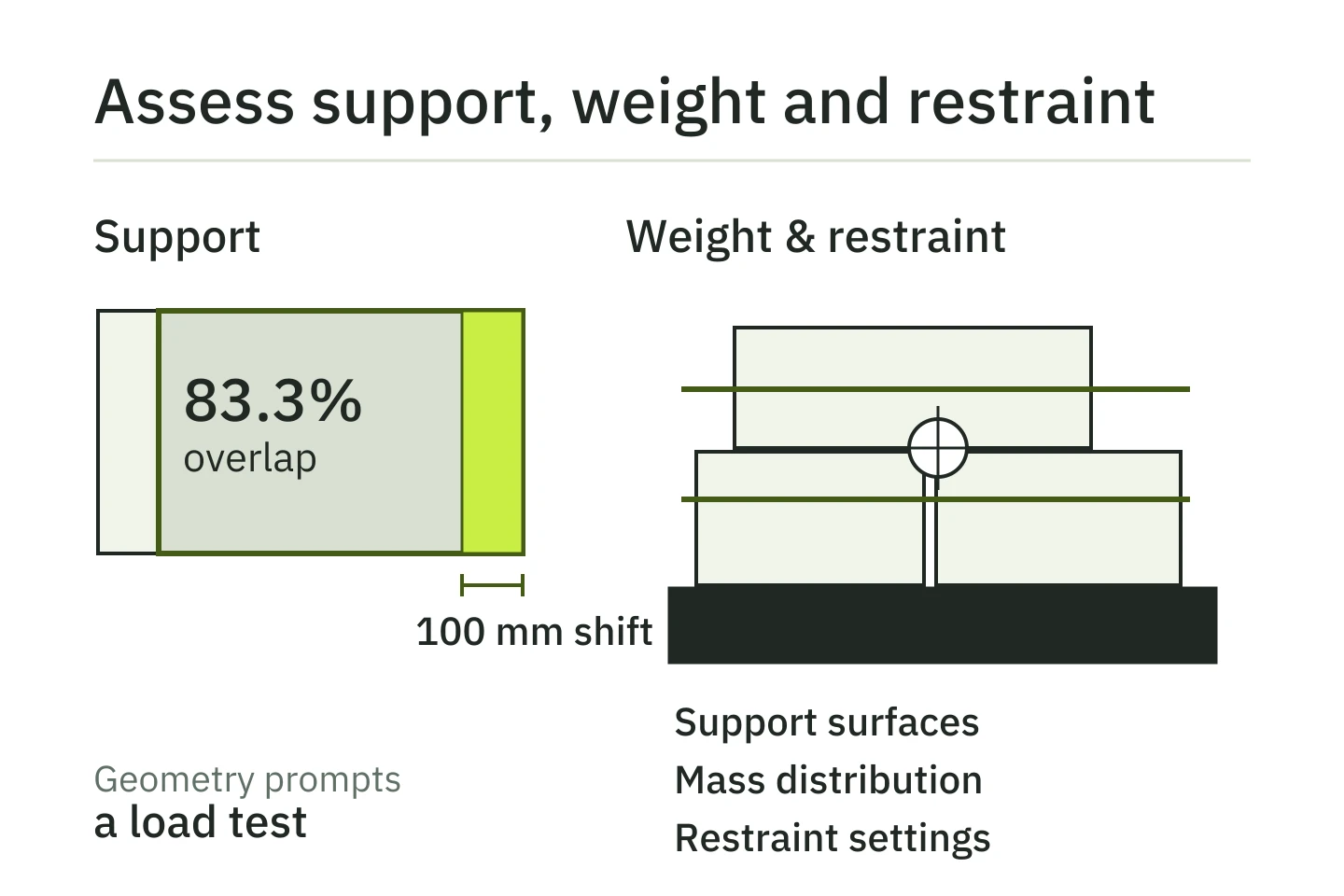
A stable mixed-case pallet keeps its cartons supported and secured throughout the intended handling route. Carton strength, weight distribution, pallet support and wrapping all affect the result.
Packing every carton into the available volume answers a geometry question. Load validation also asks whether the packaging can carry the forces and whether the completed pallet behaves acceptably during handling.
Use the load-validation worksheet to keep the carton mix, placement plan, restraint settings and test evidence together.
Start with the handling route
Define where the pallet goes after building: receiving, storage, road transport or store replenishment. Record the pallet type and condition, permitted height and mass, storage support, restraint method and destination restrictions.
Smithers’ pallet-stability guidance describes acceleration, braking and cornering as dynamic events affecting a unit load. It identifies packaging, pattern, restraint and stack height as factors in the assessment.
The packaging and operations teams should choose test methods and acceptance criteria for that route. Evidence for a short receiving move does not automatically cover a road shipment.
Record the filled carton, not just the catalog size
| Input | Detail needed | Why it matters |
|---|---|---|
| Filled dimensions and mass | Orientation, carton version and variation | Determines fit, support and weight distribution |
| Packaging | Board, closures, perforations, condition and strength evidence | Determines how the case carries load |
| Contents | Offset or movable contents | The mass center may differ from the geometric center |
| Contact surfaces | Pallet deck, carton faces, gaps and placement tolerance | Shows the load path through the stack |
| Finished configuration | Pattern, height, wrapping or other restraint | Defines the complete load to evaluate |
A bulging face, weakened corner or packaging change can alter support. Leave missing strength information unresolved until the packaging owner supplies evidence.
Assess how force passes through each carton to the pallet deck. A large contact area can still load an unsuitable face. Gripping is a separate check; use the palletizing gripper guide for pickup and release.
See how a 100 mm shift changes support
This hypothetical geometry example uses a flat 600 × 400 mm lower-carton top face and an equally sized upper-carton base. Support is limited to their projected overlap; deformation and neighboring cartons are excluded.
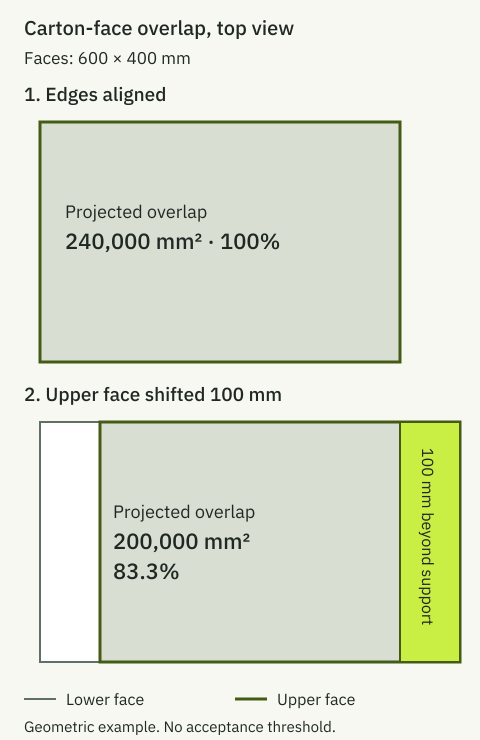
Aligned faces overlap over 600 × 400 = 240,000 mm², or 100% of the upper base. A 100 mm shift leaves 500 × 400 = 200,000 mm², or 83.3%, with an unsupported strip on one side.
The carton set and packed volume have not changed. The support has. 83.3% is a geometric result, not an acceptance threshold: it does not predict crushing, sliding, tipping or wrapping performance.
Repeat this contact check through the real stack, including placement tolerances and deck gaps. Use it to find interfaces that need packaging review.
Check where the weight sits
In a second hypothetical calculation, the lower carton is 300 mm tall and the upper carton is 200 mm tall. Uniformly distributed contents put their vertical mass centers at 150 mm and 400 mm above the lower carton’s base.
| Mass arrangement | Calculation | Combined mass center |
|---|---|---|
| 16 kg below; 8 kg above | (16 × 150 + 8 × 400) ÷ 24 | 233.3 mm |
| 8 kg below; 16 kg above | (8 × 150 + 16 × 400) ÷ 24 | 316.7 mm |
Total mass remains 24 kg, but the mass center rises by about 83 mm. The example excludes the pallet and assumes centered contents; it provides no tipping limit. The heavier lower case must also have the strength and support to carry its load.
NIST’s mixed-pallet metrics research treats pallet design as a problem assessed through quantitative measures. A useful review considers several properties, rather than approving a load from one packing score.
Evaluate the pattern and restraint together
Smithers describes a tradeoff between column alignment for compression and interlocking for lateral stability. It also notes that film and wrapping settings affect load behavior.
Assess the actual mix of carton sizes, strengths and weights with the retention system applied. Record film or restraint specification, application settings, pallet attachment and other packaging components with the tested arrangement.
A repeated single-SKU pattern may need revision for mixed cartons. Rotating a layer does not resolve a missing support surface or a weak lower case.
Test representative mixes and changes
Include combinations that expose the limits of the intended operation:
- Small cartons over larger cases, and larger cases over small ones.
- Concentrated heavy products or offset contents.
- Tall loads and partial final layers.
- Changed board, perforations, tape or wrapping.
- Different storage support or transport destinations.
For each test, retain the carton versions, mix, placement plan, pallet, restraint settings, conditions and observations. Record who accepts the result and the limits it covers. Link that evidence to the pilot acceptance record.
If the planner changes arrangements as cases arrive, keep the rule and plan versions that produced the tested load. The software requirements guide covers that record.
Include pickup and the real pallet route
A pallet may be accepted beside the robot yet still need inspection, restraint or a different handling arrangement before transport. Include the actual pallet construction, fork-entry arrangement, collection position and route in the finished-load brief. Record thresholds, turns, storage supports and the required delivery condition with the responsible site team.
For KRONA autonomous forklift transport, define which load is ready for pickup and which conditions keep it on hold. Assess the selected vehicle and load together; do not transfer a result from a different pallet, restraint or route without reviewing the change.
A partial or reworked mixed pallet also needs a clear status. Link its contents and any changed pattern to the confirmed pallet-state record before it is released. The acceptance question is whether the finished load suits its intended journey, not only whether the last carton could be placed.
Questions about pallet stability
Is a dense mixed pallet necessarily stable?
Density measures use of space. It does not establish packaging support, restraint or behavior during handling. Assess the completed load against its intended route.
What changes need another review?
Changes to packaging, filled mass or dimensions, arrangement, pallet, restraint or handling can affect previous results. The responsible team should decide whether the change remains within the tested limits.
Include the finished load in the unloading brief
The mixed-case overview separates collection on a receiving pallet from planned mixed-pallet building. KRONA U1 provides eligible carton extraction with conveyor or pallet handoff; mixed-load planning and transport validation need their own project scope.
Send the required finished-load rules and packaging evidence with the freight profile. Discuss the receiving and palletizing requirements before selecting the downstream arrangement.
- mixed case palletizing
- palletizing
- cardboard cartons
KRONA U1 unloads boxes from containers onto pallets or conveyors and also loads containers with boxes from pallets or conveyors. Explore KRONA U1 →
Discuss your mixed-load acceptance requirements