
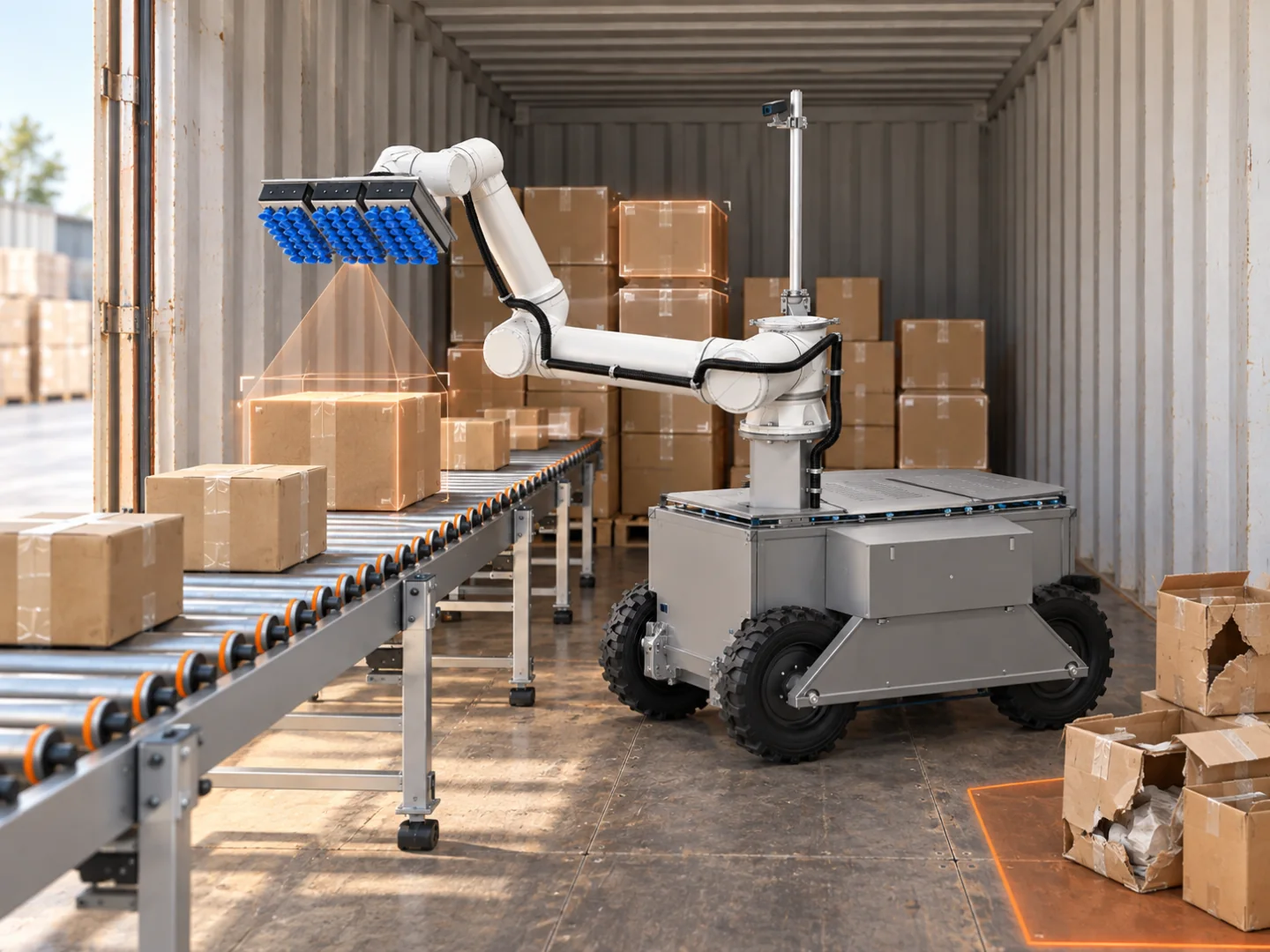
A container unloading robot picks individual cartons from a floor-loaded shipping container or trailer and transfers them to a receiving process. Choosing one starts with the freight and the handoff: a robot that can grip a box still needs a clear extraction path, somewhere to place it, and a workable response to exceptions.
Build the shortlist around a representative inbound load rather than a demonstration with convenient boxes.
Define the unloading task
“Container unloading equipment” covers several different jobs. A forklift removes palletised freight; a bulk discharge system empties loose material; a crane moves the container itself. None describes the same application as removing closed cartons from a wall of floor-loaded boxes.
Write a one-sentence application brief: where the cartons arrive, their filled weight and dimensions, how they are stacked, and where they must go. For example, “extract closed cartons from trailers and feed the existing receiving conveyor” identifies a different integration from “unload cartons directly onto pallets.”
Use the floor-loaded freight and pallets guide to separate extraction, pallet movement and depalletising before comparing equipment.
Compare the system architectures
| Approach | What to investigate | Where the process can stop |
|---|---|---|
| Mobile robot with arm, vision and gripper | Positioning, container access, reachable cartons and relocation between docks | Inaccessible cartons, exceptions or a blocked handoff |
| Conveyor-attached unloading system | Conveyor geometry, extension, robot clearance and carton transfer | Conveyor availability or a downstream queue |
| Manual handling with a vacuum lifter or conveyor | Operator access, lifting assistance and staffing | Labour availability, operator pace or receiving congestion |
These categories describe architectures, not a performance ranking. A vacuum-assisted manual process may improve an operation that cannot support a robotic installation. A mobile robot still requires a confirmed working area and operating procedure.
The robot comparison guide discusses Stretch, Pickle Robot, KRONA and other supplier approaches.
Test the carton, not just its weight
A package specification should include filled weight, dimensions, board condition, tape and labels, contact faces, and whether the contents shift. The front face exposed inside a container may be less suitable for gripping than the top face available on a conveyor.
Include transported cartons with ordinary compression and dents, alongside the most frequent package types. Identify open, wet, unstable or otherwise unsuitable freight and agree how it will leave the process.
For vacuum tooling, use the carton-gripper selection guide. A successful static lift does not establish that the same grip will survive the extraction and transfer movement.
Check the complete dock layout
Give the supplier measured container and door dimensions, dock clearance, thresholds, ramp gradients and floor conditions. Show the conveyor or pallet receiving area and the routes used by people, forklifts and vehicles.
Ask who positions the robot, prepares the dock, supplies utilities and handles a carton the robot cannot complete. For conveyor integration, establish the receiving capacity and the response when the line is full. For pallet handoff, establish available space, pallet replacement and any downstream scanning or sorting.
The conveyor-or-pallet workflow guide helps define that boundary. Site photographs are useful context, but critical dimensions need measurement.
Agree a pilot scorecard
Evaluate a stable configuration across representative loads. Record the same process start and finish for manual and robotic operation.
- Sustained throughput: cartons completed divided by the agreed elapsed operating time, including the stops defined in the test.
- Assistance: operator minutes and assistance events per load; a normalised count per 1,000 picks helps compare different load sizes.
- Package care: drops, damaged cartons and extra handling.
- Dock occupancy: preparation, unloading, exceptions and clearance before the next vehicle.
- Freight coverage: the share of incoming cartons inside the verified operating envelope.
Keep peak picking rate separate from whole-container performance. A downstream queue can limit a system even when the robot itself works quickly. The pilot acceptance checklist provides a practical review sequence.
Ask about the commercial deployment
Compare installation work, support responsibilities, service arrangements and the purchase, rental or usage model. Ask each supplier to confirm availability and support in the intended European country. Obtain the applicable site risk assessment and integration requirements rather than assuming that a robot description establishes suitability.
Use the unloading cost guide to compare the complete current process with a realistic operating scenario.
Separate mandatory fit from preferences in the shortlist
Ask every bidder to mark each requirement confirmed, conditional, outside scope or unknown, with a supporting document or proposed test. A weighted score can compare preferences after mandatory fit is established. A low price should not compensate for a carton weight outside the system’s limit.
| Requirement | Evidence to request | Shortlist consequence |
|---|---|---|
| Recurring carton profiles | Written envelope and representative freight test | Keep untested profiles out of confirmed coverage |
| Container access | Measured layout and movement review | Resolve critical clearance before the pilot |
| Required receiving flow | Defined handoff and line-capacity estimate | Include downstream equipment and responsibilities |
| Shift operation | Assistance procedure and local support scope | Include remaining operator work in the proposal |
| Commercial comparison | Quote inclusions, recurring charges and exclusions | Compare the same period and installed scope |
For example, a conveyor-based system can fit carton extraction but require a new receiving line at a site currently building pallets manually. Record the conveyor, scanning and pallet-building scope before comparing it with direct pallet handoff. Use the handoff guide to define the receiving destination.
Finish the shortlist with an unresolved-questions register: requirement, owner, evidence needed and decision date. That gives the pilot a purpose beyond watching a robot move.
Carry the shortlist into a comparable supplier brief
Use the downloadable supplier-assessment sheet for the evidence behind each confirmed, conditional or unknown requirement. If considering conveyor or lifting assistance alongside a robot, use the equipment-comparison worksheet to retain the same unloading and receiving boundary.
For multi-client warehouses, attach the 3PL client qualification sheet so recurring volume and assessment coverage stay tied to the relevant client rather than an unsupported site-wide total.
Where KRONA U1 fits
KRONA U1 is a complete mobile unloading system for eligible closed cardboard boxes weighing up to 25 kg. It offers conveyor or pallet handoff and a maximum specification of up to 10 boxes per minute. Actual throughput, unload time and assistance depend on the freight and site.
The same KRONA U1 also loads containers with boxes from pallets or conveyors. For a loading project, share the carton profile, box-supply layout and required container loading sequence.
KRONA offers a usage-based monthly plan after freight and site assessment. Send representative carton details, regular container volume and the receiving layout to start an assessment.
What should I send to an unloading robot supplier?
Start with filled carton dimensions and weights, photos of actual load walls, regular container or trailer volume, current unload times and the desired handoff. Those inputs make the first discussion about an application rather than a generic robot.
Before requesting comparable offers, use the unloading robot RFQ template to define the freight, site scope and evidence suppliers should quote.
- container unloading
- robot selection
- warehouse automation
KRONA U1 unloads boxes from containers onto pallets or conveyors and also loads containers with boxes from pallets or conveyors. Explore KRONA U1 →
Request a freight assessment