
Mixed-SKU container loading needs more than a list of box sizes. The loading team must know which cartons are required, which are available, where they may be placed and what to do when the actual supply differs from the plan. Keep the carton list, approved rules and loading sequence connected through one plan reference.
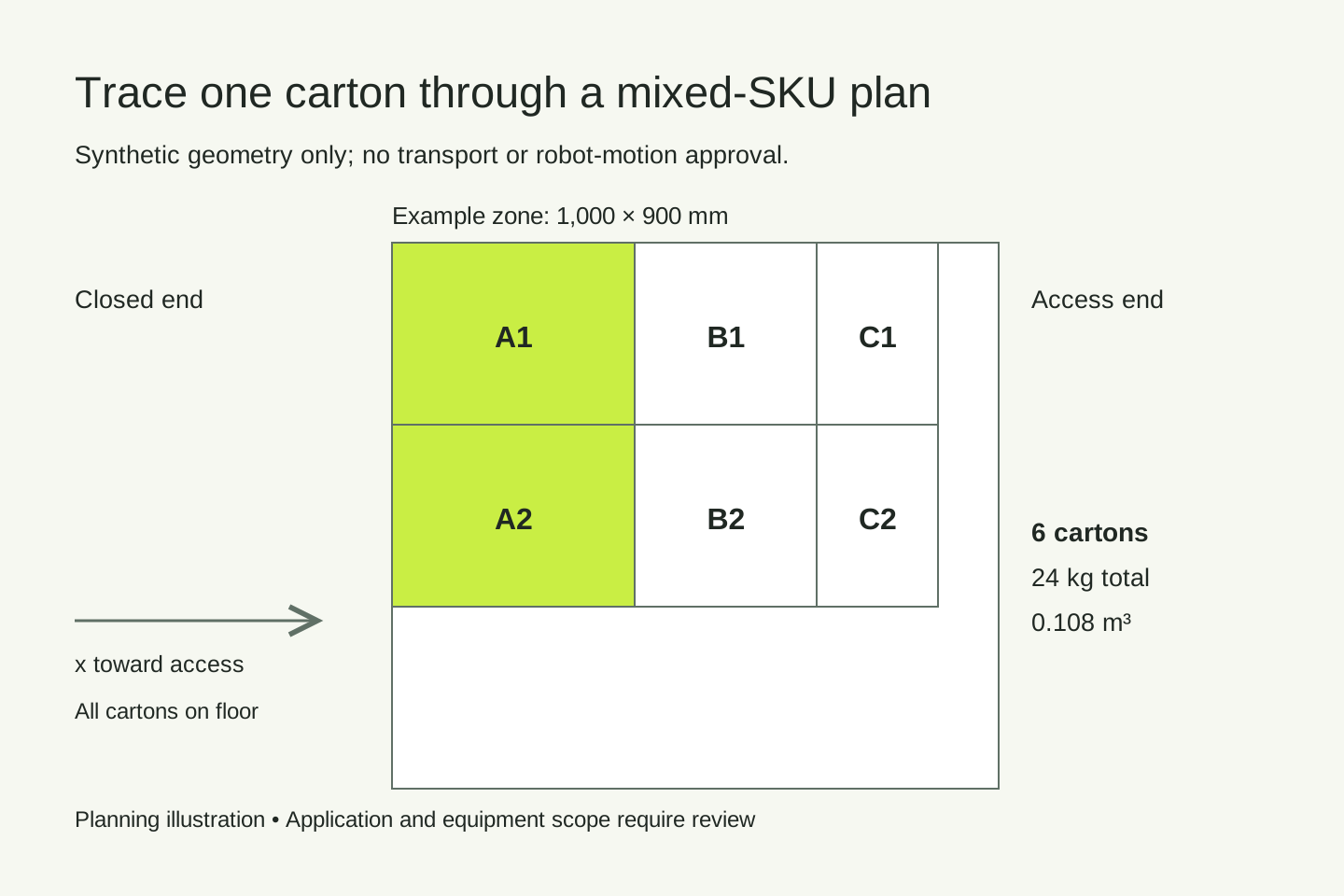
The example below uses six cartons and a small abstract loading zone so the sequence can be checked by hand. It illustrates records and decisions, not a complete container design. No loading performance, transport suitability or collision-free robot motion is implied.
Download the example dataset and open the editable loading plan and exception record. Replace the synthetic inputs with measured project data before reviewing a real application.
Collect the carton and vehicle inputs
A SKU identifies a product profile; a carton reference identifies one physical handling unit. Two cartons with the same SKU still need separate identities if placements, shortages and retries are to be reconciled individually.
Record filled dimensions, mass, quantity, packaging version and permitted orientations for each profile. Include the source of any support, crush, separation or restraint rule. Missing packaging evidence remains an open requirement rather than permission to stack freely.
For the vehicle, measure usable space, opening, intrusions and the intended equipment access. Identify the coordinate origin and units. On truck routes, provide approved mass-distribution constraints and any destination order. The optimization requirements guide covers that wider input brief.
Define a deliberately small example
Assume an abstract zone 1,000 mm long × 900 mm wide × 400 mm high, with x measured from its closed end toward the access end, y across the width and z upward from the floor. The example keeps every carton upright and on the floor. It does not specify tool clearance or a restraint method.
| SKU / profile | Filled dimensions, L × W × H | Mass per carton | Carton references |
|---|---|---|---|
| A / A-01 | 400 × 300 × 200 mm | 6 kg | A1, A2 |
| B / B-01 | 300 × 300 × 200 mm | 4 kg | B1, B2 |
| C / C-01 | 200 × 300 × 200 mm | 2 kg | C1, C2 |
There are two cartons of each SKU: six cartons and 24 kg in total. Their combined geometric volume is 0.108 m³: 0.048 m³ of A, 0.036 m³ of B and 0.024 m³ of C. These totals are useful reconciliation checks; they do not establish how many cartons fit a real container.
The zone is deliberately underfilled. A sequence example should not be mistaken for an optimization result. Real clearances, packaging limits, access and loading rules can reduce the space available for cartons.
Record the proposed placement order
Call the example plan L-01, revision 1. For each carton, record its lower corner at x, y, z in millimeters and the upright orientation. The assumed order builds from the closed end toward the access end.
| Step / move reference | Carton | Lower corner x, y, z, mm | Profile |
|---|---|---|---|
| 1 / L01-M01 | A1 | 0, 0, 0 | A-01 |
| 2 / L01-M02 | A2 | 0, 300, 0 | A-01 |
| 3 / L01-M03 | B1 | 400, 0, 0 | B-01 |
| 4 / L01-M04 | B2 | 400, 300, 0 | B-01 |
| 5 / L01-M05 | C1 | 700, 0, 0 | C-01 |
| 6 / L01-M06 | C2 | 700, 300, 0 | C-01 |
These modeled cartons do not overlap and remain within the abstract zone. Adjacent boxes touch in the model. That geometric check is narrower than a validated loading method: it does not prove approach clearance, gripping access, stability in transport or the feasibility of the assumed placement order.
Keep the coordinate definitions with the exported record. A robot interface might require a different reference point or frame. Name the party that performs and verifies that translation.
Trace a changed supply order
Suppose cartons arrive as B1, A1, A2, C1, B2, C2 while the required placement order stays A1, A2, B1, B2, C1, C2. For this simplified trace, assume arrivals are separated by enough time to complete the available placements and one waiting carton can be independently retrieved.
- B1 arrives first. Identify it and hold it; A1 is still required.
- A1 arrives. Place and confirm A1 using L01-M01.
- A2 arrives. Place A2, then retrieve and place the held B1.
- C1 arrives. Hold it while waiting for B2.
- B2 arrives. Place B2, then retrieve and place C1.
- C2 arrives. Place and confirm C2, then reconcile the load.
This particular trace uses at most one waiting position under its timing assumptions. It is not a physical buffer specification. Faster arrivals, slower placement, additional retrieval time or a conveyor that cannot retrieve a selected carton can change the requirement completely.
Use the outbound sequence and buffer guide to include timing. Existing mixed-case palletizing sequencing addresses a related but different job: building a pallet rather than loading a vehicle.
Keep the proposed and confirmed states separate
A proposed move does not establish that a carton is physically in place. Record when the loading equipment accepts the request and when the agreed completion event confirms it. Preserve carton identity and move reference across retries.
At the end of the example, the confirmed record should contain A1, A2, B1, B2, C1 and C2 once each, against L-01 revision 1. The required and confirmed quantities should match by SKU. Record missing, rejected or manually handled cartons separately rather than silently counting them as completed placements.
If the response for B1 is lost after placement, first resolve whether B1 is physically at its destination. Do not infer a second placement by issuing the same request again. An uncertain physical state needs reconciliation, with operator confirmation where required by the agreed process.
Test a missing or changed carton
If B2 never arrives, record the shortage and ask the responsible planner how to proceed around the placements already completed. A decision to omit B2, substitute another carton or change the sequence needs an approved plan revision and a clear effect on the remaining load.
If an observed B carton is 350 mm long while profile B-01 says 300 mm, hold the mismatch under the agreed rule. The 50 mm difference is not automatically an acceptable tolerance. Confirm the revised profile and reassess the relevant placements before continuing.
For an interrupted load, retain vehicle identity, plan revision, confirmed moves, pending moves and the physical review needed to resume. Treat a changed vehicle or carton profile as a new review condition rather than assuming the previous record remains sufficient.
Turn the example into a project brief
Bring a representative real carton list, measured vehicle geometry, available supply order and the approved load requirements to the assessment. Include ordinary loads and the mixes that regularly create waiting, rehandling or manual exceptions.
For actual load rules, use the responsible packaging and transport review, informed by the IMO CTU Code. A record template helps make decisions traceable; it does not approve the arrangement for transport.
KRONA’s loading assessment reviews carton supply, conveyors and robotic loading together. The loading pilot checklist turns the proposed sequence into tests and agreed evidence.
- container loading
- mixed SKU
- loading sequence
- system integration
KRONA U1 unloads boxes from containers onto pallets or conveyors and also loads containers with boxes from pallets or conveyors. Explore KRONA U1 →
Assess your loading flow