
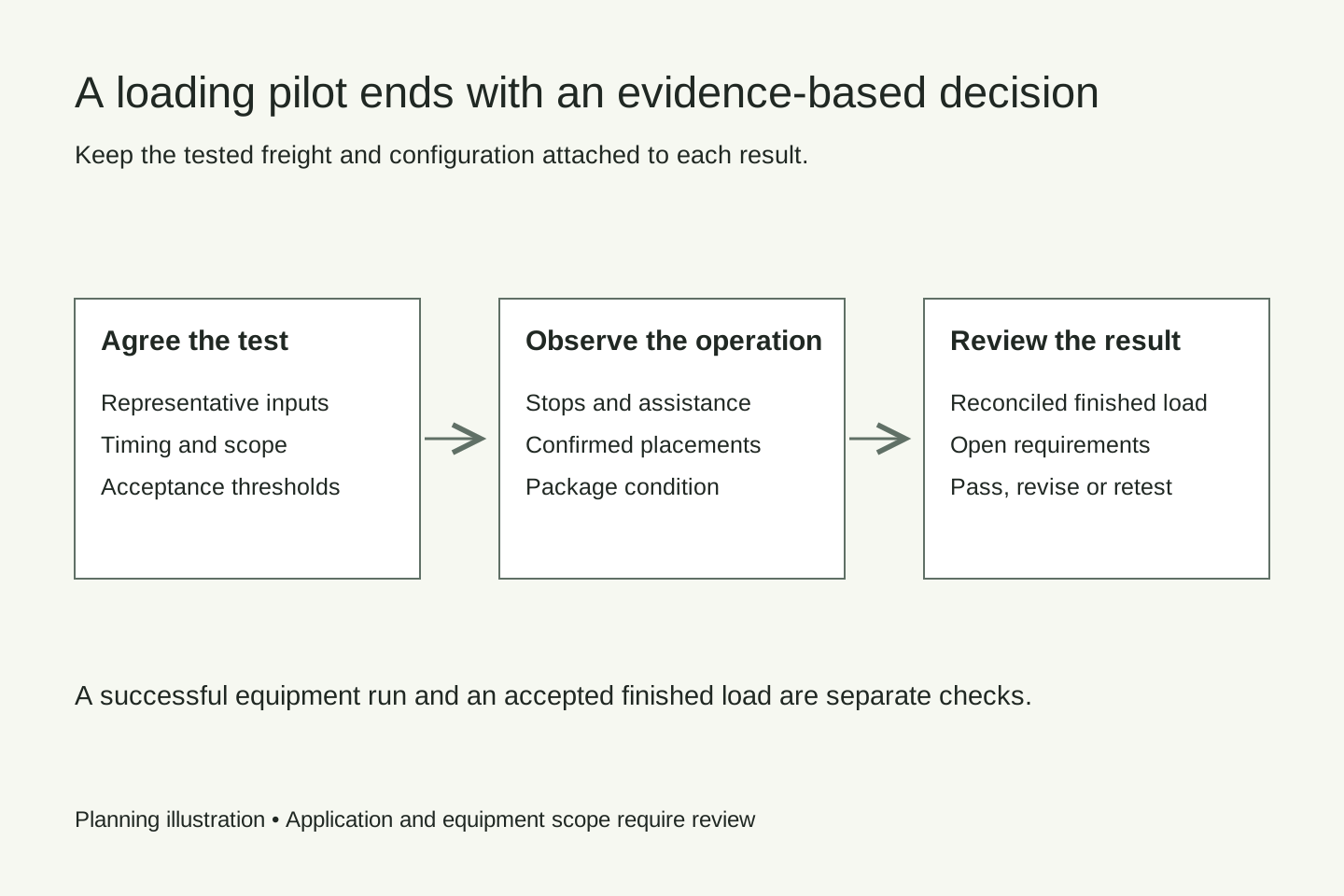
Agree the loading pilot decision before running the demonstration. Select representative cartons and a defined finished-load requirement, then measure the complete process. Record carton supply, confirmed placements, operator assistance, stoppages and the review of the finished load alongside the headline loading time.
This protocol concerns loading cartons into a vehicle. The existing unloading integration checklist covers the inbound job. A successful unloading test does not by itself establish loading sequence, placement or finished-load performance.
Open the editable loading acceptance register, stop and assistance log and case-study evidence record. Agree the actual thresholds and responsible reviewers for the application; the templates do not supply universal pass criteria.
State the decision and the tested boundary
Write down the decision the pilot supports: application suitability, a defined equipment configuration, a proposed integration or an operating business case. Identify requirements that the trial will not test and how those will be resolved before deployment.
Define the first and last events on the clock. A useful full-process measure can include preparation, carton supply, loading, interruptions and agreed completion checks. If active placement time is also recorded, keep it separate from complete loading time and dock occupancy.
Name the people authorized to run the test, stop it, review the load and accept the result. Agree the site-specific safeguarding and intervention procedure before equipment operates. The pilot record should reference the applicable approved arrangements rather than inventing generic safe distances or restart rules.
Freeze the inputs and configuration
Record carton profiles, quantities, packaging versions and condition. Include measured vehicle geometry and opening, source layout, conveyor arrangement, tooling and software versions. Tie every run to its loading-plan reference and revision.
Describe the approved orientations, support and loading requirements, plus the owner of each rule. For truck routes, retain the actual vehicle constraints and destination order where applicable. A changed carton, load rule or vehicle is a review condition that may invalidate a comparison with an earlier run.
Preserve the intended supply order and the actual arrival stream. If source cartons are prepared by people or separate equipment, record that work and its timing. Otherwise, a fast placement result can conceal substantial preparation outside the measured boundary.
Select representative runs
Choose recurring carton mixes and operating conditions, including the profiles responsible for ordinary delays or exceptions. Record the basis for selection and the coverage it provides. Neither the cleanest load nor an exceptional worst case alone represents the whole operation.
Agree enough runs and variation to support the decision being made. Preserve results for unsuccessful and interrupted runs. If a run is excluded, record the reason before comparing averages so the evidence does not silently favor the equipment.
Keep synthetic software scenarios separate from physical tests. The mixed-SKU worked plan is useful for checking data and reconciliation, but its abstract zone and assumptions do not validate a real loading application.
Measure the complete loading process
| Measure | Definition to agree | Record alongside it |
|---|---|---|
| Complete loading time | Declared start to accepted finish | Carton count, configuration and included work |
| Confirmed placement rate | Confirmed cartons divided by stated time | Active or complete-process denominator |
| Person-hours | Time contributed by all participating people | Feeding, assistance, checking and support tasks |
| Assistance | Defined interventions and their duration | Cause, task owner and affected carton |
| Stops | Start, end and classified cause | Upstream, equipment, planning or review state |
| Package condition | Agreed inspection before and after | Sample rule, observations and disposition |
| Load completion | Required versus confirmed cartons and review outcome | Plan revision and unresolved exceptions |
Report values for each run before summarizing them. For mixed freight, a single average can hide a slower carton group or frequent short stops. State the coverage, spread and limitations of the observed sample rather than presenting one peak as a sustained rate.
Test exceptions and uncertain completion
Include a missing required carton, an unknown identity and a changed carton profile. Confirm that the agreed hold, rejection or replan behavior occurs and that a pending move does not become a confirmed placement merely because the plan expected it.
Test blocked infeed, full temporary holding and an unavailable loading position. Record how upstream supply stops, what remains in motion and who clears the condition. Use the sequence and buffer guide to define the scenarios rather than relying only on a steady-flow run.
Test an interruption before a move starts and a lost completion response after a move may have finished. Reconcile the actual carton location and stable move reference before repeating or continuing. Where automatic recovery is not established, verify the required operator decision and its record.
Review the completed load separately
Reconcile required and confirmed quantities by SKU and physical carton reference where used. Record rejected, substituted, omitted and manually placed cartons. Check that any plan revision describes the actual partially completed load rather than a new empty vehicle.
Review package condition and the approved finished-load requirements with the responsible party. A robot reporting all placements complete does not establish transport suitability. The IMO CTU Code overview provides context for packing and securing responsibilities; use the qualified application review for the actual load.
Record unresolved checks, the person responsible and the decision that prevents premature release. Keep the distinction between “equipment test complete” and “load accepted for the next step” visible in the register.
Close the pilot with a traceable decision
For each requirement, record pass, revise, additional test or excluded application, with the evidence and the decision owner. Identify changes to carton coverage, layout, software, controls or operating method needed before the next run or deployment.
Update the loading cost worksheet using measured labor, elapsed time, assistance and quoted equipment scope. Released labor capacity and avoided expenditure remain different business outcomes. Preserve the assumptions that still have not been measured.
For a future case study, keep the dataset description, run dates, equipment configuration, methods, complete results and limitations. Obtain approval before using customer identities, photographs or footage. This template is a way to collect evidence, not a claim that the described result already exists.
Bring the test brief to a KRONA loading assessment or use the loading RFQ checklist to align the proposed responsibilities before the trial.
- container loading
- robotics pilot
- system integration
- mixed SKU
KRONA U1 unloads boxes from containers onto pallets or conveyors and also loads containers with boxes from pallets or conveyors. Explore KRONA U1 →
Discuss a representative loading test