
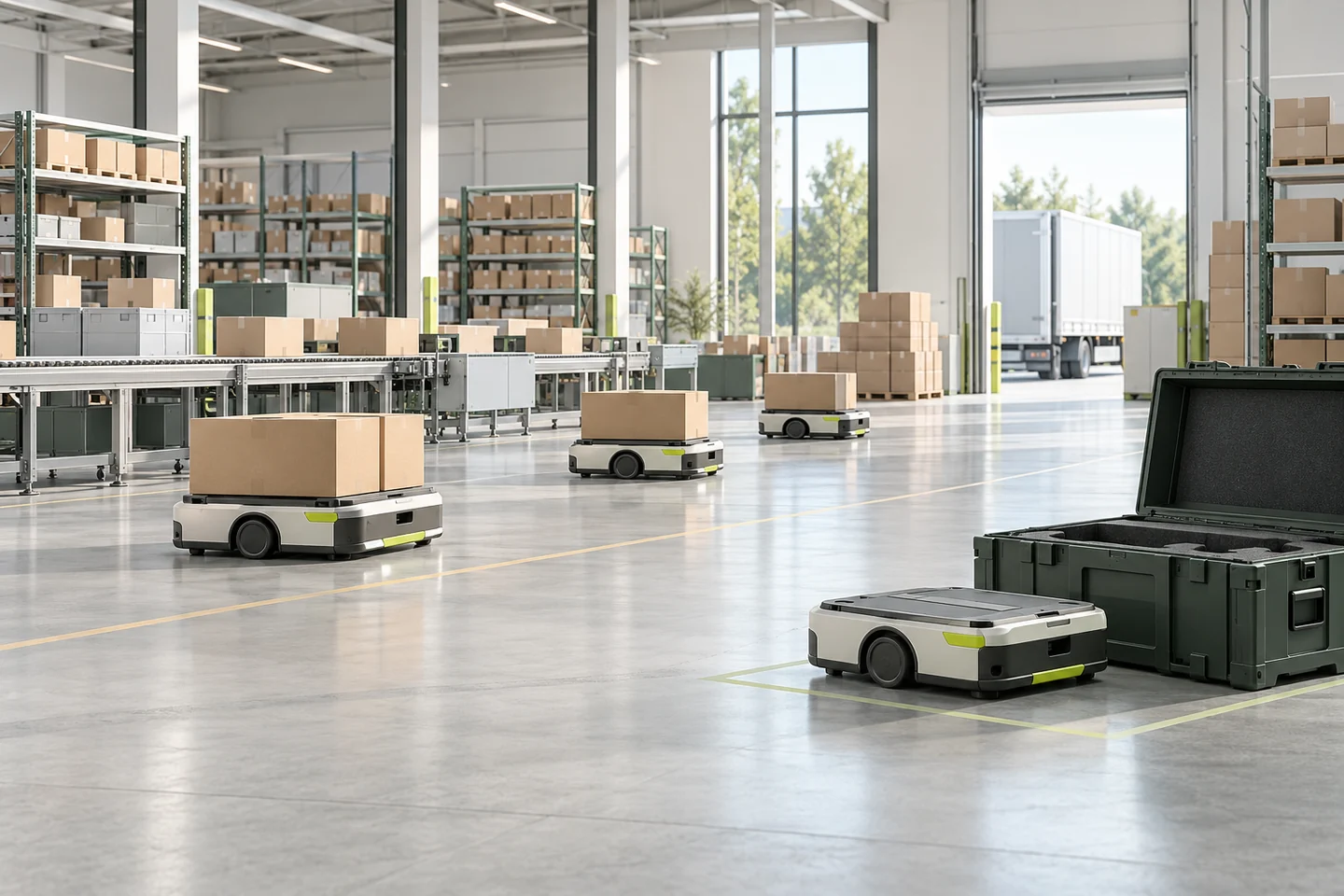
How can a warehouse add temporary robot capacity for peak season and return it afterward?
Use a seasonal robot rental or a robotics-as-a-service (RaaS) fleet expansion with a defined end date and a right to remove the extra units. Arrange deployment before peak, measure the work the robots must complete and agree collection, billing stop and return condition in the offer.
This model already operates in warehouse fulfilment. Locus Robotics’ FlexBot program describes shipping additional robots to an operation ahead of peak, then collecting them when demand returns to normal. The key distinction is between expanding a working robot system and commissioning automation for the first time. The latter also needs site preparation, integration, training and acceptance testing.
For inbound carton unloading, KRONA offers monthly robot rentals. The site and freight assessment establishes the equipment and deployment scope; the enquiry template below helps specify the months and return arrangements you need.
What real seasonal deployments show
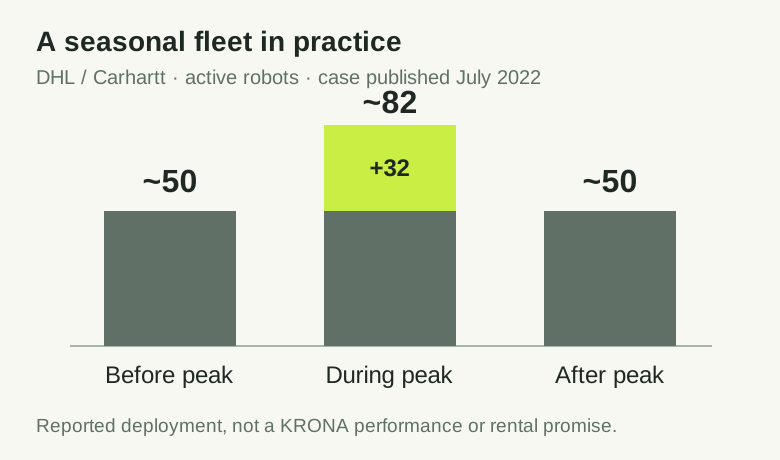
DHL and Carhartt: about 50 robots, 32 extra for peak, then back to 50
In a DHL Supply Chain-authored case published in July 2022, DHL described approximately 50 LocusBots at Carhartt’s distribution centre. Another 32 supported peak demand; afterward, the active fleet dropped to its original 50. That is a documented example of increasing and reducing an existing picking fleet. The article does not publish the rental price or physical collection terms.
iForce: a six-week first deployment and a planned three-month expansion
Locus’s iForce case study, page 2, reports six-week implementations at Corby and Rugby, with 24 robots at each site. It then describes a plan to double the combined fleet for three peak months. The six-week implementations are reported results; the seasonal doubling is a plan in that document, not evidence that the later return was completed.
Both examples concern mobile robots supporting order picking. They demonstrate a fleet model, not a deployment time or seasonal offer for container unloading robots. For an unloading project, the cartons, dock and receiving equipment still determine suitability.
Can I lease warehouse automation equipment?
Yes. Equipment leasing is available for conveyors, sortation, storage systems, mobile robots and other warehouse technology. CHG-MERIDIAN’s warehouse automation offer describes financing across these categories and return, extension or purchase at the end of the agreed term.
The important comparison is the payment commitment and usable operating period:
| Option | Best question to resolve | Seasonal fit |
|---|---|---|
| Extra units in an existing RaaS fleet | Can the extra units end separately from the core subscription? | A useful starting point when the approved workflow already exists |
| Fixed-period robot rental | What dates, minimum charges and return obligations are included? | Fits only if deployment and removal leave enough productive time |
| Equipment lease | What is the total term and payment obligation? | End-of-term return does not establish a right to stop paying after peak |
| New automation project | What site work, software and acceptance testing are needed? | Assess the full deployment effort before treating it as temporary capacity |
For maintenance, software, usage definitions and fault responsibility, use the separate RaaS contract checklist.
Size the rental for the work that is actually constrained
Start with the peak shift or arrival window. Extra order-picking robots will not resolve a shortage in inbound unloading, and more extraction capacity will not fix a full receiving area.
For floor-loaded cartons, provide carton counts, filled sizes and weights, load-wall photographs, dock windows and the receiving destination. Map each eligible delivery onto the proposed shift. The peak-container capacity guide shows how to test complete-load occupancy and overlapping arrivals.
Retain a route for freight outside the assessed robot scope. Measure completed work and the people still needed for preparation, receiving and exceptions rather than applying a headline robot rate to every load.
Build a deployment plan before booking peak capacity
Use these gates instead of assuming that delivery day is the first productive shift:
- Scope and reservation: identify the exact task, equipment configuration, quantity and delivery window.
- Site and integration readiness: assign power or charging, network, software interfaces, access and receiving responsibilities as applicable.
- Acceptance: run representative work, including expected exceptions, and record completed output, operator assistance and recovery events.
- Peak operation: provide trained staff and support coverage for the intended shifts. Review the actual constraint as demand changes.
- Exit: book the final shift, removal and collection, with a named owner for the final invoice and equipment handover.
The pilot acceptance checklist helps define the evidence required at the third gate. The six-week iForce example illustrates initial implementation; it is not a universal lead time for extra robots or a new site.
Calculate seasonal cost and cost per eligible load
For an hourly offer with a monthly minimum:
Usage charge = hourly rate × sum of max(actual hours, minimum hours) for every committed month
Hypothetical example, not market pricing or a KRONA quote: one robot costs €30 per operating hour with a 60-hour monthly minimum and a three-month commitment.
| Month | Actual hours | Billable hours | Usage charge |
|---|---|---|---|
| First | 40 | 60 | €1,800 |
| Second | 100 | 100 | €3,000 |
| Third | 140 | 140 | €4,200 |
| Total | 280 | 300 | €9,000 |
Add hypothetical setup of €2,000, outbound and return transport together of €1,000, and removal of €500. The subtotal is €12,500 before tax, site work, energy, operator assistance and separately charged support. A €1,500 refundable deposit increases cash paid during the term to €14,000 before its refund; payment dates determine the upfront requirement.
If the deployment covers 100 eligible loads, that subtotal is €125 per load. At only 40 eligible loads it is €312.50 per load. Add the excluded costs to both scenarios and compare the same completed work with the current alternative. Released staff time creates a cash saving only where spending actually falls; otherwise describe the work the released capacity can absorb.
A twelve-month commitment requires twelve months of payments in the comparison, even if peak lasts three. Returning the equipment early does not necessarily end the payment obligation.
Make the end of peak an agreed handover
Resolve five items in the seasonal offer:
- Notice and renewal: the notice deadline, named recipient, end date and any automatic extension.
- Billing stop: the exact event that ends charges, including treatment of delayed collection.
- Removal and transport: who disconnects equipment, packs it, books collection and bears transit responsibility.
- Condition and deposit: inspection criteria, wear or damage treatment, deductions and refund timing.
- Records and access: serial numbers, accessories, final usage record, required data export and software-access removal.
Keep a signed collection receipt and reconcile the final invoice. If demand remains high, agree an extension before the existing term ends.
KRONA monthly rentals for container unloading
KRONA offers monthly rentals for container unloading robots. The rental model uses an hourly pay-per-use rate and a one-time installation fee, with conveyors available to suit the workflow. The monthly rental period and hourly usage charge describe different parts of the offer: duration and how robot work is priced.
KRONA U1 handles assessed floor-loaded, closed cardboard boxes up to 25 kg from trailers or shipping containers, with handoff to a conveyor or pallets. Pricing and deployment scope are tailored to the freight and site; integrators can request private robot purchase terms. Include the required rental months, notice, collection and billing-stop arrangements in the seasonal enquiry.
You can reuse this brief:
Please quote monthly robot rental from [start] to [finish] at [site]. Our normal/peak volume is [loads per week], with [cartons per load] and [dock/receiving windows]. Attached are carton dimensions, filled weights, load photographs and the proposed handoff. Include deployment, usage commitment, support, removal and return scope, including notice and the event that stops billing.
Send the seasonal unloading brief to KRONA. For arrival planning, the container-ship guide separates port milestones from the later warehouse task.
Questions about temporary warehouse robots
Can we rent robots for only a few weeks?
That requires an offer for the specific duration, task and site. An hourly rate states how usage is priced; it does not establish a weekly rental term. Include commissioning and removal when comparing the productive weeks with total cost.
Can we keep the core fleet and return just the extra units?
Yes, that structure exists in seasonal fleet programs such as FlexBot. The order must identify which units or capacity are temporary and how their removal changes subscription, software and support charges. A new unloading project needs its own agreed arrangement.
- warehouse automation
- robotics as a service
- capacity planning
KRONA U1 unloads boxes from containers onto pallets or conveyors and also loads containers with boxes from pallets or conveyors. Explore KRONA U1 →
Discuss peak-season unloading capacity