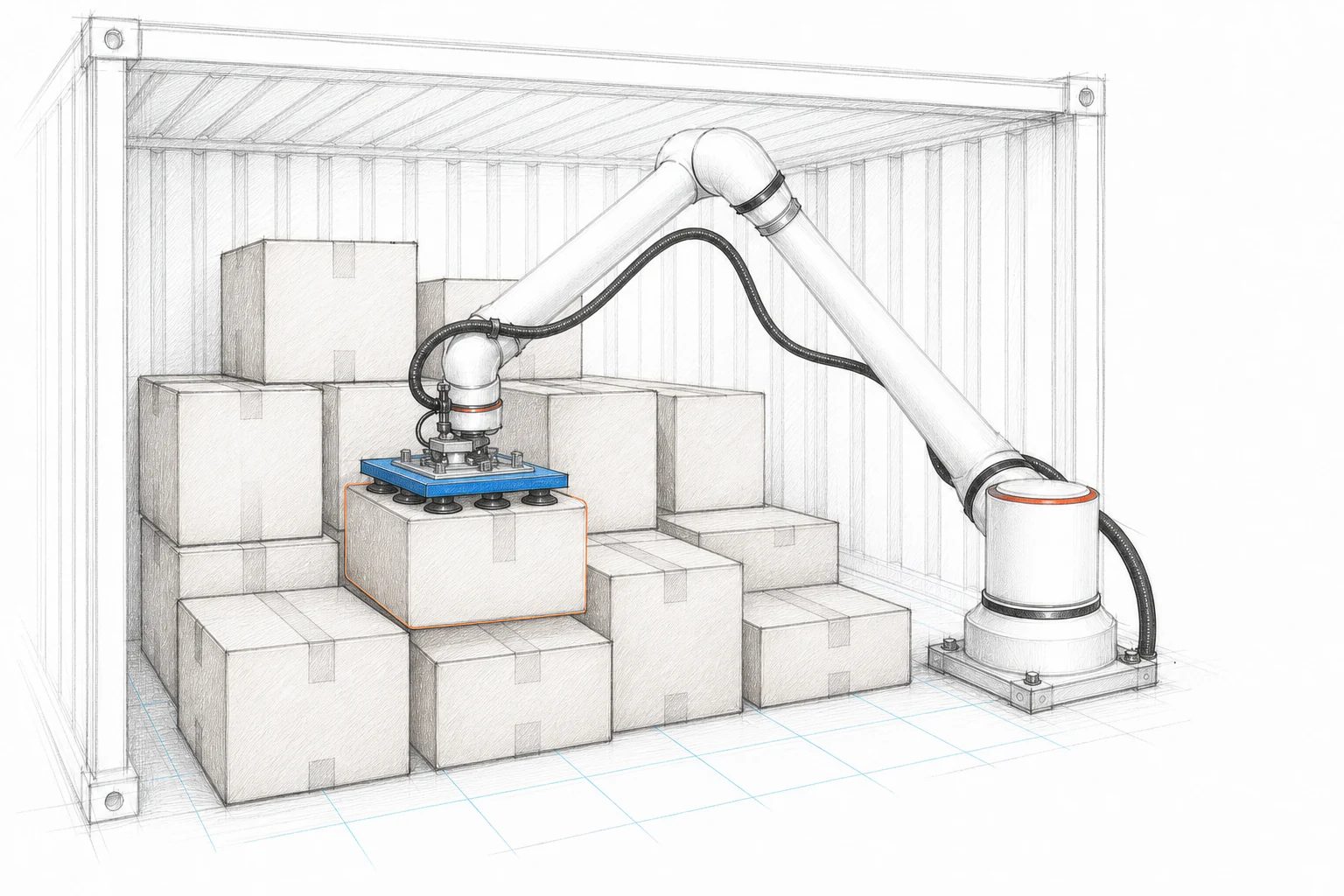
Robotic unloading does not start with the choice of robot arm. It starts with the freight. Two containers of the same size can represent completely different automation problems.
A closed corrugated box is the strongest starting point
A vacuum tool needs a sufficiently flat, sealed contact surface. The best initial pilot freight therefore consists of:
- closed corrugated boxes;
- a visible flat front surface;
- dry and intact packaging;
- a predictable weight range;
- contents that do not shift dangerously.
Open boxes, netting, sacks, and heavily indented surfaces may require a different end effector or additional manipulation methods.
The average weight is not enough
If most boxes weigh 8 kg but several weigh 30 kg, the system must either detect and reject the heavy boxes safely or be designed for the complete range.
Useful information before a pilot includes:
- minimum and maximum weight;
- the most common weight range;
- whether package markings identify weight;
- likely centre-of-gravity offset.
The loading pattern determines access
A box can have a good surface and still be trapped by surrounding freight. Assess:
- whether front faces are visible;
- how tightly boxes are compressed;
- how much freight is positioned at walls and ceiling;
- whether box walls are likely to collapse;
- whether straps, wrap, or spacers are used.
These conditions affect the pick sequence, motion plan, and safety concept.
The environment is part of the product
The robot does not interact only with a box. It needs space, power, lighting, and a safe process around the trailer.
Check:
- dock height and door dimensions;
- condition of the trailer floor;
- conveyor position;
- movement of people and vehicles nearby;
- temperature, dust, and moisture;
- network and power availability.
Use a representative sample
Ten convenient boxes do not prove that a system fits the shift. The first test should include different sizes, weights, surfaces, and realistic damage. Record how frequently each package appears in the real inbound mix.
A useful answer may be “not yet”
The purpose of a suitability assessment is not to sell a pilot at any cost. If most freight consists of bags, open objects, or heavily damaged packaging, the current system version may not fit. That conclusion saves both teams time and helps define future product requirements.
- robotic unloading
- freight eligibility
- pilot