
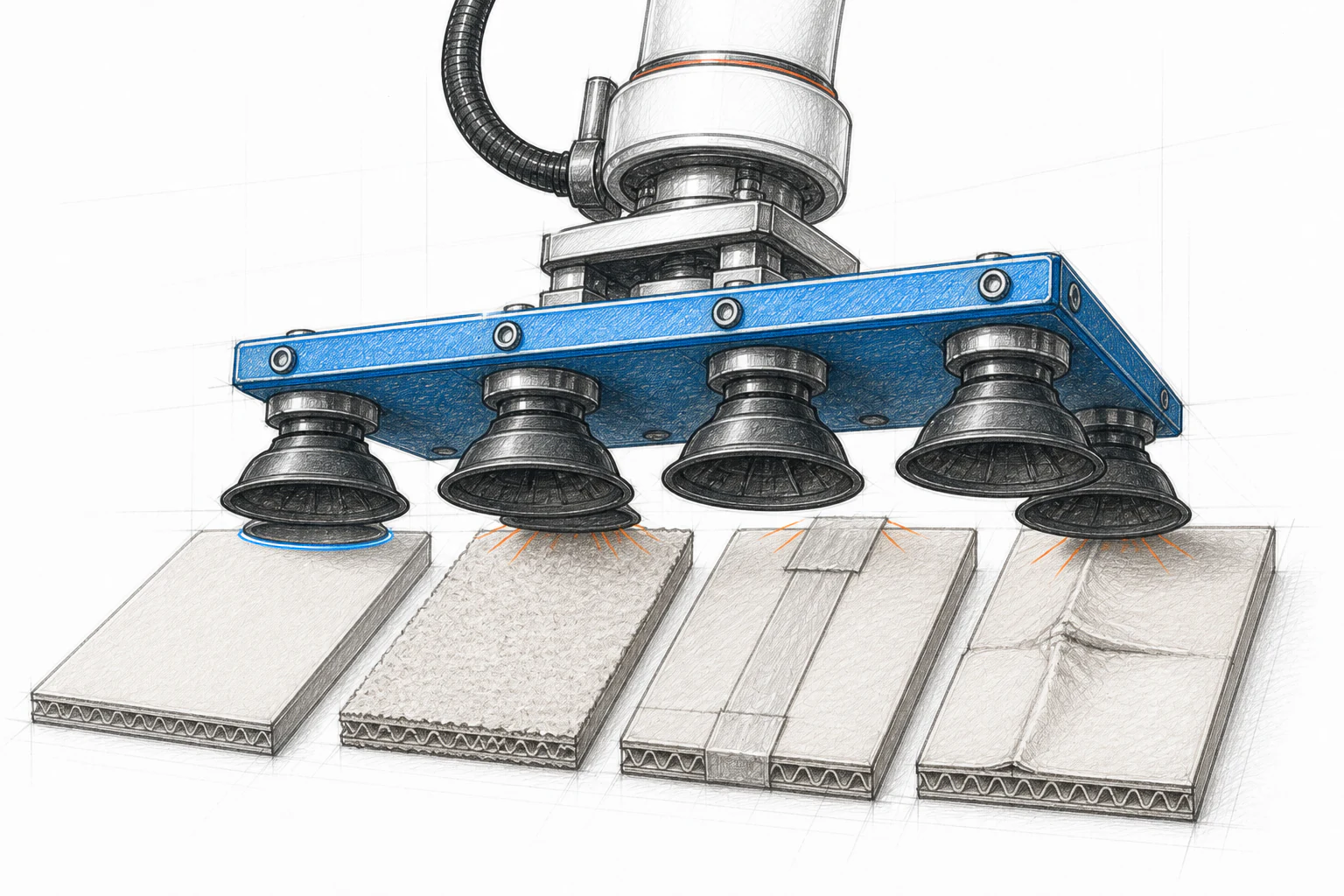
A vacuum gripper gives a robot a practical way to lift a cardboard carton without placing mechanical fingers underneath it. “Cardboard,” however, covers a wide range of surfaces. One carton maintains a stable vacuum while another leaks, dents, or tears before reaching the handoff point.
Eligibility should be established with a test that represents the complete package and the real robot movement.
Vacuum requires a sealed contact
The gripper holds a carton by creating a pressure difference between the suction element and the surface. Reliability does not depend only on pump power. The element must conform to the surface, and the system must cope with leakage.
Contact can be weakened by:
- rough or highly porous board;
- creases and dents;
- a gap at a carton edge;
- poorly attached tape;
- labels that lift away from the surface;
- holes, perforations, or moisture.
Several smaller vacuum zones behave differently from one large zone, but no arrangement is universal. The tool should be selected against the actual package mix.
The front panel has to carry the load
A good seal is not enough if the carton deforms under the suction element or its contents tear the wall. Package construction, corrugation direction, fill level, and storage humidity interact.
Check whether:
- the carton is full or contains voids;
- contents can shift during the lift;
- the front wall is reinforced or weak;
- the package has been stored in humid conditions;
- surrounding freight has already compressed it.
A test with a new, empty carton does not predict the behaviour of inbound freight.
Weight is only part of the force
During a slow vertical lift, the gripper mainly counters package weight. Acceleration, braking, and direction changes add dynamic loads. The centre of mass may also sit far away from the contact point.
The test should reproduce the planned trajectory rather than only lifting the carton from a table. Controls should limit acceleration for the package profile and monitor whether vacuum remains inside a safe range throughout the movement.
Package position changes the pick
In a real load wall, the most convenient surface does not always face the robot. Adjacent packages, a strap, or a damaged edge can partially block it. A carton near the ceiling may lean, while one at the floor may be heavily compressed.
Vision and motion planning need to select more than a detected rectangle. They need an accessible contact area and a safe extraction path. Sometimes the correct action is to leave the carton and request operator assistance.
Build a package test matrix
Select cartons according to frequency and risk. For each type, record:
- dimensions and actual weight;
- board and sealing type;
- surface damage;
- distribution of contents;
- contact point and orientation;
- successful or failed result;
- maximum vacuum leakage;
- package condition after repeated cycles.
Include dry, humidity-affected, dented, and genuinely transported packaging. Give high-volume carton types more repetitions.
A reliable grip includes failure detection
An industrial process cannot assume that every pick will succeed. The system needs to detect a missing seal, package movement, or an unintended release. It then has to stop safely, execute another verified action, or call an operator with a clear message.
Do not measure only the successful-pick percentage. Track false confirmations, dropped packages, retry counts, and time required to resume operation.
Eligibility belongs to a package–system pair
It is not meaningful to declare every cardboard carton suitable for vacuum handling. The result depends on the specific end effector, robot movement, package construction, and environment. A representative package test before deployment is the fastest way to define a reliable operating envelope and clear exceptions.
- vacuum gripper
- cardboard cartons
- robotic manipulation