
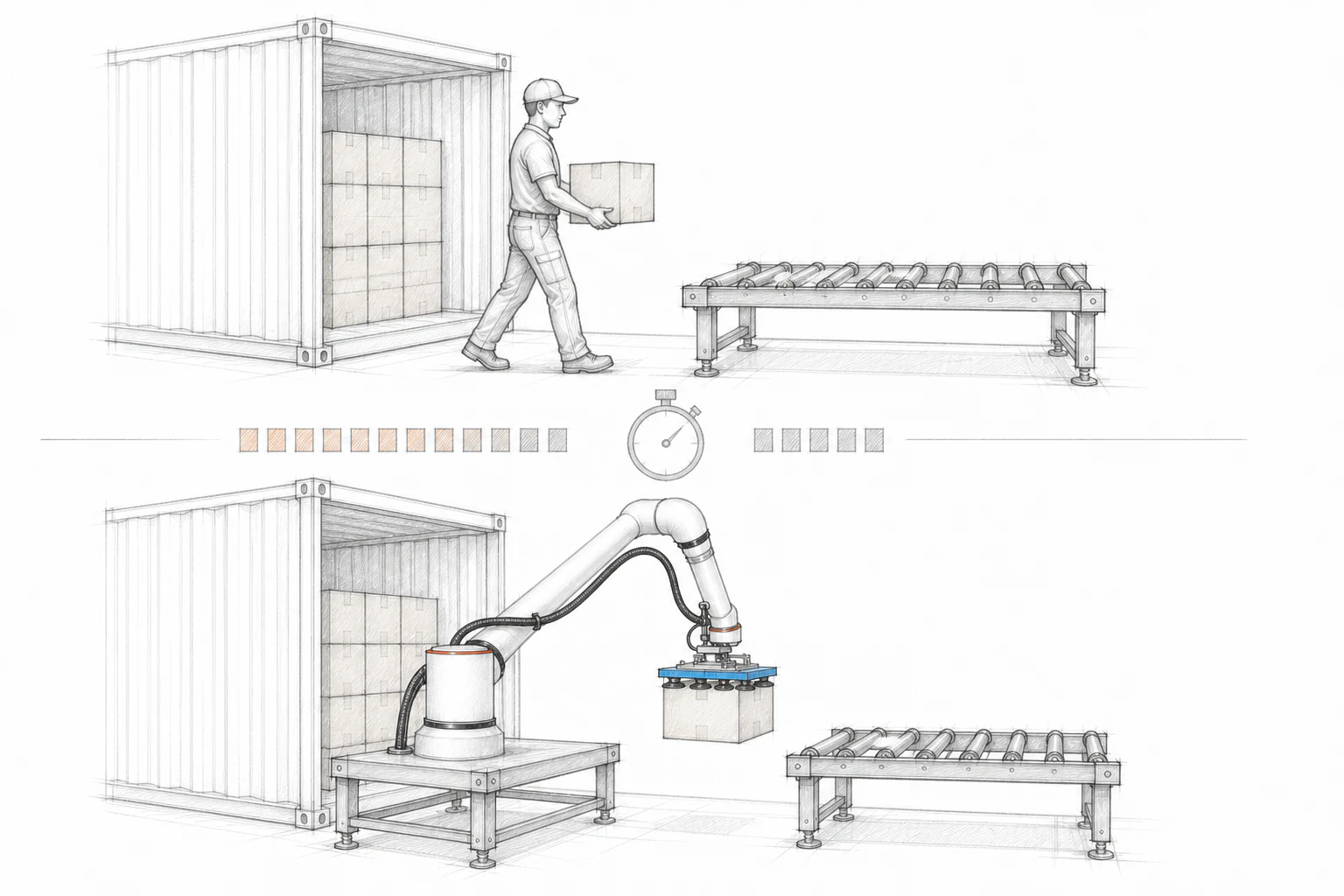
It is easy to turn manual and robotic unloading into a speed contest. A warehouse, however, does not need to know which side moved the most convenient wall of boxes during a short demonstration. It needs to know how the complete process behaves across shifts, freight profiles, and unexpected events.
A useful comparison starts with the same definition of the task and the same measurement boundaries.
Give both processes the same start and finish
If manual time begins when the doors open while robotic time counts only active picks, the results are not comparable. Mark the following events in both scenarios:
- when the dock becomes occupied;
- how long safety and equipment preparation take;
- when the first package starts moving;
- the time and causes of every stop;
- when the container is considered complete;
- any additional work left after unloading.
This creates three separate measures: active handling time, complete unload time, and dock occupancy. Most operational decisions require all three.
Manual unloading is strong at adaptation
An experienced worker quickly understands that a box is trapped, the board is wet, or an unstable void sits behind the visible package. A person can change grip, ask a colleague for help, or set a problem package aside with little formal procedure.
Manual capacity, on the other hand, depends on crew composition, fatigue, time of shift, and labour availability. An average rate can hide a large gap between a good day and a difficult one. Record the median, the slowest loads, and total labour-hours—not just the average speed.
Robotic unloading is strong at repetition
A robotic system can repeat a suitable action consistently and produce detailed operating data. It can reduce the time people spend lifting boxes inside a trailer. But it works within a defined operating envelope: package surface, weight, position, and environment must remain within the system’s capabilities.
Separate these outcomes when evaluating a robot:
- packages completed autonomously;
- packages rejected safely;
- exceptions resolved by a person;
- technical stops;
- time required to resume work.
An instantaneous picks-per-minute result does not show how much freight the system will complete over a shift.
Human time changes rather than disappearing
Automation should not be modelled as the simple removal of an entire crew. People may still open doors, prepare the dock, supervise the safe area, handle damaged cartons, resolve exceptions, and move equipment between doors.
Measure active human minutes, not only how many people are assigned to the area. One operator who oversees several processes and occasionally handles an exception is a different operating model from a person who has to stand beside the robot continuously.
Ergonomics and risk are separate outcomes
A financial model does not represent all value. Repetitive work in a confined, hot, or cold trailer carries an ergonomic burden. Record heavy lifts, time inside the container, awkward postures, and events involving an unstable package wall.
Robotic deployment also creates new hazards: moving equipment, conveyor interfaces, energy sources, and the need to control access to the working area. Safety must therefore be engineered as a new system, rather than treated only as the removal of manual lifting.
Compare at least five outcomes
For the same representative freight sample, compare:
- complete unload time and dock occupancy;
- labour-hours per load;
- share of packages handled autonomously;
- damage and additional handling;
- variation between loads.
Add the complete scenario cost: labour, equipment use, integration, service, and residual manual work. Keep assumptions next to the result so the model can be updated when volume changes.
The strongest answer may be a mixed process
For many operations, the sensible first step is to automate a large, repeatable share of suitable freight while leaving exceptions to a trained person. That is not failed autonomy. It is a deliberately designed operation when the timing and method of human intervention are clear.
Base the decision on real freight and shift data. The goal is not to win a demonstration; it is to build an unloading process that is safer, more predictable, and economically sound.
- manual unloading
- robotic unloading
- operations planning