
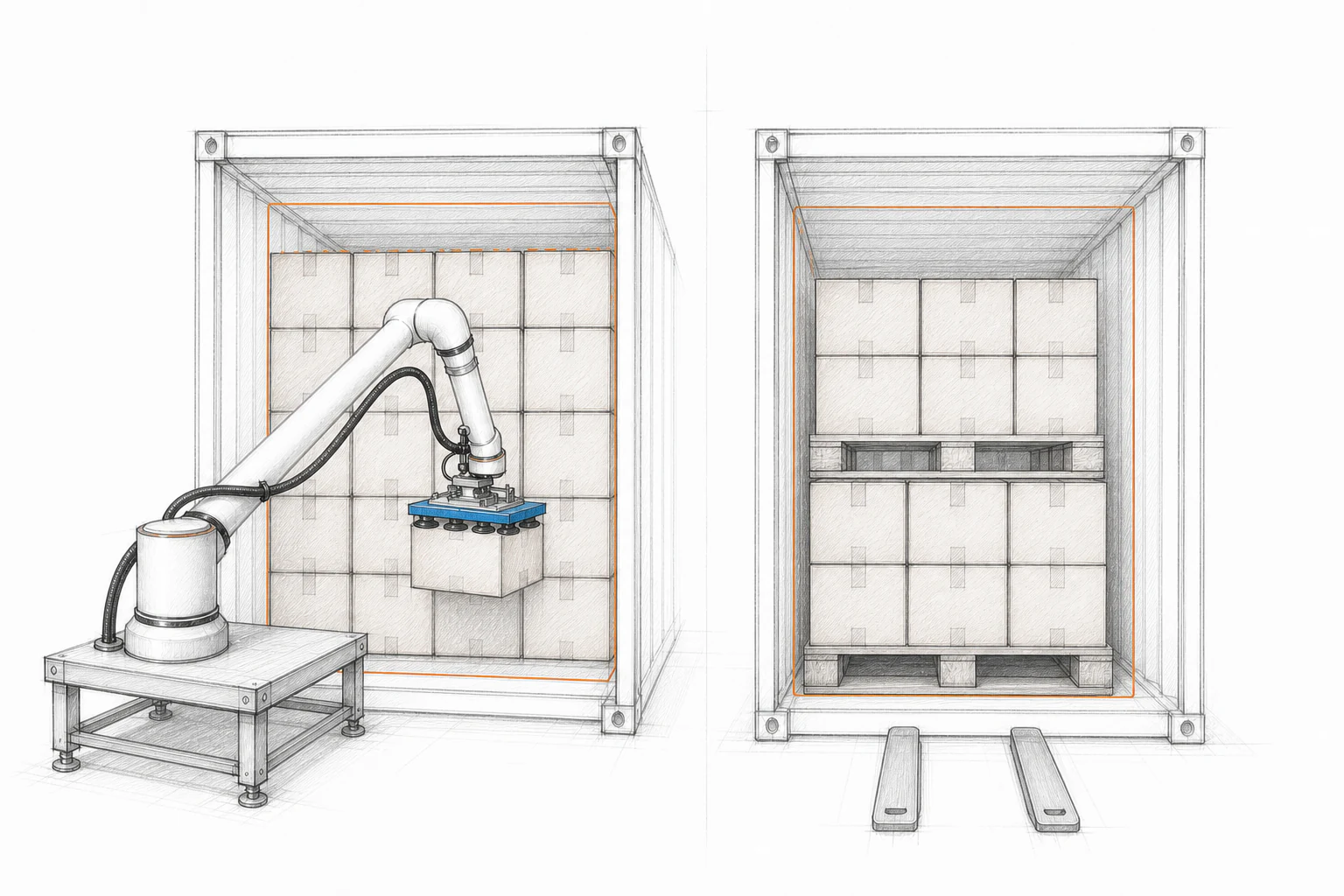
Palletised freight and cartons loaded directly on a container floor may arrive at the same dock, but they create two different operations. A stable pallet can often be removed with one forklift movement. Floor-loaded freight must be broken down and transferred one carton at a time.
The best automation approach depends on why each loading method is used and what happens both before and after unloading.
Why freight travels without pallets
A pallet makes handling easier, but it consumes space and adds weight. Floor loading can use container volume more efficiently, particularly when many cartons travel over a long international route.
The choice may be driven by:
- transport volume and cost optimisation;
- supplier loading practices;
- mixed package sizes and SKUs;
- incompatible pallet standards;
- phytosanitary or return requirements;
- a need to sort products immediately at receiving.
“Just use pallets” is therefore not always a supply-chain solution. It may reduce unloading work while increasing transport or supplier cost.
The palletised process
When a pallet is stable, correctly labelled, and compatible with receiving equipment, unloading is relatively structured. The main variables are pallet count, weight, height, condition, and forklift access.
A pallet is not necessarily the final handling unit, however. Receiving may still have to:
- remove stretch wrap;
- inspect and count cartons;
- rebuild onto a local pallet standard;
- break down mixed SKUs;
- feed packages into a conveyor or storage system.
Alternatives should be compared across the whole internal process, not only the minutes needed to empty the vehicle.
The floor-loaded process
Loose cartons form an unstructured three-dimensional wall. Packages may be rotated, compressed, damaged, or have different weights. The front package is not always safe to remove because it may support freight above it.
In a manual process, people combine perception, selection, lifting, and exception handling. A robotic system has to implement each function deliberately: vision identifies accessible surfaces, controls select an action, the gripper confirms the hold, and the safety system manages the working area.
Where automation can be introduced
There are at least three distinct automation points:
- Extraction from the vehicle. A robot transfers suitable cartons to a conveyor or handoff point.
- Inbound-flow handling. Packages are scanned, sorted, and routed after extraction.
- Palletising after unloading. Local pallets are built from the floor-loaded carton stream.
These stages can be deployed independently. In one site, the primary problem is manual work inside the container while an existing conveyor already handles cartons well. Elsewhere, unloading is fast but inbound sortation creates the queue.
Measure the constraint across the whole flow
Robot capacity has no value without somewhere to send the boxes. A full conveyor stops both a person and a robot. Measure:
- maximum downstream carton flow;
- available buffer capacity;
- scanning and label quality;
- time needed to route exceptions;
- availability of empty pallets and space at the palletising point.
An automation project should balance the line instead of moving the bottleneck several metres downstream.
Decide from the freight profile
Segment inbound loads into palletised freight, eligible floor-loaded cartons, and packaging outside the current system’s envelope. For each group, estimate volume, labour time, dock occupancy, and the downstream process.
This map identifies a realistic first automation stage. The goal is not to force every load to look the same. It is to apply the right handling method where it improves the outcome of the complete operation.
- floor-loaded freight
- pallets
- warehouse automation